
Session Information
Date: Saturday, November 6, 2021
Title: Patient Outcomes, Preferences, & Attitudes Poster I: Impact (0225–0240)
Session Type: Poster Session A
Session Time: 8:30AM-10:30AM
Background/Purpose: The Lupus Foundation of America (LFA) has completed a 5-year cooperative agreement with the CDC to develop and evaluate an online lupus self-management (SM) program based on the Transtheoretical Model of Change. The program, Strategies to Embrace Living with Lupus Fearlessly (SELF), is designed to help users adopt 4 key lupus SM behaviors shown to have the highest impact on health and functional status: 1) managing symptoms, 2) managing stress, 3) managing medications, and 4) working with your healthcare team. The pilot was conducted using mixed methods to assess the feasibility and acceptability of SELF.
Methods: SELF consists of an intake assessment, user-tailored SM behavior change guidance/education, and a follow-up assessment every 90 days. At intake, users report their readiness to engage in the 4 SM behaviors consisting of 3-5 skills each. Users select one SM behavior as a focus for a 2-week period and begin the program via a customized web portal. In addition to tailored digital coaching, SELF offers: symptom and medication trackers; a journal; tailored text/email tips; and links to the LFA National Resource Center on Lupus, Health Educators, and LupusConnect™, an online community for peer-to-peer support.
Participants with a lupus diagnosis were recruited from three academic medical centers and the LFA constituency to take part in the 90-day pilot. Program evaluation included intake and follow-up assessments, a follow-up email survey and in-depth interviews. At intake, users were evaluated for their stage of change for each SM skill. They were defined as having a ‘skill gap’ when staged at one of the building stages. They ‘mastered a skill’ if they improved from a building stage of change at baseline to a mastery stage at follow-up. Feasibility and acceptability were assessed using enrollment/retention, utilization, readiness for and improvement to SM behaviors, and user feedback.
Results: Of those who registered, 62% (n=150 of 241) completed the intake assessment and 28% (n=42) remained engaged through the 90-day follow-up. Self-reported barriers to engagement included the impact of the COVID-19 pandemic, busy lives, length of intake, and belief that SELF’s target audience was newly diagnosed people with lupus (PWL).
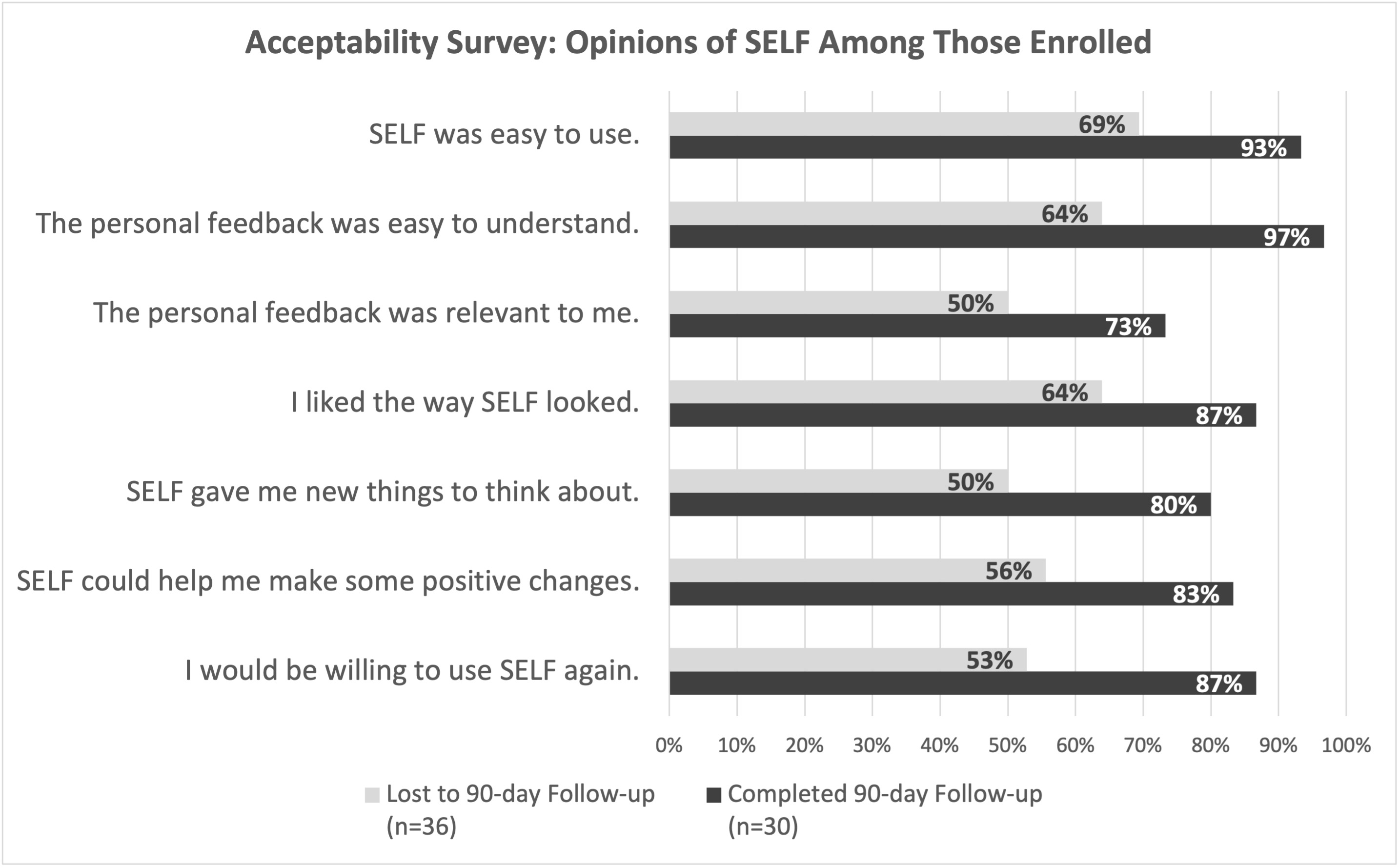
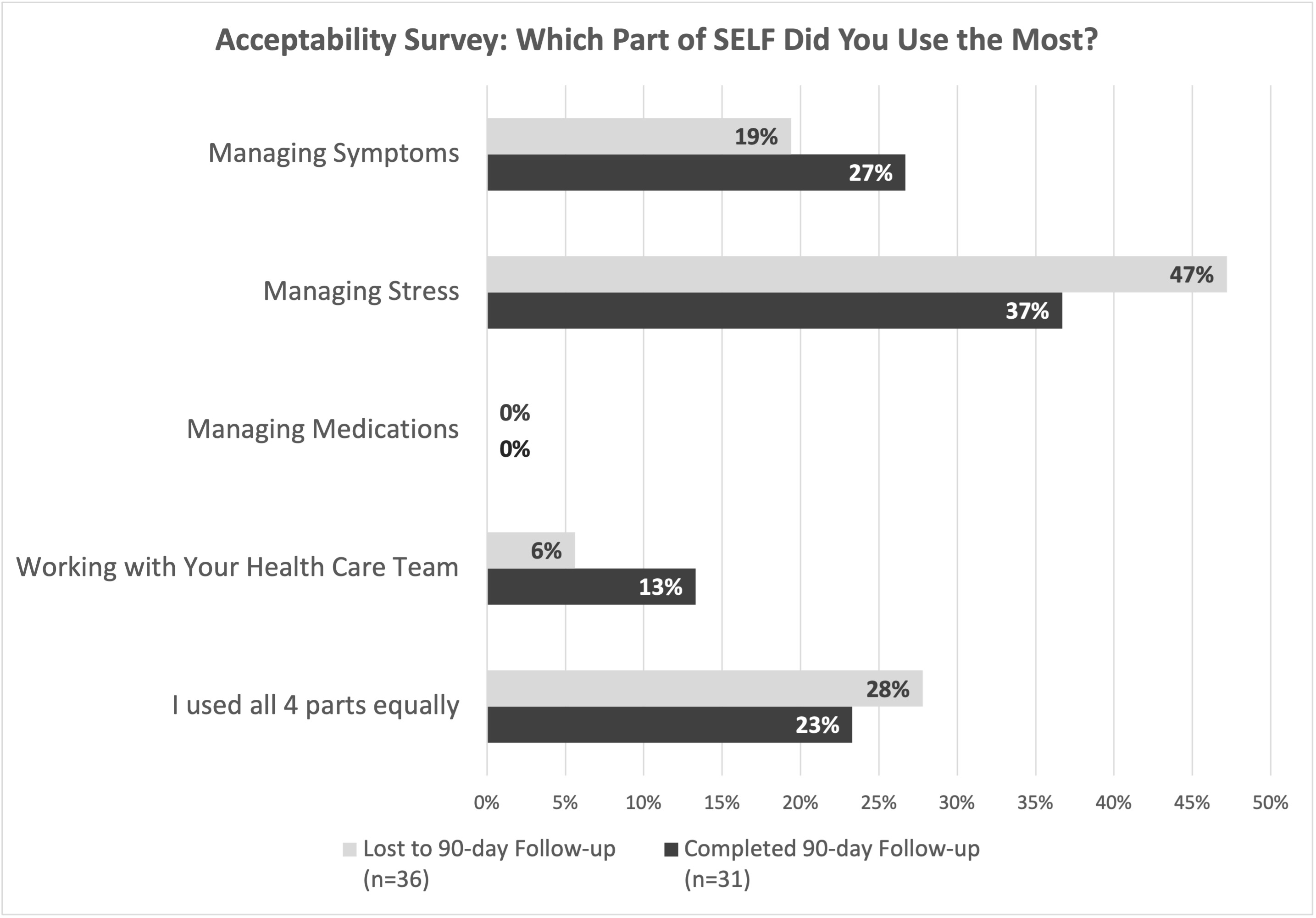
Users showed substantial need; 80% had moderate/ high skill gaps in key SM skills. Users who completed the program were successful in building new skills; 57% mastered 1 or more SM skills. Most users provided favorable opinions of SELF (Figure 1) with managing stress and managing symptoms being the most popular modules (Figure 2).
Conclusion: Although the COVID-19 pandemic and other factors impacted participants’ time and ability to engage with SELF, this pilot provided valuable insights for optimizing SELF to improve enrollment and retention (e.g., adding social login and text/email reminders, reducing length of intake). SELF is designed to provide a cohesive, tailored experience to help PWL manage their condition. The pilot showed promising results in meeting user needs and building skills to impact behavior change.
Acknowledgements: The authors are grateful for the support of Kamil Barbour and Margaret Kaniewski, Public Health Advisors for the Centers for Disease Control and Prevention.
To cite this abstract in AMA style:
Carpenter K, French M, Balestrieri S, Johnson S, Gilman S, Drenkard C, Lim S, Dall'Era M, Somers E, Zick S, Werth V, Wallace D, Miller M, Crimmings M. Feasibility and Acceptability of an Online Intervention for Lupus Self-Management Based on the Transtheoretical Model of Change [abstract]. Arthritis Rheumatol. 2021; 73 (suppl 9). https://acrabstracts.org/abstract/feasibility-and-acceptability-of-an-online-intervention-for-lupus-self-management-based-on-the-transtheoretical-model-of-change/. Accessed .« Back to ACR Convergence 2021
ACR Meeting Abstracts - https://acrabstracts.org/abstract/feasibility-and-acceptability-of-an-online-intervention-for-lupus-self-management-based-on-the-transtheoretical-model-of-change/