ACR Meeting Abstracts

ACR Meeting Abstracts

  • Meeting Abstracts
    • All Meetings
    • PRSYM 2026
    • ACR Convergence 2025
    • Download Abstract Supplements
  • Keyword Index
  • Search
  • My Favorites
    • View and print all favorites
    • Clear all favorites

Abstract Number: 1124

Examining the Relationships Between Treatment and Pain and Physical Function Outcomes in Patients with Osteoarthritis: A Mediation Modeling Approach

Lucy Abraham1, Robert Dworkin2, Dennis C. Turk3, John D. Markman2, David A. Williams4, Andrew G Bushmakin5, Jerry A. Hall6, David C. Semel7, Joseph C Cappelleri5 and Ruoyong Yang8, 1Pfizer Ltd., Tadworth, United Kingdom, 2University of Rochester, Rochester, NY, 3University of Washington, Seattle, WA, 4University of Michigan, Ann Arbor, MI, 5Pfizer Inc, Groton, CT, 6Eli Lilly and Company, Indianapolis, IN, 7Pfizer, New York, NY, 8Pfizer Inc., New York, NY

Meeting: ACR Convergence 2021

Keywords: Mediation Model, Osteoarthritis, pain, physical function, treatment

  • Tweet
  • Email a link to a friend (Opens in new window) Email
  • Print (Opens in new window) Print
Session Information

Date: Monday, November 8, 2021

Title: Osteoarthritis – Clinical Poster III (1118–1134)

Session Type: Poster Session C

Session Time: 8:30AM-10:30AM

Background/Purpose: To better understand the complex relationships between treatment and pain and physical function (PF) outcomes, we investigated a set of mediation models of osteoarthritis (OA) patients’ responses to tanezumab, an antibody against nerve growth factor that is in development for the treatment of OA.

Methods: Data came from two randomized clinical trials of tanezumab (Study 1: NCT02697773, JAMA. 2019;322:37-48 and Study 2: NCT02709486, Ann Rheum Dis. 2020;79:800-810); in both trials tanezumab provided greater pain relief and improvements in PF than placebo in patients with OA (all patients satisfied the American College of Rheumatology criteria for OA). A set of mediation models was used to explore the interrelationships among treatment, PF as measured by the Western Ontario and McMaster Universities Osteoarthritis Index (WOMAC*) PF scores, and pain (WOMAC Pain scores) as a mediator of the effect of treatment on PF: (a) cross-sectional mediation models, (b) longitudinal mediation models, and (c) pseudo steady-state longitudinal mediation models. The cross-sectional mediation models include the following variables: treatment (tanezumab vs placebo), pain and PF scores (models were assessed separately at weeks 2, 4, 8, 12, 16, or 24). The longitudinal mediation models estimate relationships using data from all weeks simultaneously and include treatment, pain and PF scores at weeks 2, 4, 8, 12, 16, and 24. The longitudinal steady-state mediation model also uses all available data at weeks 2, 4, 8, 12, 16, and 24 with the assumption that relationships among variables in the model are the same at all time points.

*© 1996 Nicholas Bellamy. WOMAC® is a registered trademark of Nicholas Bellamy (CDN, EU, USA).

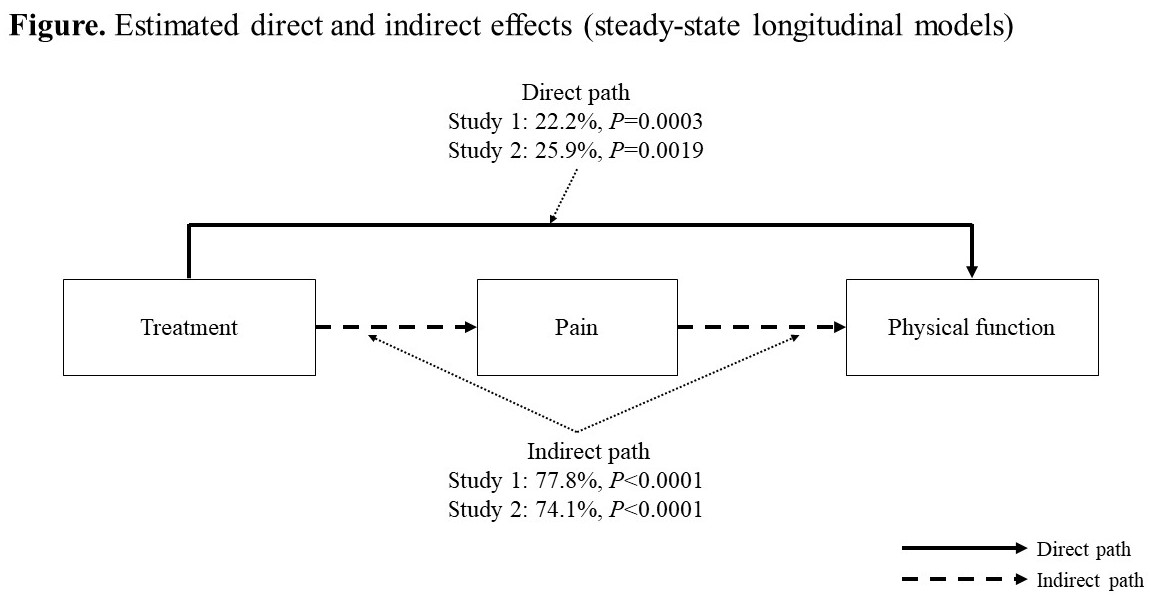
Results: The results of the cross-sectional and longitudinal mediation models showed that the indirect effect of treatment through pain on PF was stable across time (cross-sectional: 78.8–95.1%, all P< 0.0001; longitudinal: 70.5–86.6%, all P< 0.0001), indicating that a pseudo steady-state model is appropriate. The results of the longitudinal steady-state mediation models showed that the indirect effect of the treatment on PF was 77.8% in Study 1 and 74.1% in Study 2 (P< 0.0001, respectively), while the direct effect of the treatment on PF was 22.2% for Study 1 (P=0.0003) and 25.9% for Study 2 (P=0.0019) (Figure).

Conclusion: At least 75% of the treatment effect of tanezumab on physical functioning can be explained by the improvements in pain. However, tanezumab has an additional effect on physical functioning (approximately 25%), which is independent of improvements in pain. Research is needed to explain this effect and evaluate additional mediators (e.g., sleep, fatigue, method variance) that may contribute to the observed direct effect.

Disclosures: L. Abraham, Pfizer, 3, 11; R. Dworkin, Abide, 1, 2, Acadia, 1, 2, Adynxx, 1, 2, Analgesic Solutions, 1, 2, Aptinyx, 1, 2, Aquinox, 1, 2, Asahi Kasei, 1, 2, Astellas, 1, 2, AstraZeneca, 1, 2, Biogen, 1, 2, Biohaven, 1, 2, Boston Scientific, 1, 2, Braeburn, 1, 2, Cardialen, 1, 2, Celgene, 1, 2, Centrexion, 1, 2, Chromocell, 1, 2, Clexio, 1, 2, Collegium, 1, 2, Concert, 1, 2, Confo, 1, 2, Decibel, 1, 2, Dong-A, 1, 2, Editas, 1, 2, Eli Lilly and Company, 1, 2, Ethismos, 1, 2, Eupraxia, 1, 2, Glenmark, 1, 2, Gloriana, 1, 2, Grace, 1, 2, Hope, 1, 2, Immune, 1, 2, Lotus, 1, 2, Mainstay, 1, 2, Merck, 1, 2, Neumentum, 1, 2, Neurana, 1, 2, NeuroBo, 1, 2, Novaremed, 1, 2, Novartis, 1, 2, Olatec, 1, 2, OliPass, 1, 2, Pfizer, 1, 2, Phosphagenics, 1, 2, Quark, 1, 2, Reckitt Benckiser, 1, 2, Regenacy, 1, 2, Relmada, 1, 2, Sangamo, 1, 2, Sanifit, 1, 2, Scilex, 1, 2, Semnur, 1, 2, SIMR Bio, 1, 2, SK Life Sciences, 1, 2, Sollis, 1, 2, SPRIM, 1, 2, Teva, 1, 2, Theranexus, 1, 2, Trevena, 1, 2, Vertex, 1, 2, Vizuri, 1, 2; D. Turk, AccelRx, 2, Eli Lilly and Company, 2, Flexion, 2, GlaxoSmithKline, 2, Pfizer, 2; J. Markman, Trigemina, 2, Editas Medicine, 2, Plasma Surgical, 1, 2, Novartis, 1, 12, Data safety monitoring board, Allergan, 1, 12, Data safety monitoring board, Clexio Biosciences, 1, Flexion Therapeutics, 1, Quark Pharmaceuticals, 1, Quartet Medicine, 1, Collegium Pharmaceutical, 1, Purdue Pharma, 1, Biogen, 1, Aptinyx, 1, Nektar, 1, Grünenthal, 1, Eli Lilly and Company, 1, Depomed, 1, Janssen, 1, Teva Pharmaceutical Industries, 1, KemPharm, 1, Abbott Laboratories, 1, Chromocell, 1, Convergence Pharmaceuticals, 1, Inspirion, 1, Pfizer, 1, Sanofi, 1, Daiichi Sankyo, 1, Trevena, 1; D. Williams, Swing Therapeutics, Inc, 2, Community Health Focus Inc, 2; A. Bushmakin, Pfizer Inc, 3, 11; J. Hall, Eli Lilly & Co, 3, 11; D. Semel, Pfizer, 3, 11; J. Cappelleri, Pfizer Inc, 3, 11; R. Yang, Pfizer Inc., 3, 8, 11.

To cite this abstract in AMA style:

Abraham L, Dworkin R, Turk D, Markman J, Williams D, Bushmakin A, Hall J, Semel D, Cappelleri J, Yang R. Examining the Relationships Between Treatment and Pain and Physical Function Outcomes in Patients with Osteoarthritis: A Mediation Modeling Approach [abstract]. Arthritis Rheumatol. 2021; 73 (suppl 9). https://acrabstracts.org/abstract/examining-the-relationships-between-treatment-and-pain-and-physical-function-outcomes-in-patients-with-osteoarthritis-a-mediation-modeling-approach/. Accessed .
  • Tweet
  • Email a link to a friend (Opens in new window) Email
  • Print (Opens in new window) Print

« Back to ACR Convergence 2021

ACR Meeting Abstracts - https://acrabstracts.org/abstract/examining-the-relationships-between-treatment-and-pain-and-physical-function-outcomes-in-patients-with-osteoarthritis-a-mediation-modeling-approach/

Advanced Search

My Favorites

Save and print abstracts during your browser session by clicking the “Favorite” button at the bottom of any abstract (must have cookies enabled in browser). See saved favorites.

Abstract Policies

  • ACR Convergence Abstract Embargo Policies
  • ACR Convergence Abstract Permissions & Reprints
  • PRSYM Abstract Policies

ACR Convergence. Where Rheumatology Meets

ACR Convergence 2026

Join us November 6-11 in Orlando, Florida.
See Registration Information

  • Contact ACR
  • Privacy Policy
  • ACR Policies
  • Cookie Preferences

© Copyright 2026 American College of Rheumatology