
Session Information
Date: Monday, November 13, 2023
Title: (1221–1255) Pediatric Rheumatology – Clinical Poster II: Connective Tissue Disease
Session Type: Poster Session B
Session Time: 9:00AM-11:00AM
Background/Purpose: Problems with cognitive functioning are common in childhood-onset systemic lupus erythematosus (cSLE); these may be attributed to many factors including underlying brain inflammation. Socioenvironmental factors are known to impact disease outcomes, with poorer outcomes associated with those from disadvantaged groups. However, little is known about how socioenvironmental disadvantage may be related to cognition in cSLE. We examined the associations between socioenvironmental disadvantage, disease factors, and cognitive functioning in a pediatric cSLE cohort.
Methods: We examined a cross-sectional sample of youth with cSLE aged 10-17 years from a major tertiary hospital SLE outpatient clinic between January 2020 and April 2023. All patients met ACR or SLICC classification criteria for SLE. Area-level indicators of socioenvironmental disadvantage were obtained using the Ontario Marginalization Index, which measures levels of poverty (material deprivation) and proportion of immigrants or minoritized ethnic groups within a region (ethnic concentration). Cognition was evaluated using standardized measures of sustained attention (Conners Continuous Performance Test – Third Edition), working memory (Digit Span subtest from the age-appropriate Wechsler intelligence Scale), and inhibitory control (Color-Word Interference test from the Delis Kaplan Executive Function System).The associations between cognitive function scores, disease activity (SLEDAI-2K), disease damage (SDI) and each socioenvironmental factor were examined using separate multivariable linear regression models. P-values < .05 were considered statistically significant.
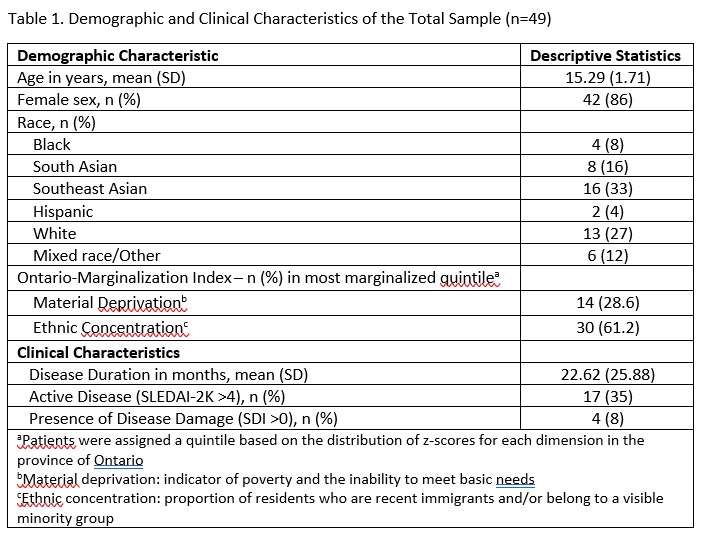
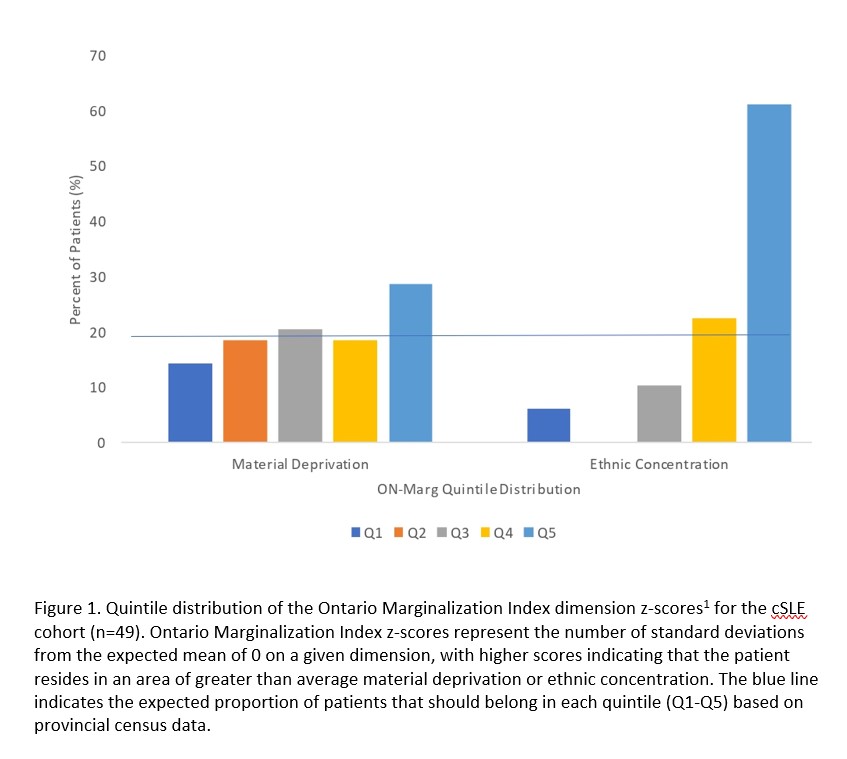
Results: A total of 49 youth with cSLE (86% female) with a mean age of 15.3 years (SD=1.7) were included in the study; mean disease duration was 22.6 months (SD=25.9), 33% had active disease (SLEDAI-2K >4) and 8% had disease damage (SDI >0). 28.6% of patients lived in the highest quintile of material deprivation, and 61.2% lived in the highest quintile of ethnic concentration (Table 1, Figure 1).
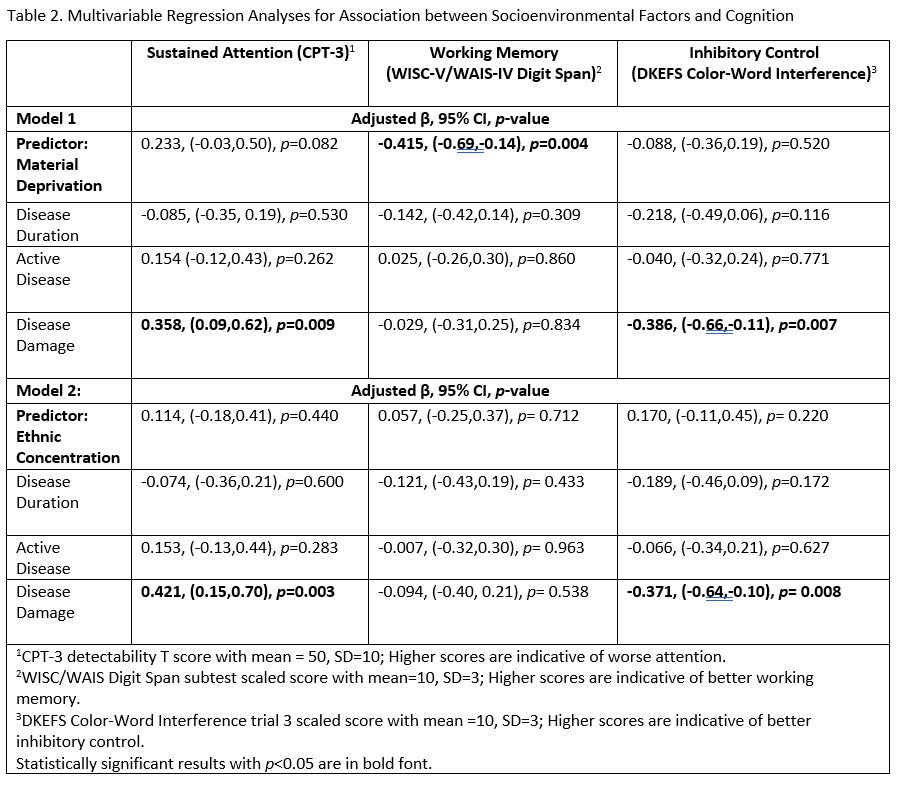
In multivariable analysis, higher material deprivation was associated with poorer working memory (β = -0.415, 95% CI -0.69, -0.14, p=0.004) (Table 2).Ethnic concentration was not associated with the cognitive outcomes. The covariate for presence of disease damage showed independent statistically significant associations with worse attention and poorer inhibitory control in both of the models for material deprivation and ethnic concentration (Table 2).
Conclusion: In keeping with known health disparities in cSLE, our data shows that higher levels of material deprivation were associated with poorer working memory performance, even when adjusting for current disease activity, damage and duration of disease. In our small cohort, disease damage was associated with worse attention and inhibitory control; replication of this finding is needed with larger samples. Continued examination of the range of disparate outcomes in cSLE over time is essential for better understanding how we can best provide care for all youth with cSLE, and mitigate both disease-related and socioenvironmental risk factors.
To cite this abstract in AMA style:
Danguecan A, Mohamed I, Mossad S, El Tal T, Davis A, Jeyanathan A, Sandhu S, Ng L, Moaf P, Levy D, Hiraki L, Knight A. Examining the Relationship Between Socioenvironmental Factors and Cognitive Functioning in Youth with Childhood-Onset Systemic Lupus Erythematosus [abstract]. Arthritis Rheumatol. 2023; 75 (suppl 9). https://acrabstracts.org/abstract/examining-the-relationship-between-socioenvironmental-factors-and-cognitive-functioning-in-youth-with-childhood-onset-systemic-lupus-erythematosus/. Accessed .« Back to ACR Convergence 2023
ACR Meeting Abstracts - https://acrabstracts.org/abstract/examining-the-relationship-between-socioenvironmental-factors-and-cognitive-functioning-in-youth-with-childhood-onset-systemic-lupus-erythematosus/