
Session Information
Session Type: Poster Session A
Session Time: 10:30AM-12:30PM
Background/Purpose: Research shows that peer support groups effectively provide emotional support, enhance knowledge, & improve coping for chronic illnesses. An evaluation of a bilingual hospital based national program for teens, young adults, with SLE & their loved ones, ongoing since 1994 was conducted. The program provides support & education for coping with SLE, including a monthly support group facilitated by professionals on SLE related topics. The monthly support group transitioned to a virtual format in 2020.
Methods: Participants (Teen Young Adults (TYA) & Parents (Ps)) completed a 50-item survey, including Likert scale & open-ended questions, during the 2021-2022 (Y1) & 2022-2023 (Y2) periods. A comparison analysis assessed reach, satisfaction, knowledge, coping, & disease management. Demographic data on ethnicity, race, gender, & age were collected. Topics included self-management, coping strategies, medications, nutrition, pain management, & research. A total of 18 virtual support & education groups were facilitated.
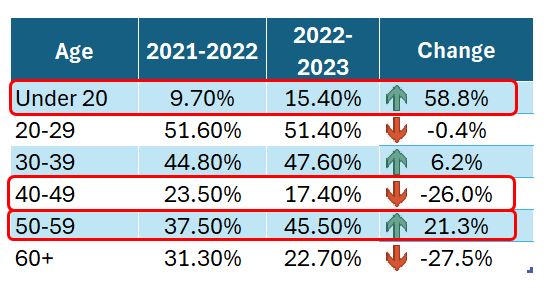
Results: In total, 107 surveys were completed (Y1: 52 & Y2: 55). Most respondents (83%) identified as female. The racial breakdown included 60% Hispanic, 43% African American, 22% White, 13% Asian, 22% other races. The demographic composition remained similar between the two years. There was a substantial 59% á in participants under 20 years old. In contrast, there were notable decreases in participants aged 40-49 & 60+. These shifts suggest a trend towards younger participants reaching our target population after transition to a virtual forum. (See figure 1)
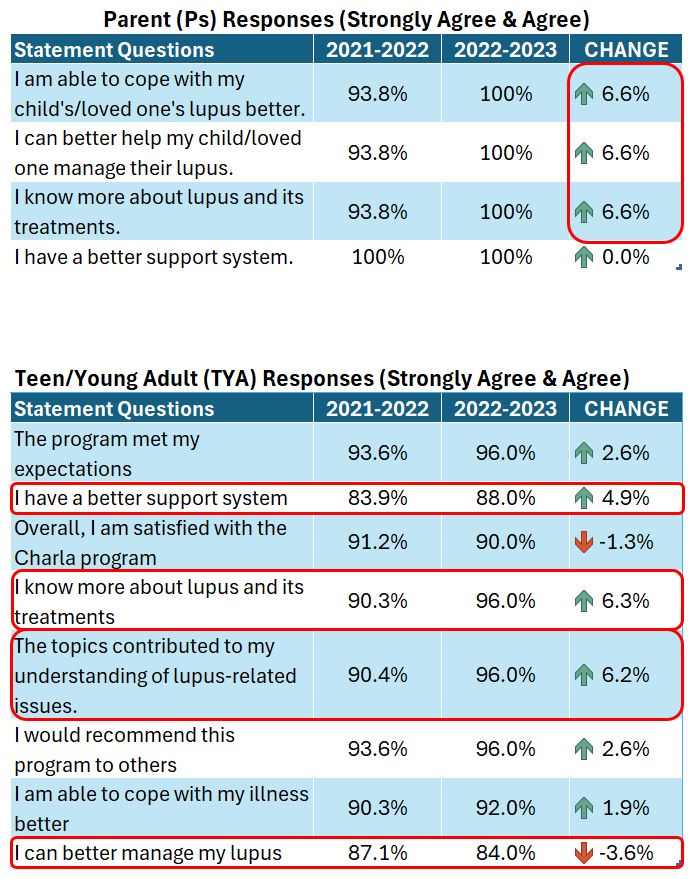
TYA responses reported a 4.9% á in feeling that they have a better support system, with 88% in Y2 to 83.9% in Y1. Knowledge about lupus & its treatments saw a significant increase, á 90.3% to 96% in Y2. Understanding of lupus-related issues also á to 90.4% to 96% in Y2. However, there was a slight â in TYAs’ ability to manage their lupus, dropping to 84% from 87.1%. Despite this, the overall trend reflects enhanced support & educational impact of the program.
Ps responses showed significant positive changes: 100% of Ps felt better able to cope with their child’s or loved one’s lupus in Y2, a 6.6% á from Y1. Additionally, 100% of Ps felt they could better help their child manage lupus, had more knowledge about lupus & its treatments & felt they had a better support system in Y2, reflecting a 6.6% improvement over Y1. Overall, trends indicate enhanced support & educational impact of the program. (See figure 2)
Open-ended responses reinforced the positive impact of the support group model. TYA noted, “The Charla group is very supportive to me, there’s always someone to talk to whenever things are rough.” Ps appreciated the sense of community, likening it to a “second family;” similarly TYA valued peer support, educational programs, & opportunities for self-advocacy encouraged by facilitators.
Conclusion: Findings underscore the enduring value of peer support groups in empowering TYA & their families facing SLE. Despite limitations like survey fatigue, the program demonstrated consistent satisfaction & increased knowledge among participants, highlighting its pivotal role in enhancing coping & support strategies.
To cite this abstract in AMA style:
Rodriguez, LCSW G, Calvache P, Mendez L, Cabrera K, Horton R, Imundo L, Rose-Smith J. Empowering Lupus Communities: Evaluating a National Peer Support Program for Lupus Teen, Young Adult Patients and Their Families [abstract]. Arthritis Rheumatol. 2024; 76 (suppl 9). https://acrabstracts.org/abstract/empowering-lupus-communities-evaluating-a-national-peer-support-program-for-lupus-teen-young-adult-patients-and-their-families/. Accessed .« Back to ACR Convergence 2024
ACR Meeting Abstracts - https://acrabstracts.org/abstract/empowering-lupus-communities-evaluating-a-national-peer-support-program-for-lupus-teen-young-adult-patients-and-their-families/