
Session Information
Date: Sunday, November 13, 2022
Title: Pediatric Rheumatology – Clinical Poster II: Connective Tissue Disease
Session Type: Poster Session C
Session Time: 1:00PM-3:00PM
Background/Purpose: Eculizumab is a monoclonal antibody that prevents the cleavage of C5, which inhibits the formation of the terminal complement complex. It is approved in pediatric patients with atypical hemolytic uremic syndrome to inhibit complement mediated Thrombotic Microangiopathy (TMA), and its use in Systemic Lupus Erythematosus (SLE) is gaining popularity. The efficacy and safety of eculizumab in childhood-onset SLE is yet to be defined.
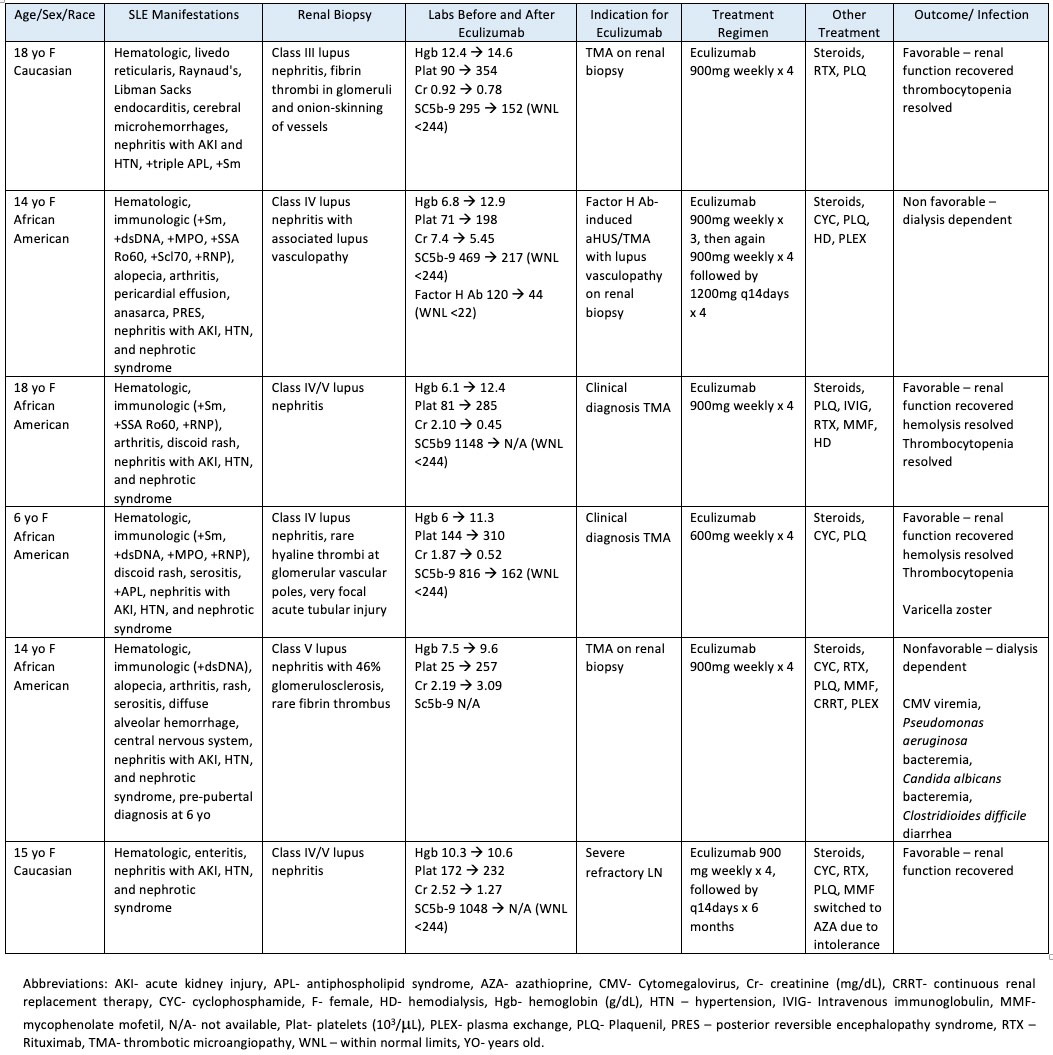
Methods: With approval for our institutional review board, we studied a single-center retrospective observational cohort of children diagnosed with SLE who were prescribed eculizumab for severe refractory lupus nephritis with or without TMA from 2014-2022. TMA was determined either histologically or clinically based on the combination of microangiopathic hemolytic anemia, thrombocytopenia, and renal impairment. Clinical, laboratory measures, indications for eculizumab, treatment regimens, outcomes, and adverse effects were described. A favorable outcome was defined as resolution of hematologic abnormalities and recovery of renal function based on age-defined lab parameters and clinical need for hemodialysis.
Results: Six patients with SLE received eculizumab as treatment for severe disease (Table 1). One patient with scleroderma overlap and multiorgan involvement was excluded. The majority of the patients (67%) exhibited a favorable response to eculizumab. At 4 weeks, 83% had full recovery in hemolysis and thrombocytopenia. Twopatients remained dialysis dependent, and of these, one patient had relapse requiring re-treatment in the setting of factor H antibodies, and the other patient had a history of medication non-compliance. One patient developed varicella zoster with no cutaneous or visceral organ dissemination. She improved with intravenous acyclovir and transitioned to oral valacyclovir for a total 14-day course. Another patient had recurrent infections including line infections (Pseudomonas aeruginosa and Candida albicans), antibiotic-associated Clostridioides difficile diarrhea, and Cytomegalovirus (CMV) viremia requiring ganciclovir as well as CMV immune globulin. However, no infections related to meningococcal disease or other encapsulated organisms were reported. No infusion related reactions were noted.
Conclusion: Based on this observation cohort, we recommend considering eculizumab as an adjunctive treatment for pediatric SLE patients with TMA. Since these patients are on multiple immunosuppressive agents, it is important to monitor for infectious complications. Additional studies are needed to determine the optimal treatment duration and the risk factors for future TMA events after discontinuation of eculizumab in this population.
To cite this abstract in AMA style:
Pereira M, Chun A, Stubbs L, De Guzman M. Eculizumab Is Safe as an Adjunctive Therapy in Systemic Lupus Erythematosus with Severe Refractory Nephritis with or Without Thrombotic Microangiopathy in Children [abstract]. Arthritis Rheumatol. 2022; 74 (suppl 9). https://acrabstracts.org/abstract/eculizumab-is-safe-as-an-adjunctive-therapy-in-systemic-lupus-erythematosus-with-severe-refractory-nephritis-with-or-without-thrombotic-microangiopathy-in-children/. Accessed .« Back to ACR Convergence 2022
ACR Meeting Abstracts - https://acrabstracts.org/abstract/eculizumab-is-safe-as-an-adjunctive-therapy-in-systemic-lupus-erythematosus-with-severe-refractory-nephritis-with-or-without-thrombotic-microangiopathy-in-children/