ACR Meeting Abstracts

ACR Meeting Abstracts

  • Meeting Abstracts
    • All Meetings
    • PRSYM 2026
    • ACR Convergence 2025
    • Download Abstract Supplements
  • Keyword Index
  • Search
  • My Favorites
    • View and print all favorites
    • Clear all favorites

Abstract Number: 0164

Disrupted Executive Control Network Structural-Functional Integration Is Associated with Inferior Performance of Cognitive Switching Tasks in Patients with Systemic Lupus Erythematosus (SLE)

Xing Qian1, Danielle S Bassett2, Kwun Kei Ng1, Beatrice RY Loo1, Amelia J Koh1, Juan Helen Zhou1 and Anselm Mak3, 1Center for Sleep and Cognition, Department of Medicine, Yong Loo Lin School of Medicine, National University of Singapore, Singapore, Singapore, 2Departments of Physics & Astronomy, Bioengineering, Electrical & Systems Engineering, Neurology, and Psychiatry, University of Pennsylvania, Philadelphia, PA, 3National University of Singapore, Singapore, Singapore

Meeting: ACR Convergence 2021

Keywords: BOLD, Brain, Cognitive dysfunction, Neuroimaging, Systemic lupus erythematosus (SLE)

  • Tweet
  • Email a link to a friend (Opens in new window) Email
  • Print (Opens in new window) Print
Session Information

Date: Saturday, November 6, 2021

Title: Imaging of Rheumatic Diseases Poster (0149–0182)

Session Type: Poster Session A

Session Time: 8:30AM-10:30AM

Background/Purpose: Cognitive flexibility, a process that enables goal-oriented cognitive switching between mental function modes, is central to executive function which is impaired in SLE patients. Multimodal integration of brain network anatomy and functional signals has recently been shown to mediate the cognitive switching process. Specifically, alignment between blood-oxygenation-level-dependent (BOLD) signals and the architecture of the underlying white matter (WM) network is associated with higher cognitive flexibility. In SLE patients, whether WM networks that constrain brain dynamics during cognitive switching is altered remains unknown. Here, brain structural-functional alignment and liberality between SLE patients and healthy controls (HC) were studied by performing the Modified Wisconsin Card Sorting Test (MCST) that probed cognitive flexibility. We hypothesized that the structural-functional integration of the executive control network (ECN) would be disrupted, with behavioral implications in SLE patients.

Methods: We studied 17 SLE patients without neuropsychiatric manifestation (aged 33.3±7.9 years) and 44 HC (aged 28.3±8.2 years). Functional brain magnetic resonance imaging (MRI) during MCST, T1-weighted structural and diffusion MRI were conducted. Region-of-interest (ROI) time series were extracted using a 144-ROI brain functional parcellation scheme. We constructed the anatomical brain network by defining the connectivity between each pair of ROIs as the normalized connection probability derived from probabilistic diffusion tractography. BOLD signals were decomposed into a proportion that aligned with the anatomical network and a proportion that indicated liberality (Fig. 1). We performed group comparison on alignment and liberality at the global and network levels using two-sample t-tests (a=0.05) and evaluated their relationships with MCST performance.

Results: The two groups did not differ in overall MCST performance. SLE patients showed higher global functional liberality and lower global functional alignment with the structural networks during MCST (p=0.014 and 0.045, respectively) compared to HC. At the network level, SLE patients showed higher liberality in the ECN compared to HC (FDR-corrected, p=0.026). Focusing on the 3 ECN sub-networks (Fig. 2H), the abnormality of functional organization atop the ECN anatomy was driven by the lower alignment in ECN-A and higher liberality in ECN-A and ECN-B in SLE patients (FDR-corrected p=0.007, 0.008 and 0.026, respectively). ECN-A and ECN-B are the typical lateral fronto-parietal executive control regions while ECN-C is near to the default mode network. Higher liberality and lower alignment were correlated with reduced task accuracy (p< 0.05). The correlation between ECN liberality and task accuracy remained significant (p=0.023) after controlling for global liberality and alignment.

Conclusion: Our study demonstrated reduced functional-structural alignment of the ECN in SLE patients using a novel graph signal processing method that constrained BOLD signal magnitude to the anatomical network architecture. Reduced functional-structural alignment was associated with poorer cognitive switching performance.
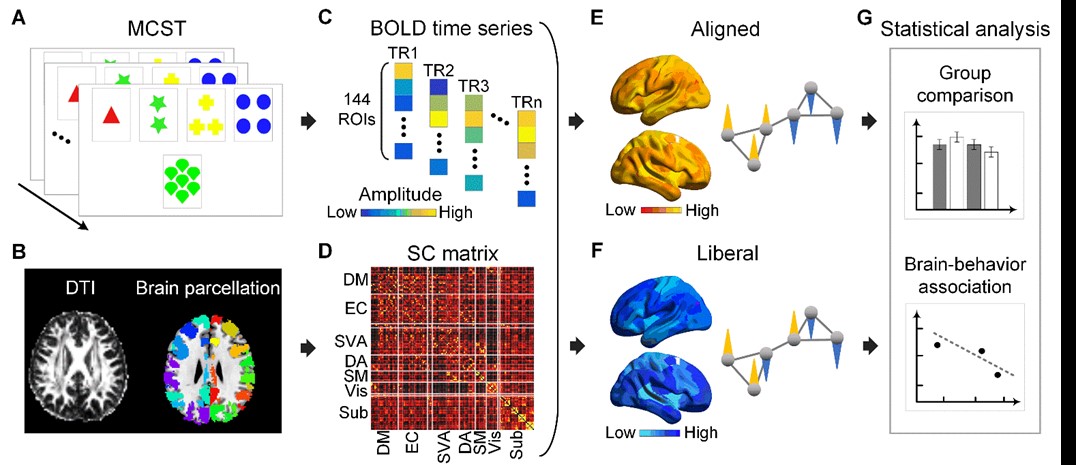
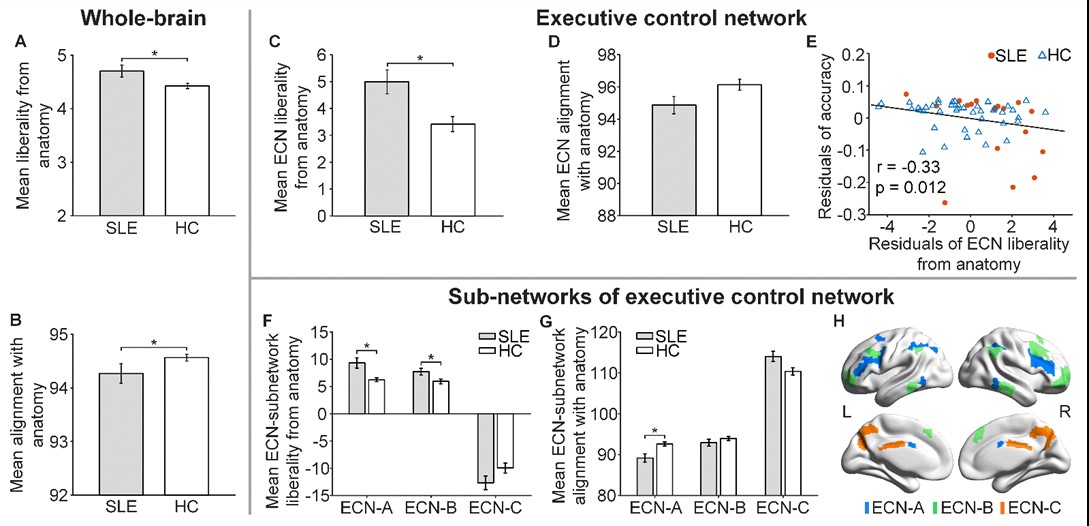
Figure 1. Study design schematic diagram. Subjects performed the Modified Wisconsin Card Sorting Test (MCST) in which they were asked to match the stimulus card at the bottom of the screen to one of the four index cards displayed at top of the screen while undergoing functional MRI scan (A). Structural connectivity (SC) network was constructed using diffusion tensor imaging (DTI) for each individual based on a predefined set of 144 regions of interest (ROIs), which included 114 cortical ROIs and 30 subcortical regions (B & D). ROI blood oxygen level-dependent (BOLD) time series were extracted from fMRI data and decomposed into a proportion which was aligned well with the structural network and a proportion which was liberal from the network (C, D, E & F). We conducted group comparison on functional alignment and liberality between SLE and healthy controls and examined the association of alignment and liberality with task performance (G). Abbreviations: DM: default mode, EC: executive control, SVA: salience/ventral attention, DA: dorsal attention, SM: somatomotor, Vis: visual, Sub: subcortical

Figure 2. Patients with SLE had higher liberality from anatomy and lower alignment with anatomy related to MCST performance. Patients with SLE showed higher mean liberality from anatomy and lower mean alignment with anatomy during MCST than HC (p<0.05, A&B). SLE patients showed higher mean liberality from anatomy in ECN (FDR corrected p<0.05) and a trend towards lower mean alignment in ECN during MCST than HC (C&D). Increased mean liberality in ECN was correlated with reduced task accuracy across SLE and HC groups (E). Amongst ECN sub-networks highlighted in the brain surfaces (H), ECN-A and ECN-B showed higher mean liberality from anatomy during MCST in SLE patients than HC, and ECN-A showed lower mean alignment with anatomy during MCST in SLE patients than HC (FDR corrected p<0.05, F&G). Error bars represent standard errors. Abbreviations: SLE: systemic lupus erythematosus, HC: healthy control, ECN: executive control network, MCST: Modified Wisconsin Card Sorting Test


Disclosures: X. Qian, None; D. Bassett, None; K. Ng, None; B. Loo, None; A. Koh, None; J. Zhou, None; A. Mak, None.

To cite this abstract in AMA style:

Qian X, Bassett D, Ng K, Loo B, Koh A, Zhou J, Mak A. Disrupted Executive Control Network Structural-Functional Integration Is Associated with Inferior Performance of Cognitive Switching Tasks in Patients with Systemic Lupus Erythematosus (SLE) [abstract]. Arthritis Rheumatol. 2021; 73 (suppl 9). https://acrabstracts.org/abstract/disrupted-executive-control-network-structural-functional-integration-is-associated-with-inferior-performance-of-cognitive-switching-tasks-in-patients-with-systemic-lupus-erythematosus-sle/. Accessed .
  • Tweet
  • Email a link to a friend (Opens in new window) Email
  • Print (Opens in new window) Print

« Back to ACR Convergence 2021

ACR Meeting Abstracts - https://acrabstracts.org/abstract/disrupted-executive-control-network-structural-functional-integration-is-associated-with-inferior-performance-of-cognitive-switching-tasks-in-patients-with-systemic-lupus-erythematosus-sle/

Advanced Search

My Favorites

Save and print abstracts during your browser session by clicking the “Favorite” button at the bottom of any abstract (must have cookies enabled in browser). See saved favorites.

Abstract Policies

  • ACR Convergence Abstract Embargo Policies
  • ACR Convergence Abstract Permissions & Reprints
  • PRSYM Abstract Policies

ACR Convergence. Where Rheumatology Meets

ACR Convergence 2026

Join us November 6-11 in Orlando, Florida.
See Registration Information

  • Contact ACR
  • Privacy Policy
  • ACR Policies
  • Cookie Preferences

© Copyright 2026 American College of Rheumatology