
Session Information
Date: Monday, November 9, 2020
Title: RA – Diagnosis, Manifestations, & Outcomes Poster IV: Lifespan of a Disease
Session Type: Poster Session D
Session Time: 9:00AM-11:00AM
Background/Purpose: Description of disease activity status in patients with rheumatoid arthritis (RA) at fixed points in time modelled as continuous (e.g. number of swollen joints counts), dichotomous variable (e.g. remission or low disease status using composite measures) do not reflect the patient’s disease course in chronic and relapsing RA. We proposed to describe the longitudinal disease activity trajectories for patients with early and established RA over two years’ follow-up in routine clinical care.
Methods: RA patients enrolled in the Ontario Best Practices Research Initiative (OBRI) with available DAS28-ESR over two years of follow-up were included. Using a latent growth curve modelling (LCGM), subgroups of patients following distinct pattern of DAS28-ESR change over time were identified. Model selection was based on Bayesian information criterion (BIC).
Results: A total of 1273 patients were included, 454 (36%) with early RA and 819 (64%) with established RA. At baseline, patients with early RA were significantly younger (57.3 vs. 59.1 years) and with higher DAS28-ESR (4.6 vs. 4.3), and were less likely to have an erosion (25.0% vs. 59.7%), to be RF-positive (70.3% vs. 76.8%), and to use biologic DMARDs (7.0% vs. 29.2%).
In patients with early RA (Figure 1A), three subgroups of patients were identified by LCGM with a better fit (BIC: -3070.84). Almost 88% patients with moderate disease activity reached remission (group 1: 48.4%) or low disease status (group 2: 39.3%) at year 2, while 12% of patients with high disease profile remained in a moderate state (group 3).
In patients with established RA (Figure 1B), seven subgroup of patients were identified by LCGM with a better fit (BIC: -5378.13). After 2 years’ follow-up, 37.5% of patients in remission or low disease state at baseline remained or reached to remission (group 1 and 2, respectively). Only 17.3% of patients with high disease activity at baseline reached remission (group 5). 16.5% patients with high disease activity at baseline remained in high disease status at year 2 (group 4 and 6). Two other group of patients (group 3 and 7) with moderate or high disease activity at baseline remained in a moderate state after two years.
Conclusion: Disease course is different between early and established RA. While 70% of early RA patients with moderate or high disease profiles reached remission, only 17% of established patients with high disease activity achieved remission after 2 years of follow-up. These findings suggest the potential effects of receiving early treatment and health care. The impact of sociodemographic, clinical and medication profile on disease course will be examined as future work for this study.
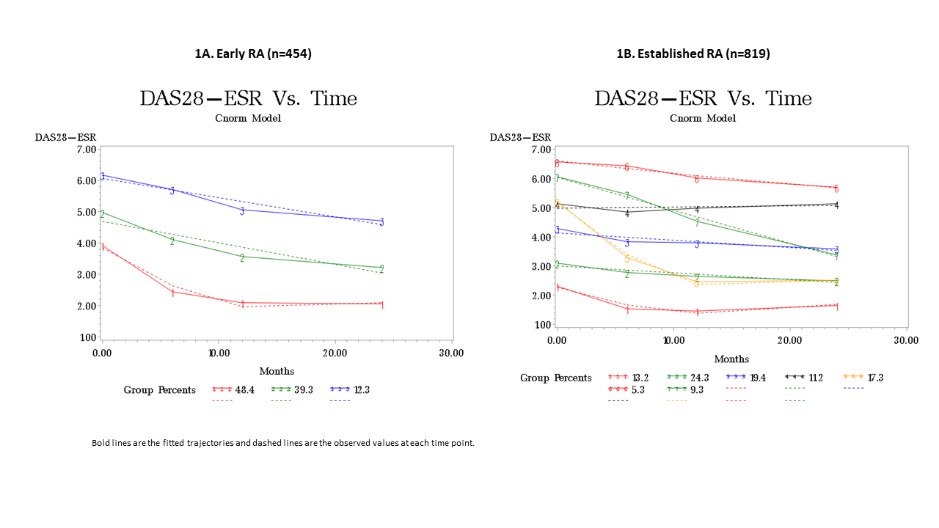 Figure 1: Observed and fitted trajectories from latent growth curve analysis in patients with early and established RA.
To cite this abstract in AMA style:
Movahedi M, Cesta A, Li X, Bombardier C. Disease Activity Trajectories for Early and Established Rheumatoid Arthritis: Real World Results from a Rheumatoid Arthritis Cohort [abstract]. Arthritis Rheumatol. 2020; 72 (suppl 10). https://acrabstracts.org/abstract/disease-activity-trajectories-for-early-and-established-rheumatoid-arthritis-real-world-results-from-a-rheumatoid-arthritis-cohort/. Accessed .« Back to ACR Convergence 2020
ACR Meeting Abstracts - https://acrabstracts.org/abstract/disease-activity-trajectories-for-early-and-established-rheumatoid-arthritis-real-world-results-from-a-rheumatoid-arthritis-cohort/