
Session Information
Session Type: Abstract Session
Session Time: 3:30PM-3:45PM
Background/Purpose: Barriers to developing effective osteoarthritis (OA) therapies include the lack of standardized definitions for disease progression and structural endpoints that reliably predict changes in symptoms (e.g., pain). We recently developed a “disease activity” composite metric that combines bone marrow lesion (BML) and effusion-synovitis volumes on magnetic resonance (MR) imaging into a standardized definition of disease progression related to pain. While many imaging biomarkers are associated with pain, the clinically meaningful magnitude of change in these measures remains unclear. We aimed to examine the association between 2-year changes in disease activity and 2-year changes in knee pain and quantify thresholds of clinically meaningful change for our novel disease activity composite metric.
Methods: We conducted a longitudinal nested cohort study within the Osteoarthritis Initiative, including participants with at least possible radiographic knee OA (Kellgren-Lawrence grade ≥ 1) and mild knee pain (WOMAC pain score ≥ 10/100). We measured BML and effusion-synovitis volumes on MR images (intraclass correlation coefficients > 0.95). We assessed 4 methods to calculate the disease activity metric: 1) sum of standardized volumes, 2) z-score, 3) percentile, and 4) adjusted percentile. We used established cut-points to categorize 2-year change in pain: 1) pain improvement (< – 20), 2) minimal change (-20 to 20), and 3) worsening ( > 20). We calculated the distribution of each disease activity metric across categories of changes in WOMAC knee pain. We then used multinomial logistic regression to explore the association between 2-year changes in disease activity and categories of changes in WOMAC knee pain (3-level outcome, reference = minimal change).
Results: Among 1,295 knees (641 participants), 139 knees had meaningful pain improvement (71% female, 53% obese, 81% radiographic knee OA), 75 knees had worsening (70% female, 62% obese, 79% radiographic knee OA), and 1,081 had no meaningful change (58% female, 45% obese, 79% radiographic knee OA). Changes in each disease activity metric were associated with both pain improvement (OR= 0.46 to 0.87; Table) and pain worsening (OR= 1.16 to 2.09; Table). Among knees with minimal change in pain, most knees experienced worsening disease activity scores (Table). Median disease activity changes among participants with pain improvement or worsening may serve as a threshold for defining minimally clinically important changes to effectively distinguish most knees with minimal pain changes as having minimal disease activity changes (Table, Figure).
Conclusion: All disease activity metrics were associated with knee pain, underscoring their utility in monitoring disease activity as an indicator of pain. Most knees with minimal changes in pain had subtly worsening disease activity, which reflects the natural history of OA progression. Most knees showing clinically meaningful improvement in pain experienced improved disease activity; in contrast, knees with worsening knee pain had worsening disease activity. Our composite disease activity metric shows promise as a biomarker for defining structural progression in knee OA that is clinically relevant to pain outcomes.
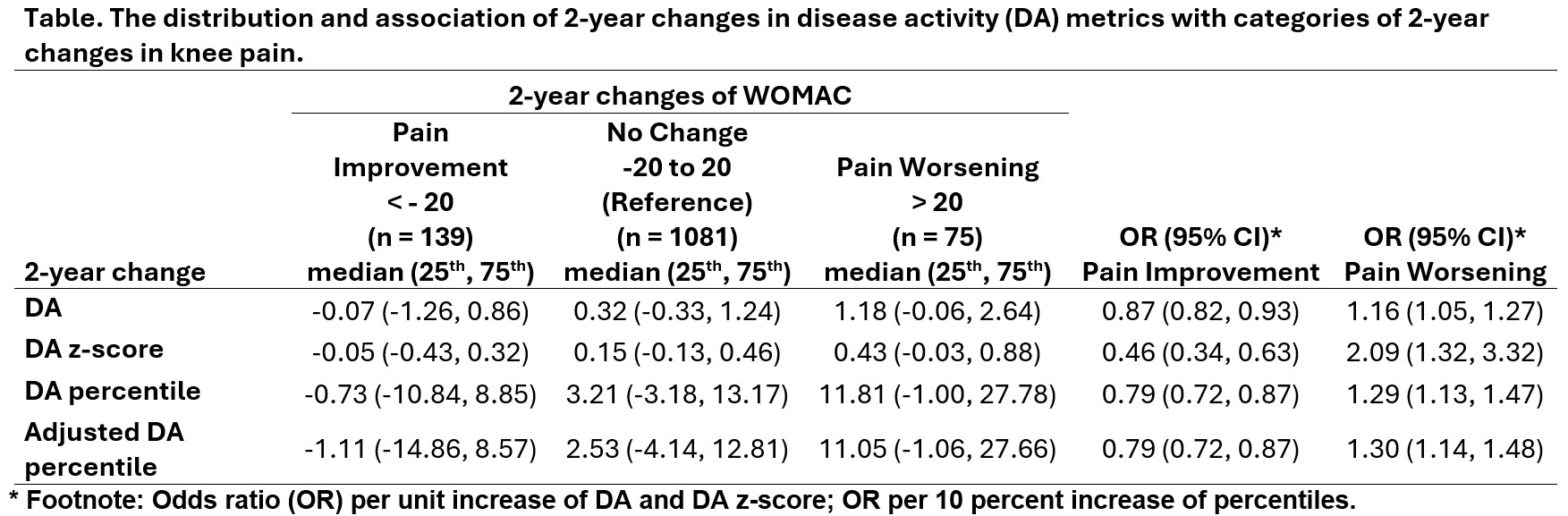 Table. The distribution and association of 2-year changes in disease activity (DA) metrics with categories of 2-year changes in knee pain.
.jpg) Figure. The distribution of 2-year changes in disease activity (DA) metrics across categories of 2-year changes in WOMAC knee pain scores, with orange reflecting clinically meaningful worsening in disease activity and blue representing clinically meaningful improvement in disease activity. Note. A. Disease activity score, B. Disease activity z-score, C. Disease activity percentile, and D. Disease activity adjusted percentile.
Figure. The distribution of 2-year changes in disease activity (DA) metrics across categories of 2-year changes in WOMAC knee pain scores, with orange reflecting clinically meaningful worsening in disease activity and blue representing clinically meaningful improvement in disease activity. Note. A. Disease activity score, B. Disease activity z-score, C. Disease activity percentile, and D. Disease activity adjusted percentile.
Disclosures: J. Driban: None; J. Baek: None; J. Patarini: None; E. Kirillov: None; N. Vo: None; M. Richard: None; M. Zhang: None; M. Harkey: None; G. Lo: None; K. Lapane: None; S. Liu: None; C. Eaton: None; J. Mackay: AstraZeneca, 3, Blue Earth Diagnostics, 3; J. Harvey: None; T. McAlindon: Anika, 2, Grunenthal, 2, Kiniksk, 2, Kolon TissueGene, Inc., 2, Medipost, 2, Novan, 2, Organogenesis, 2, Regeneron, 2, Remedium-Bio, 2, Samumed, 2, Sanofi, 2, Scarcell, 2, Visor, 2.
To cite this abstract in AMA style:
Driban J, Baek J, Patarini J, Kirillov E, Vo N, Richard M, Zhang M, Harkey M, Lo G, Lapane K, Liu S, Eaton C, Mackay J, Harvey J, McAlindon T. Disease Activity is a Novel Imaging Biomarker Associated with Knee Pain: Data from the Osteoarthritis Initiative [abstract]. Arthritis Rheumatol. 2025; 77 (suppl 9). https://acrabstracts.org/abstract/disease-activity-is-a-novel-imaging-biomarker-associated-with-knee-pain-data-from-the-osteoarthritis-initiative/. Accessed .« Back to ACR Convergence 2025
ACR Meeting Abstracts - https://acrabstracts.org/abstract/disease-activity-is-a-novel-imaging-biomarker-associated-with-knee-pain-data-from-the-osteoarthritis-initiative/