
Session Information
Session Type: Poster Session A
Session Time: 10:30AM-12:30PM
Background/Purpose: We sought to characterize the most recent cohort of patients presenting with DAH and AAV and to identify risk factors for respiratory failure and mortality. Second, we compared the outcomes of this recent cohort with those of an earlier cohort. Third, we aimed to investigate the effect of concurrent active renal involvement on outcomes of patients with DAH.
Methods: : We performed a retrospective analysis of all consecutive patients with DAH due to AAV presenting at Mayo Clinic sites from January 1, 2013, to August 31, 2022 (recent cohort). Patients who were at least 18 years old at the time of DAH presentation, met ACR criteria for GPA and Chapel Hill Consensus definitions for GPA or MPA and had DAH confirmed by bronchoalveolar lavage, were included. We then compared their clinical characteristics and outcomes with those of an earlier AAV cohort of patients diagnosed with DAH between January 1, 2002 and December 31, 2012.
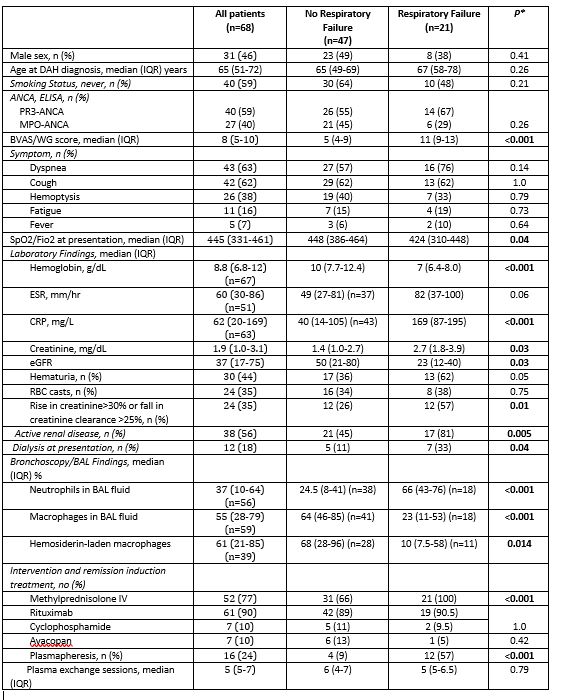
Results: Sixty-eight patients (46% male, mean age [SD] at DAH presentation 61 [17]) met inclusion criteria. Their baseline demographic and clinical features are shown in Table 1. Twenty-one (31%) of these patients experienced respiratory failure (Table 1). SpO2:FiO2 ratio upon initial presentation was independently associated with the development of respiratory failure by multivariate analysis (B:0.09 CI 95%: 0.01-0.89, p=0.04).
The overall survival of these patients was 93% at 3 months and at 1 year after the DAH. Age at DAH onset (p=0.048), MPO-ANCA (p=0.029), and SpO2:FiO2 at DAH presentation (p=0.012), were related to mortality by univariate analysis. We could not identify any independent factor related to mortality in patients with DAH by multivariate analysis.
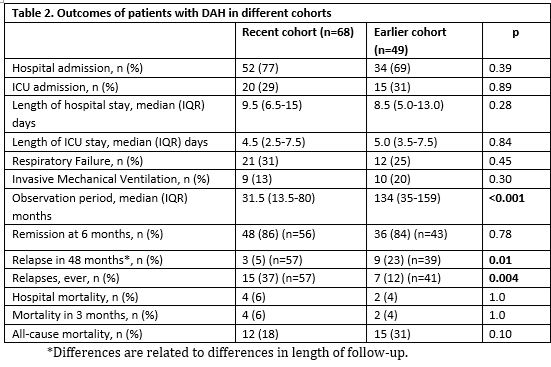
Forty-nine patients were included in the earlier cohort, and baseline demographic and clinical features were similar to those of the recent cohort. The comparison of features of the recent cohort to those of the earlier cohort are shown in Table 2.
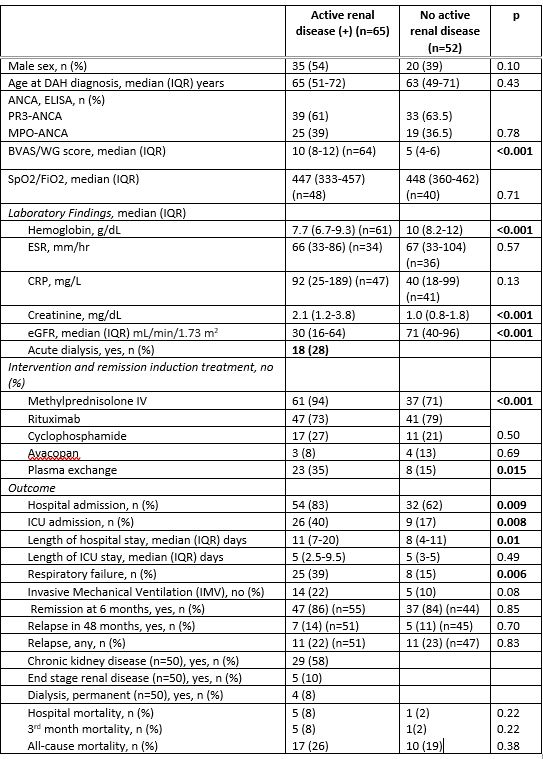
Thirty-eight patients (56%) in the recent cohort and 27 (55%) in earlier cohort had concurrent active renal involvement. Compared to patients who did not have active renal involvement, a higher disease burden and need for higher level of care was identified, but no statistically significant differences in hospital mortality, 3-months mortality, overall mortality, remission at 6 months, or relapse rate were identified between patients with and without active renal disease (Table 3).
Conclusion: Hypoxemia at presentation is the most significant predictor of respiratory failure. Over the 11 year period comprising the recent cohort, rituximab has emerged as the most frequently used remission induction agent for patients with DAH and AAV. This was not accompanied by any difference in outcomes. The presence of active renal involvement in patients with DAH had no impact on remission or relapse rates..
To cite this abstract in AMA style:
Falde S, Ediboglu E, Baqir M, Cartin-Ceba R, Fervenza F, Zand L, Koster M, Warrington K, Specks U. Diffuse Alveolar Hemorrhage in Antineutrophil Cytoplasmic Antibody-Associated Vasculitis Revisited [abstract]. Arthritis Rheumatol. 2024; 76 (suppl 9). https://acrabstracts.org/abstract/diffuse-alveolar-hemorrhage-in-antineutrophil-cytoplasmic-antibody-associated-vasculitis-revisited/. Accessed .« Back to ACR Convergence 2024
ACR Meeting Abstracts - https://acrabstracts.org/abstract/diffuse-alveolar-hemorrhage-in-antineutrophil-cytoplasmic-antibody-associated-vasculitis-revisited/