ACR Meeting Abstracts

ACR Meeting Abstracts

  • Meeting Abstracts
    • All Meetings
    • PRSYM 2026
    • ACR Convergence 2025
    • Download Abstract Supplements
  • Keyword Index
  • Search
  • My Favorites
    • View and print all favorites
    • Clear all favorites

Abstract Number: 0701

Diagnostic Performances of Vascular Biomarkers Soluble Fms-like Tyrosine Kinase (sFlt-1) and Placental Growth Factor (PlGF) in Scleroderma Renal Crisis: A Case Control Study

Aïcha Kante1, Paul Legendre2, Bérangère Joly3, bertrand Dunogue4, Alexandre Hertig5, Benjamin Terrier6, Elodie Massolin7, Felix Ackermann8, Luc Mouthon4, Jean Guibourdenche9 and Benjamin Chaigne10, 1Department of internal medicine, Centre de Compétence Maladies Rares autoimmunes et inflammatoires, Université Paris Cité, Paris, Ile-de-France, France, 2Service immunologie clinique, Centre hospitalier du Mans, Le Mans, France, Le Mans, 3Service d'Hématologie Biologique, Hôpital Lariboisière, Assistance Publique-Hôpitaux de Paris (APHP.Nord), Université Paris Cité, Paris, Ile-de-France, France, 4Service de Médecine Interne, Centre de Référence Maladies Systémiques Autoimmunes et Autoinflammatoires Rares d'Ile de France de l’Est et de l’Ouest, Hôpital Cochin, Assistance Publique-Hôpitaux de Paris (AP-HP), Paris, France, 5Department of Nephrology, Hôpital Foch, Suresnes, France, Suresnes, Ile-de-France, France, 6Service de Médecine interne, Hôpital Cochin, AP-HP, Paris, Ile-de-France, France, 7UF d'Hormonologie, Hôpital Cochin, Assistance Publique-Hôpitaux de Paris (APHP), Paris, Paris, Ile-de-France, France, 8Department of Internal Medicine, Foch Hospital, Suresnes, France., Suresnes, France, 9APHP-CUP, Hôpital Cochin, F-75014 Paris, Université Paris Cité, Paris, Ile-de-France, France, 10Service de Médecine Interne, Centre de Référence Maladies Systémiques Autoimmunes et Autoinflammatoires Rares d'Ile de France de l’Est et de l’Ouest, Hôpital Cochin, Assistance Publique-Hôpitaux de Paris (AP-HP), Paris, Ile-de-France, France

Meeting: ACR Convergence 2024

Keywords: Biomechanics, prevention, Renal, Scleroderma

  • Tweet
  • Email a link to a friend (Opens in new window) Email
  • Print (Opens in new window) Print
Session Information

Date: Saturday, November 16, 2024

Title: Systemic Sclerosis & Related Disorders – Clinical Poster I

Session Type: Poster Session A

Session Time: 10:30AM-12:30PM

Background/Purpose: Scleroderma renal crisis (SRC) is a major vascular complication of systemic sclerosis (SSc), associated with high morbidity and mortality. Few biomarkers are available to predict SRC and assess its prognosis. SRC and pre-eclampsia share similar clinical phenotype and biological characteristics. The aim of this study was to assess placental growth factor (PlGF), soluble fms tyrosine kinase 1 (sFlt-1) and sFlt1/PlGF ratio as biomarkers in SRC.

Methods: Serum samples from 27 SSc patients with history of SRC (SSc-SRC+) were collected. Biomarker levels were assessed using Cobas Roche® immunoassay and compared to age- and sex-matched SSc patients with no history of SSc (SSc-SRC-) (n = 24), as well as patients with hemolytic uremic syndromes (HUS) (n = 27), malignant hypertension (MHT) (n = 22), and healthy donors with no known vasculopathy (n = 61). The diagnostic performance of the biomarkers was assessed using receiver operating characteristics (ROC) curves, and optimal thresholds determined using Youden’s index. A Cox model analysis was performed to assess the risk of long-term dialysis associated with biomarker elevation.

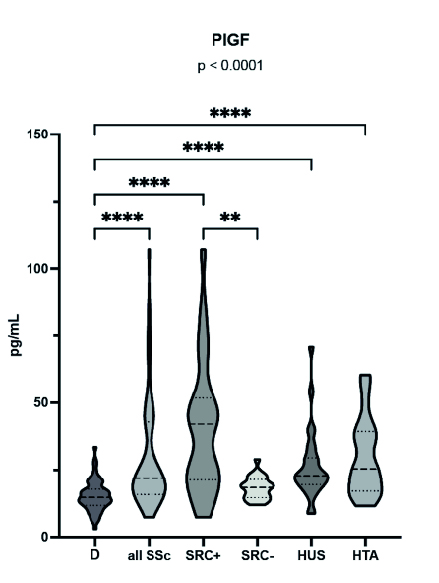
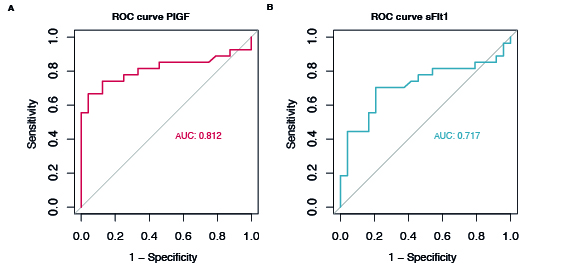
Results: The median [interquartile range] PlGF level (pg/mL) was significantly higher in the serum of SSc-SRC+ patients (42.1 [21.4 – 51.8]) compared to donors (14.7 [11.8 – 17.9]) and SSc-SRC- patients (18.5 [14.7 – 21.5]) (p < 0.0001). PlGF levels were also significantly higher in SSc-SRC+ compared to HUS (22.8 [19.5 – 29.6]) and MHT (25.5 [17.2 – 39.3]) patients (p < 0.0001) (Figure 1). A PlGF level above a threshold of 24.5 pg/mL was associated to an AUC of 81.2% [0.68 – 0.94], with a specificity of 95% and a sensitivity of 67%. sFlt-1, with an AUC of 71% [0.56 – 0.86] and sFlt1/PlGF ratio with an AUC of 67% [0.51 – 0.82] had lower diagnostic performance for the diagnosis of SRC (Figure 2). SSc-SRC+ patients who progressed to end-stage kidney disease had significantly higher levels of PlGF (42.9 [22.4 – 78.2]) compared to patients who did not require long-term dialysis (19.7 [15.6 – 29.7], p = 0.03). PlGF elevation was associated with an increased risk of long-term dialysis with a hazard ratio [CI] of 17.41 [1.88 – 160] (p = 0.012). In contrast to PlGF, sFlt-1 and sFlt-1/PlGF ratio were not significantly associated with an increased risk of long-term dialysis with a hazard ratio of 1 and 0.8 [0.5 – 1.2], respectively.

Conclusion: Serum PlGF accurately identifies the risk of SRC occurrence in SSc patients with a good specificity and may be considered a tool for SRC diagnosis and long-term dialysis risk assessment. These findings suggest that PlGF may serve as a valuable biomarker for SRC diagnosis and prognosis with no additional interest in measuring sFlt-1 and in calculating the sFlt-1/PlGF ratio.
Supporting image 1

Figure.1 Violin plot representation of PlGF levels in patients affected with SRC versus controls. Abbreviations: D: donors, HUS: hemolytic uremic syndrome, MHT: malignant hypertension, SRC: scleroderma renal crisis, SSc: systemic sclerosis.

Supporting image 2

Figure. 2 Receiver operating characteristic (ROC) curves of sFlt_1 and PlGF, in SRC versus non SRC patients. Abbreviations: AUC: area under curve. ROC: Receiver operating characteristics. A. ROC curve for PlGF (AUC: 81.2% [CI: 0.68 – 0.94]). B. ROC curve for sFlt_1 (AUC: 71.7%, [CI: 0.57 – 0.87]). A PlGF threshold of 24.5 pg/mL was associated with a specificity of 95% and a sensitivity of 67%.


Disclosures: A. Kante: None; P. Legendre: None; B. Joly: None; b. Dunogue: None; A. Hertig: None; B. Terrier: AstraZeneca, 2, GlaxoSmithKline, 2, Novartis, 2, Vifor Pharma, 2; E. Massolin: None; F. Ackermann: None; L. Mouthon: None; J. Guibourdenche: None; B. Chaigne: None.

To cite this abstract in AMA style:

Kante A, Legendre P, Joly B, Dunogue b, Hertig A, Terrier B, Massolin E, Ackermann F, Mouthon L, Guibourdenche J, Chaigne B. Diagnostic Performances of Vascular Biomarkers Soluble Fms-like Tyrosine Kinase (sFlt-1) and Placental Growth Factor (PlGF) in Scleroderma Renal Crisis: A Case Control Study [abstract]. Arthritis Rheumatol. 2024; 76 (suppl 9). https://acrabstracts.org/abstract/diagnostic-performances-of-vascular-biomarkers-soluble-fms-like-tyrosine-kinase-sflt-1-and-placental-growth-factor-plgf-in-scleroderma-renal-crisis-a-case-control-study/. Accessed .
  • Tweet
  • Email a link to a friend (Opens in new window) Email
  • Print (Opens in new window) Print

« Back to ACR Convergence 2024

ACR Meeting Abstracts - https://acrabstracts.org/abstract/diagnostic-performances-of-vascular-biomarkers-soluble-fms-like-tyrosine-kinase-sflt-1-and-placental-growth-factor-plgf-in-scleroderma-renal-crisis-a-case-control-study/

Advanced Search

My Favorites

Save and print abstracts during your browser session by clicking the “Favorite” button at the bottom of any abstract (must have cookies enabled in browser). See saved favorites.

Abstract Policies

  • ACR Convergence Abstract Embargo Policies
  • ACR Convergence Abstract Permissions & Reprints
  • PRSYM Abstract Policies

ACR Convergence. Where Rheumatology Meets

ACR Convergence 2026

Join us November 6-11 in Orlando, Florida.
See Registration Information

  • Contact ACR
  • Privacy Policy
  • ACR Policies
  • Cookie Preferences

© Copyright 2026 American College of Rheumatology