
Session Information
Session Type: Poster Session B
Session Time: 10:30AM-12:30PM
Background/Purpose: Our patients often express concerns related to ‘wellbeing’ that are not routinely attended during standard care (including QOL). Alternatively, these concerns are important components of holistic care systems. Wellbeing is a multidimensional complex construct. We present some important aspects of a novel indigenous clinically oriented questionnaire (HR-BHF) developed by us to assess wellbeing and enrich patient assessment and satisfaction in our practice.
Methods: Trained paramedics recorded concerns (ad verbatim) of wellbeing (construct of interest) volunteered by patients (chronic RA); 20 most frequent individual items shortlisted (Oct-Dec 2019). A suitable expert committee finalized 9 items (see below) by a standard consensus approach for inclusion in the self-reported HR-BHF. They approved introductory explanatory note and standard translations. They reviewed pilot testing (Feb-April 2020) in 103 RA patients and 300 healthy unrelated subjects (HC) and few corrections were made to improve comprehension and administration (HR-BHF, CRD, Pune 2020 version). The face and content validity of HR-BHF was also endorsed. Each item response was marked (│) on a standard 0-100 mm VAS (horizontal, no interval mark); 100 being the best outcome for general health, energy, bowel, happiness and appetite and 0 (reverse scoring ) indicate the best outcome for anxiety, fatigue, stress and sleep. In the final score (optimum 900), reverse score was adjusted (ascendency towards 100). Further validation (Jan 2023-May 2024) was carried out in 2 clinic based prospective cohorts (C) of RA patients- RAC1[ 68 subjects, mean age 53 years ( ± 10.4 SD] and RAC 2 [ 209 subjects, mean age 53.6 years (±10.6 SD), 185 women; mean DAS 28 ESR 3.79 (± 1.29 SD), mean total HAQ score 4.12 (± 3.12 SD]. All study subjects were volunteers (oral consent) and selected in no particular order; RA was on regular standard treatment. Standard statistics (including reliability and validity) carried out on MS Excel data sheets (significant P< 0.05).
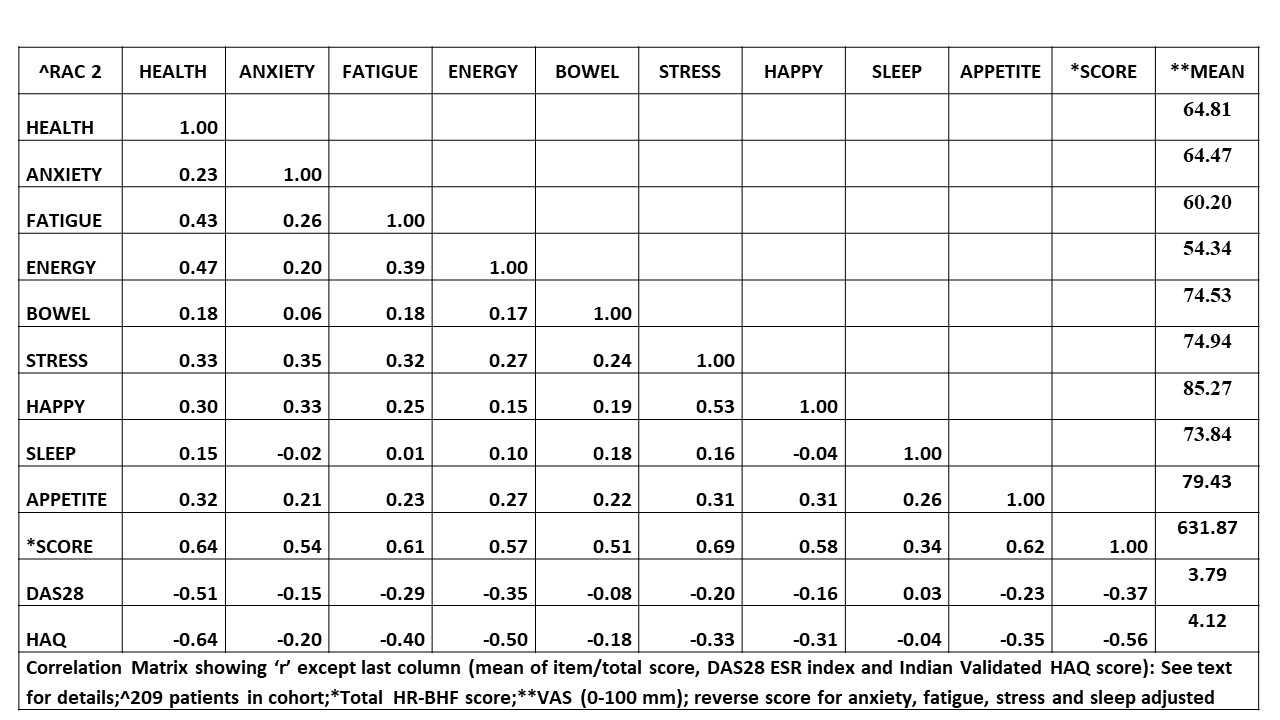
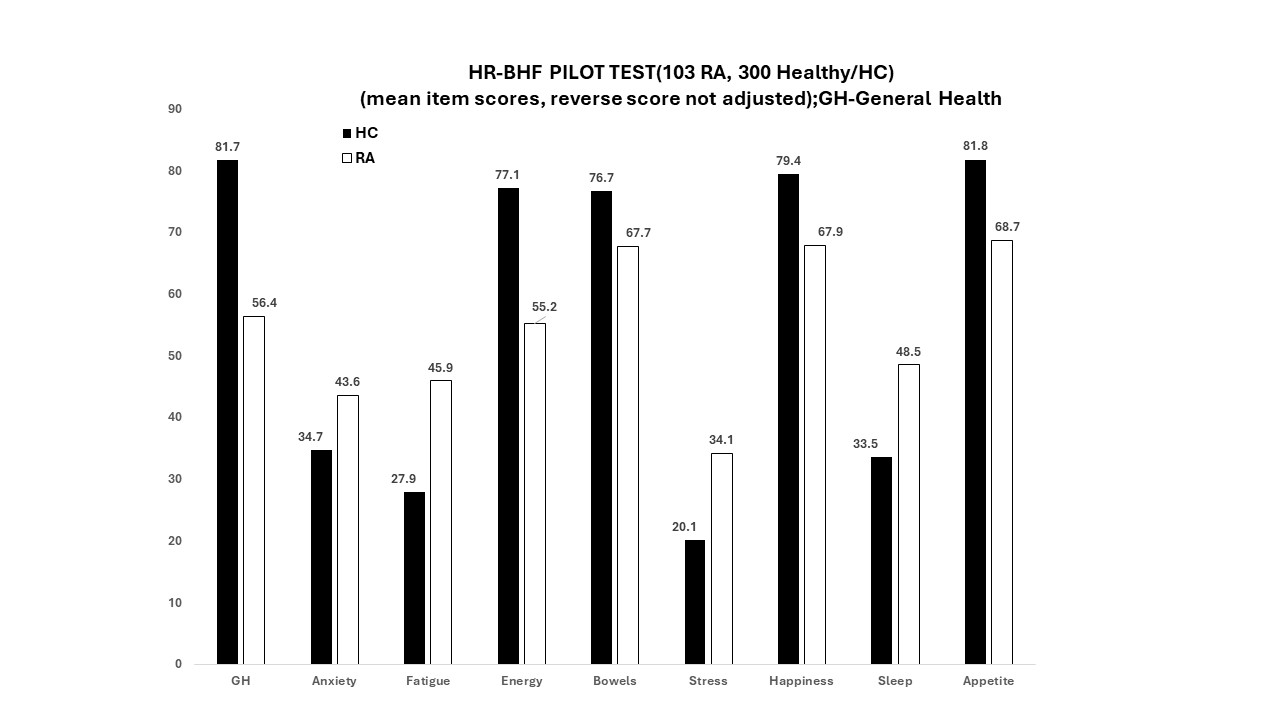
Results: (1) Pilot testing: 82% subjects and 92% respectively reported ‘no difficulty’ (understanding) and ‘useful/very useful’ (medical care). Mean item scores (mm) were higher in HC (p< 0.05); see Figure below (HC and RA groups, reverse score not adjusted). (2) RAC 1: HR-BHF score -Cronbach’ s Alfa- 0.65(test), 0.80 (retest 36-48 hours later);Intraclass Coeficient-0.81(generalizability limited to trained personnel) (3) RAC 2: Cronbach’ s Alfa- 0.69; Correlation (r):Correlation matrix/item score shown below. Several ‘r’ was moderate and significant including HR-BHF total & DAS 28 ESR/HAQ; Multivariable linear regression: 48% variation in GH explained by other HR-BHF items, Age, DAS and HAQ, Significant predictors-fatigue, energy, sleep, DAS, HAQ (4) Change/effect size (HR-BHF) over time will be presented (5) Limitations-single centre, floor/ceiling effect, multidimensional (overlap) and limited items (wellbeing), COVID pandemic influence (pilot testing).
Conclusion: HR-BHF was a reliable and valid measure of general wellbeing in RA in our setting. It may augment value-based patient care. Further research is required to show its potential universal generic use in health and disease.
To cite this abstract in AMA style:
SALUJA M, CHOPRA A. Development, Validation and Clinical Use of Health-Related Behaviour Health Fitness Questionnaire (HR-BHF) in Indian (Asian) Subjects Attending a Community Rheumatology Center [abstract]. Arthritis Rheumatol. 2024; 76 (suppl 9). https://acrabstracts.org/abstract/development-validation-and-clinical-use-of-health-related-behaviour-health-fitness-questionnaire-hr-bhf-in-indian-asian-subjects-attending-a-community-rheumatology-center/. Accessed .« Back to ACR Convergence 2024
ACR Meeting Abstracts - https://acrabstracts.org/abstract/development-validation-and-clinical-use-of-health-related-behaviour-health-fitness-questionnaire-hr-bhf-in-indian-asian-subjects-attending-a-community-rheumatology-center/