
Session Information
Session Type: Poster Session B
Session Time: 10:30AM-12:30PM
Background/Purpose: Dermatomyositis (DM) is associated with significant morbidity and mortality due to disease-related progressive interstitial lung disease (ILD) and malignancy. However, little is known about the risk factors for these outcomes. We aimed to identify the demographic, social, and disease factors associated with DM-related ILD and death.
Methods: This is a retrospective cohort study of adult patients with DM at an academic tertiary referral center. Adults with DM were identified by consistent ICD-10 visit diagnoses between 1/1/2009-1/1/2022. Patient charts were reviewed for confirmation of diagnosis and patient and disease characteristics. DM-related death was defined as that due to DM-associated end-organ damage or medication. Univariate logistic regression controlling for demographics and multivariate logistic regression adjusting for demographics plus variables with p< 0.1 in univariate analyses were performed.
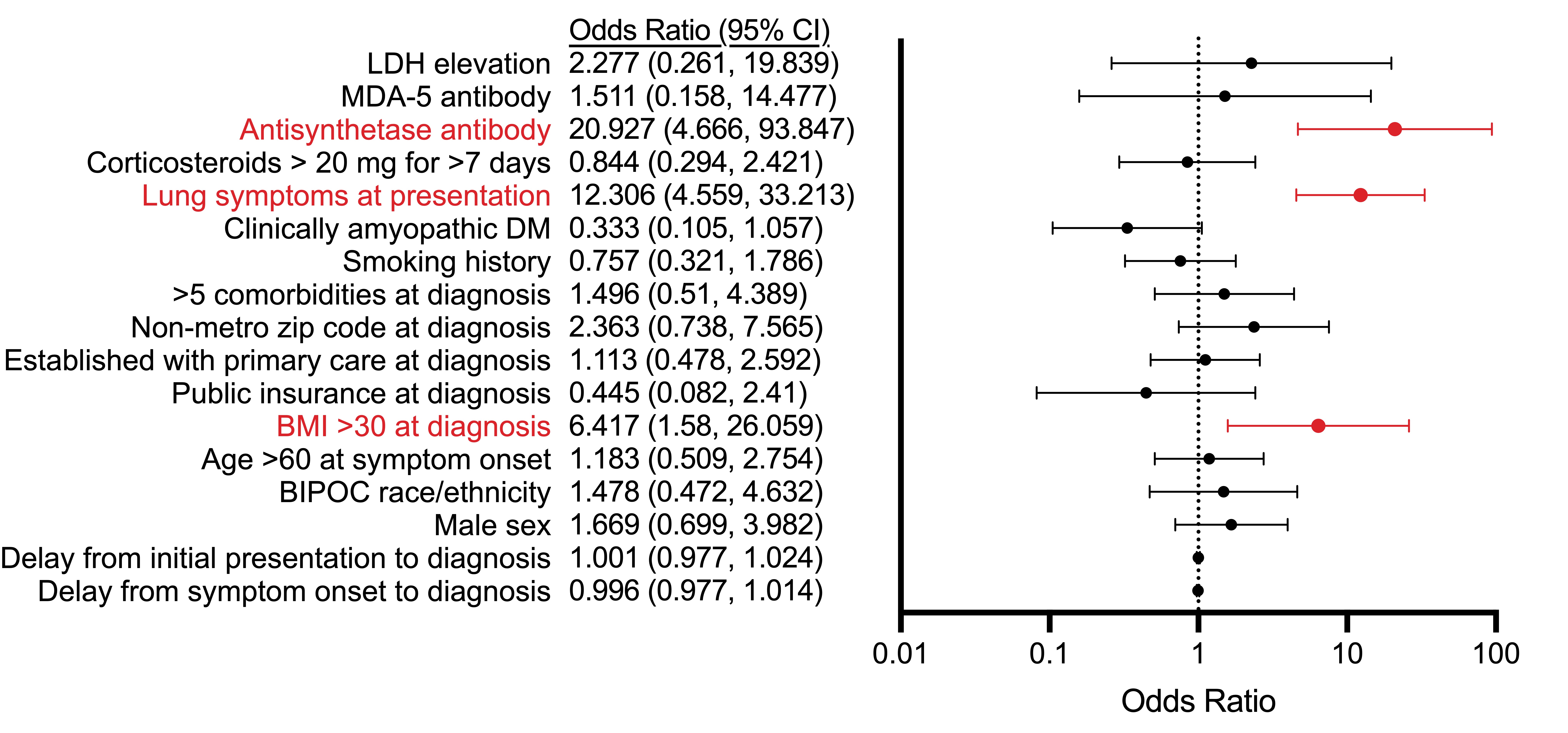
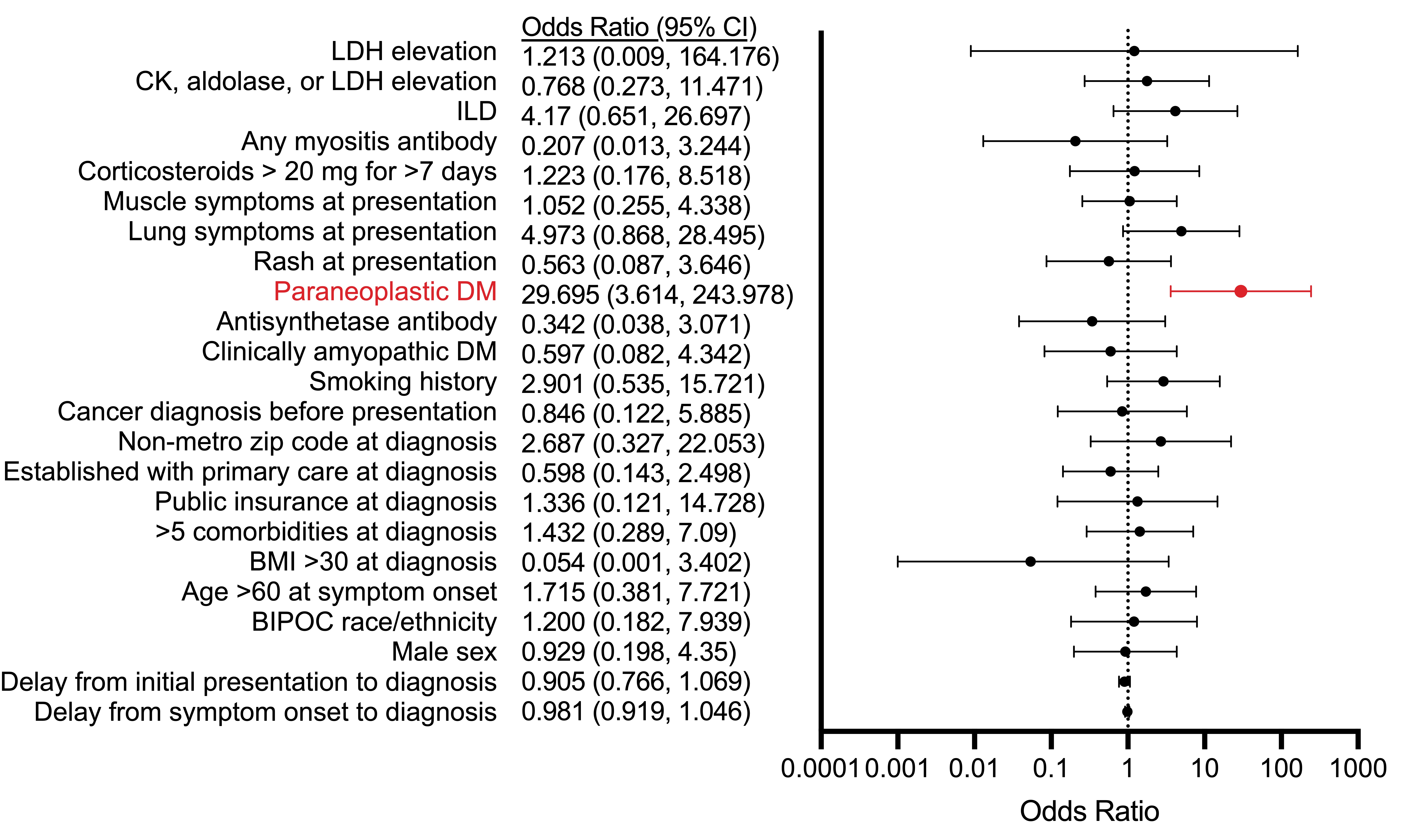
Results: 223 patients with DM were included. The DM-related mortality rate was 8.0% (17/195) and the ILD rate was 26.5% (59/223). Of DM-related deaths, the most common causes were malignancy (41.2%) and ILD (29.4%). Univariate analysis identified presence of antisynthetase antibody, lung symptoms at presentation, male sex, and non-white/BIPOC race as factors that increased odds of developing ILD. Multivariate analysis adjusting for these variables as well as BMI >30 at diagnosis and clinically amyopathic DM (CADM) subtype identified antisynthetase antibody, lung symptoms at presentation, and BMI >30 at presentation as being related to increased odds of ILD [Fig 1]. Univariate analysis identified lung symptoms at presentation, paraneoplastic DM, smoking history, and age > 60 at diagnosis as factors that increased odds of DM-related death. Multivariate analysis adjusting for these variables as well as presence of ILD identified only paraneoplastic DM as being related to increased odds of DM-related death [Fig 2].
Conclusion: While antisynthetase antibodies and respiratory symptoms are known ILD risk factors, our analysis is the first to identify elevated BMI as a risk factor for DM-related ILD, which warrants further investigation particularly as the world’s average BMI increases. Although other social and demographic variables appeared to be predictors of negative outcomes in univariate analyses, their impact disappeared in multivariate analyses, as did the effect of smoking history. Any effect of these variables may have been confounded or mediated by factors both disease-related, such as malignancy in the setting of a smoking history and advanced age, and unrelated to disease such as socioeconomic status, for which we had no data available. Lung symptoms at presentation approached significance as a predictor of DM-related death even when controlling for ILD, suggesting that lung symptoms should prompt close monitoring even absent an ILD diagnosis. Our study also affirms the importance of malignancy workup for new DM patients to predict and prevent DM-related death.
To cite this abstract in AMA style:
Buechler C, Wanberg L, Singhe N, Rasner C, McGrath J, Jiang Z, Baker-James K, Pearson D. Demographic, Social, and Disease Factors Associated with Interstitial Lung Disease and Disease-Related Death in Dermatomyositis [abstract]. Arthritis Rheumatol. 2024; 76 (suppl 9). https://acrabstracts.org/abstract/demographic-social-and-disease-factors-associated-with-interstitial-lung-disease-and-disease-related-death-in-dermatomyositis/. Accessed .« Back to ACR Convergence 2024
ACR Meeting Abstracts - https://acrabstracts.org/abstract/demographic-social-and-disease-factors-associated-with-interstitial-lung-disease-and-disease-related-death-in-dermatomyositis/