ACR Meeting Abstracts

ACR Meeting Abstracts

  • Meeting Abstracts
    • All Meetings
    • PRSYM 2026
    • ACR Convergence 2025
    • Download Abstract Supplements
  • Keyword Index
  • My Favorites
    • View & print my favorites
  • Search

Home » Meeting Abstracts » ACR Convergence 2024

Abstract Number: 0778

Comprehensive Immune Profiling of Anti-CD19 Chimeric Antigen Receptor T-Cell Therapy in Patients with Autoimmune Disease

Justin Chou1, Ricardo Grieshaber-Bouyer2, Michelle J Wu3, Christina Bergmann2, Jule Taubmann4, Fabian Müller5, Aline Bozec4, Tobias Rothe2, Andreas MAckensen6, Amber Podoll7, Jonathan Gutman7, Aiden Haghikia8, Dimitrios Mougiakakos9, Gary Tong3, Pouya Kheradpour3, Francis Kim10, Prameela Ramesan10, Brandon Kwong10, Kunbin Qu10, Bishwa Ganguly10, Dominic Borie10, James Chung10 and Georg Schett11, 1Kyverna Therapeutics, Emeryville, CA, 2Department of Medicine 3 - Rheumatology and Immunology, Friedrich-Alexander-Universität (FAU) Erlangen-Nürnberg and Uniklinikum Erlangen, Erlangen, Germany, 3Verily Life Sciences, South San Francisco, CA, 4Friedrich-Alexander Universität Erlangen-Nürnberg and Universitätsklinikum Erlangen, Erlangen, Germany, 5Department of Medicine 5 - Hematology and Oncology, Friedrich-Alexander-Universität Erlangen-Nürnberg (FAU) and Uniklinikum Erlangen, Erlangen, Germany, 6Department of Medicine 5 - Hematology and Oncology, Friedrich-Alexander-Universität Erlangen-Nürnberg (FAU) and Uniklinikum Erlangen, Erlangen, Bayern, Germany, 7University of Colorado Anschutz Medical Campus, Aurora, CO, 8Otto-von-Guericke University, Magdeburg, Germany, 9Otto-von-Guericke University, Magdeburg, Germany, Magdeburg, Germany, 10Kyverna Therapeutics, Inc., Emeryville, CA, 11Friedrich-Alexander-Universität Erlangen-Nürnberg, Erlangen, Germany

Share on X (Twitter) Share on Facebook Share on LinkedIn Share on Email
Print

Meeting: ACR Convergence 2024

Keywords: autoimmune diseases, B-Cell Targets, Gene Expression, Genomics and Proteomics, proteomics

Session Information

Date: Saturday, November 16, 2024

Title: Abstracts: B Cell Biology & Targets in Autoimmune & Inflammatory Disease I

Session Type: Abstract Session

Session Time: 1:00PM-2:30PM

Background/Purpose: Anti-CD19 chimeric antigen receptor (CAR) T-cell therapy represents a promising advancement in the treatment of autoimmune diseases, including systemic sclerosis (SSc), idiopathic inflammatory myopathy (IIM), lupus nephritis (LN), and myasthenia gravis (MG) (Müller F, et al. N Engl J Med. 2024; Podoll A, et al. Lupus Science & Medicine. 2024; Haghikia A, et al. Lancet Neurol. 2023). The deep B-cell depletion possible with anti-CD19 CAR T-cell therapy may provide sustained treatment-free remission for patients with autoimmune diseases; however, a thorough understanding of the immune modulating effects remains to be elucidated. The aim of this study was to profile the cellular and molecular changes to the immune cell populations of patients with autoimmune disease before and after anti-CD19 CAR T-cell therapy.

Methods: Peripheral blood mononuclear cells (PBMCs) were collected at baseline and during early B-cell reconstitution post-CAR T-cell therapy from 6 patients with autoimmune disease, including SSc (n=2), IIM (n=2), LN (n=1), and MG (n=1), and 5 untreated healthy donors (HDs). Post-CAR T-cell sample collection coincided with clinical improvements and normalization of disease-related biomarkers. Samples were analyzed via a multi-omics approach using Verily’s Immune ProfilerTM platform. Twenty-four different subsets encompassing myeloid, T, B, and NK cells were sorted from each sample using FACS with validated cell markers. Gene expression (RNA-seq), chromatin accessibility (assay for transposase-accessible chromatin sequencing [ATAC-seq]), protein expression (targeted protein estimation by sequencing [TaPE-seq]), and next-generation sequencing were assessed. Computational analysis was performed with quality control (QC) assessment.

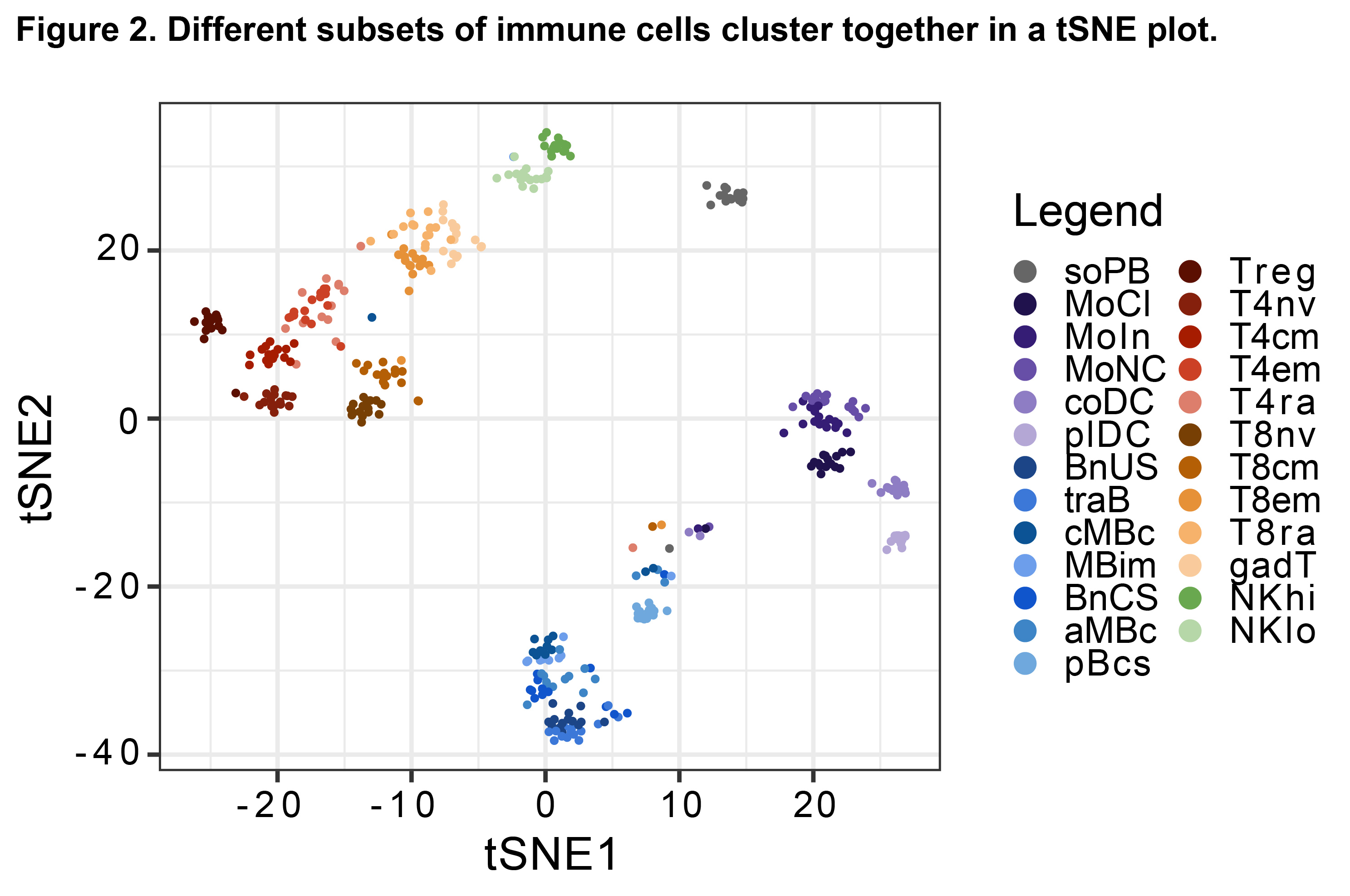
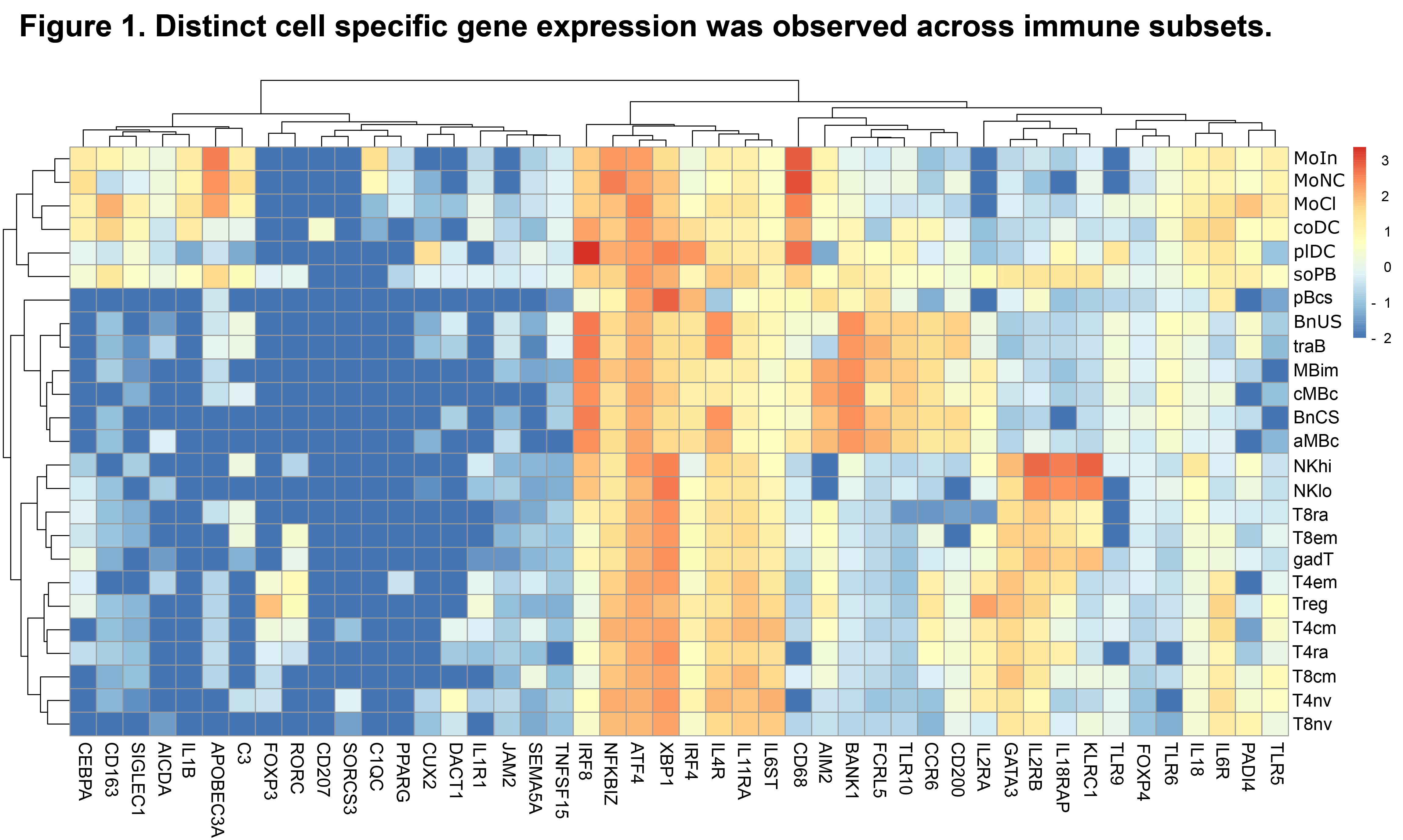
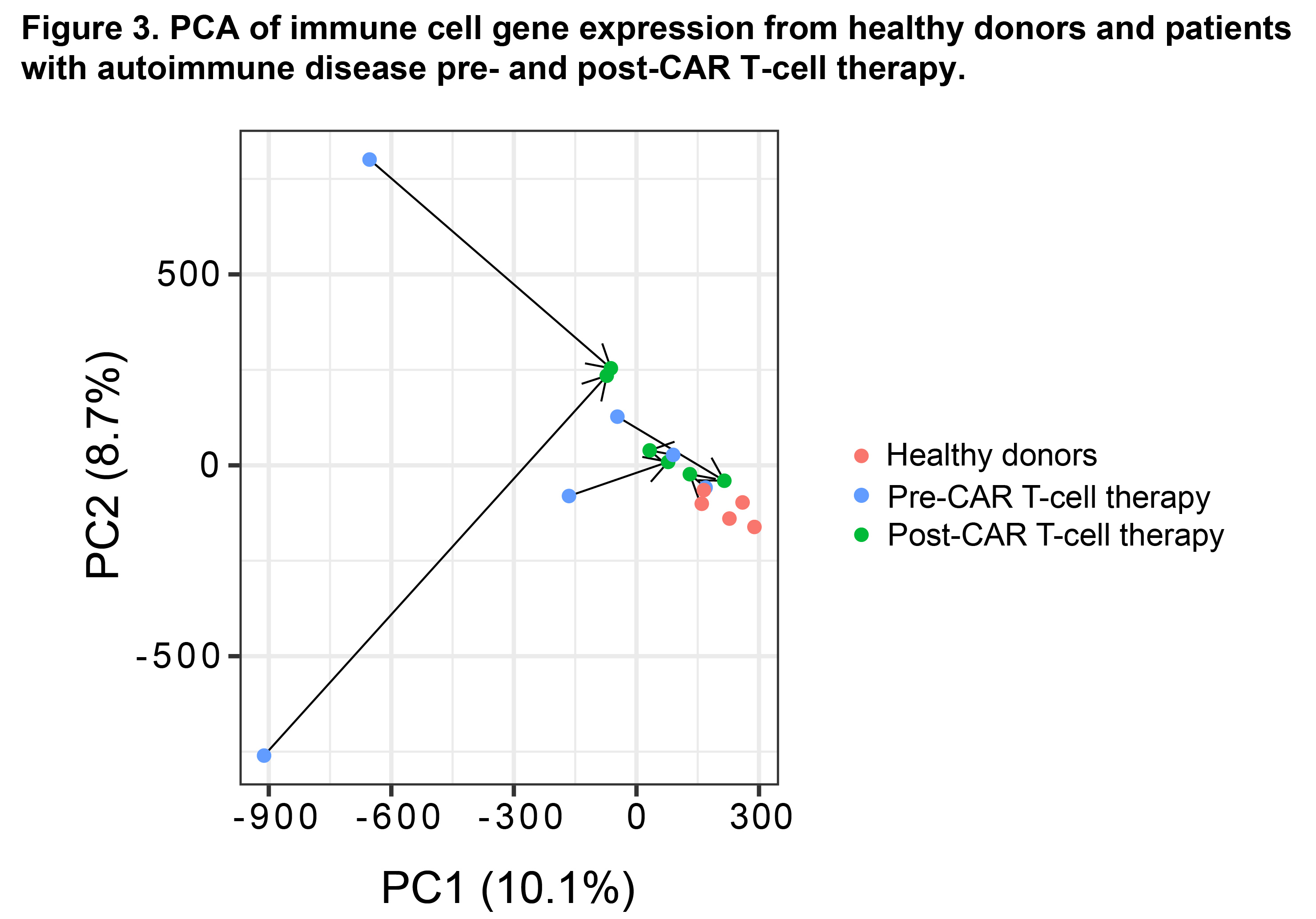
Results: A total of 1,114 sequencing datasets generated from immune cell subsets from patients and HDs met QC criteria. Immune cell type-specific gene sets were identified that aligned with published data (Fig. 1) (Ota M, et al. Cell. 2021). In addition, a t-distributed stochastic neighbor embedding plot identified distinct clusters representing each sorted immune cell subset (Fig. 2). In a pooled phenotypic analysis of all patient samples, the proportion of transitional B and CD56hi NK cells increased, and memory B and naive T cells decreased post-CAR T-cell therapy compared to baseline. A set of 6,424 differentially expressed genes, 161 differentially expressed proteins, and 53,321 differentially accessible chromatin regions (nominal p< 0.05) were observed across different immune cell subsets post-CAR T-cell therapy compared to baseline. Using principal component analysis of RNA-seq data, patients with autoimmune disease showed a trend toward convergence with HDs following CAR T-cell therapy (Fig. 3), suggestive of gene expression normalization.

Conclusion: This study demonstrates the feasibility of conducting comprehensive multi-omics analyses on PBMCs from patients with autoimmune disease pre- and post-CAR T-cell therapy. The observed molecular signatures in immune cell subsets represent promising avenues for future investigations into the mechanisms underlying the clinical effects of CAR T-cell therapy in autoimmune disease.
Supporting image 1

Heatmap of RNA-seq data showing unsupervised clustering of immune cell subpopulations and cell type-specific gene expression profiles. Specifically expressed genes included well-known lineage-specific transcription factors and cellular identity markers.
Abbreviations: seq, sequencing.

Supporting image 2

tSNE​ visualization of RNA-seq data shows​ clustering of immune cell subset types. Each dot represents one immune cell subset from one patient or healthy donor-derived sample. Note: outliers with dissimilar colors to their neighbors are from samples with low viability (<40%)​ or low cell recovery​.
Abbreviations: tSNE, t-distributed stochastic neighbor embedding; seq, sequencing.
Supporting image 3

Two-dimensional PCA of RNA-seq data from healthy donors (n=5) and patients with autoimmune disease (n=6). Each dot represents RNA-seq data across all cell subsets from one participant-timepoint, and arrows depict the magnitude and direction of change in PCA-space pre- to post-CAR T-cell therapy. PC1 covers 10.1% and PC2 covers 8.7% of the overall variability.
Abbreviations: CAR, chimeric antigen receptor; PCA, principal component analysis; seq, sequencing.


Disclosures: J. Chou: Kyverna Therapeutics, Inc., 3; R. Grieshaber-Bouyer: Bristol-Myers Squibb(BMS), 6, Kyverna Therapeutics, Inc., 5; M. Wu: Verily Life Sciences, an Alphabet subsidiary, 3, 8; C. Bergmann: Kyverna Therapeutics, Inc., 5; J. Taubmann: None; F. Müller: AstraZeneca, 2, 5, 6, BeiGene, 2, 6, Bristol-Myers Squibb(BMS), 2, 6, Janssen, 2, 6, Kite/Gilead, 1, 5, 6, 12, Travel, Miltenyi, 2, 6, Novartis, 2, 6, Sobi, 2, 6, Takeda, 2, 6; A. Bozec: None; T. Rothe: None; A. MAckensen: Bristol-Myers Squibb(BMS), 1, 2, 6, Celgene, 1, 2, 6, Century Therapeutics, 1, Gilead/Kite, 1, 2, 6, Ixaka, 1, Kyverna Therapeutics, Inc., 1, Miltenyi Biomedicine, 1, 2, 6, Novartis, 1, 2, 6; A. Podoll: Alexion, 5, Chinook, 5, Genentech, 5, Immune Tolerance Network, 5, Mallinckrodt, 5, Novartis, 5, Roche, 5, Sana, 5; J. Gutman: None; A. Haghikia: None; D. Mougiakakos: AbbVie/Abbott, 2, 6, Beigene, 2, 6, Bristol-Myers Squibb(BMS), 2, 6, Celgene, 2, 6, Galapagos, 2, 6, Gilead, 2, 6, Janssen, 2, 6, Miltenyi, 2, 6, Novartis, 2, 6; G. Tong: Verily Life Sciences, an Alphabet subsidiary, 3, 8; P. Kheradpour: Verily Life Sciences, an Alphabet subsidiary, 3, 8; F. Kim: Kyverna Therapeutics, Inc., 3; P. Ramesan: Kyverna Therapeutics, Inc., 3; B. Kwong: Kyverna Therapeutics, Inc., 3; K. Qu: Kyverna Therapeutics, Inc., 3; B. Ganguly: Kyverna Therapeutics, Inc., 3; D. Borie: Kyverna Therapeutics, Inc., 3; J. Chung: Kyverna Therapeutics, Inc., 3; G. Schett: Bristol-Myers Squibb(BMS), 6, Cabaletta, 6, Janssen, 6, Kyverna Therapeutics, 6, Novartis, 6.

To cite this abstract in AMA style:

Chou J, Grieshaber-Bouyer R, Wu M, Bergmann C, Taubmann J, Müller F, Bozec A, Rothe T, MAckensen A, Podoll A, Gutman J, Haghikia A, Mougiakakos D, Tong G, Kheradpour P, Kim F, Ramesan P, Kwong B, Qu K, Ganguly B, Borie D, Chung J, Schett G. Comprehensive Immune Profiling of Anti-CD19 Chimeric Antigen Receptor T-Cell Therapy in Patients with Autoimmune Disease [abstract]. Arthritis Rheumatol. 2024; 76 (suppl 9). https://acrabstracts.org/abstract/comprehensive-immune-profiling-of-anti-cd19-chimeric-antigen-receptor-t-cell-therapy-in-patients-with-autoimmune-disease/. Accessed .

ACR Meeting Abstracts - https://acrabstracts.org/abstract/comprehensive-immune-profiling-of-anti-cd19-chimeric-antigen-receptor-t-cell-therapy-in-patients-with-autoimmune-disease/

My Favorites

Save and print abstracts during your browser session by clicking the “Favorite” button at the bottom of any abstract (must have cookies enabled in browser). See saved favorites.

Abstract Policies

  • ACR Convergence Abstract Embargo Policies
  • ACR Convergence Abstract Permissions & Reprints
  • PRSYM Abstract Policies

ACR Convergence. Where Rheumatology Meets

ACR Convergence 2026

Join us November 6-11 in Orlando, Florida.
See Registration Information

  • Contact ACR
  • Privacy Policy
  • ACR Policies
  • Cookie Preferences

© Copyright 2026 American College of Rheumatology