ACR Meeting Abstracts

ACR Meeting Abstracts

  • Meeting Abstracts
    • All Meetings
    • PRSYM 2026
    • ACR Convergence 2025
    • Download Abstract Supplements
  • Keyword Index
  • Search
  • My Favorites
    • View and print all favorites
    • Clear all favorites

Abstract Number: 0620

Clinical Efficacy and Patient-Reported Outcomes in Anti-Ro/Sjögren’s Syndrome–Related Antigen a Antibody–Positive Patients with Active SLE Treated WithDeucravacitinib in the Phase 2 PAISLEY Trial

Benjamin A. Fisher1, Hendrika Bootsma2, Vibeke Strand3, Wan-Fai Ng4, Thomas Wegman5, Brandon Becker6, Jiyoon Choi6, Antoine Sreih6, Leo Chen7, Antonia Christodoulou6 and Eric Morand8, 1University of Birmingham, Birmingham, United Kingdom, 2Department of Rheumatology and Clinical Immunology, University of Groningen, University Medical Center Groningen, Groningen, Groningen, Netherlands, 3Division of Immunology/Rheumatology, Stanford University, Palo Alto, CA, 4Institute of Cellular Medicine, Newcastle University, Gateshead, United Kingdom, 5Bristol Myers Squibb, Beaver Falls, PA, 6Bristol Myers Squibb, Princeton, NJ, 7Bristol Myers Squibb, Richmond, BC, Canada, 8School of Clinical Sciences, Monash University, Melbourne, Victoria, Australia

Meeting: ACR Convergence 2024

Keywords: clinical trial, Outcome measures, Patient reported outcomes, Randomized Trial, Systemic lupus erythematosus (SLE)

  • Tweet
  • Email a link to a friend (Opens in new window) Email
  • Print (Opens in new window) Print
Session Information

Date: Saturday, November 16, 2024

Title: SLE – Diagnosis, Manifestations, & Outcomes Poster I

Session Type: Poster Session A

Session Time: 10:30AM-12:30PM

Background/Purpose: Deucravacitinib is a first-in-class, oral, selective, allosteric tyrosine kinase 2 (TYK2) inhibitor approved in multiple countries for the treatment of adults with moderate to severe plaque psoriasis and is under investigation in phase 3 trials in SLE, Sjögren’s disease (SjD), and PsA. In the 48-week, double-blind, phase 2 PAISLEY trial (NCT03252587) in patients with active SLE, the primary endpoint and all key secondary endpoints were met with the deucravacitinib 3-mg twice-daily (BID) dose. Patients with SLE, especially those with anti-Ro/Sjögren’s syndrome–related antigen A (SSA) antibodies, share pathophysiological, genetic, and clinical similarities to patients with SjD, including common inflammatory signatures. Here, we describe clinical efficacy and patient-reported outcomes (PROs), including pain and fatigue, in a subpopulation of patients from PAISLEY who were anti-Ro/SSA positive and evaluate if outcomes remained consistent with those in the overall PAISLEY population.

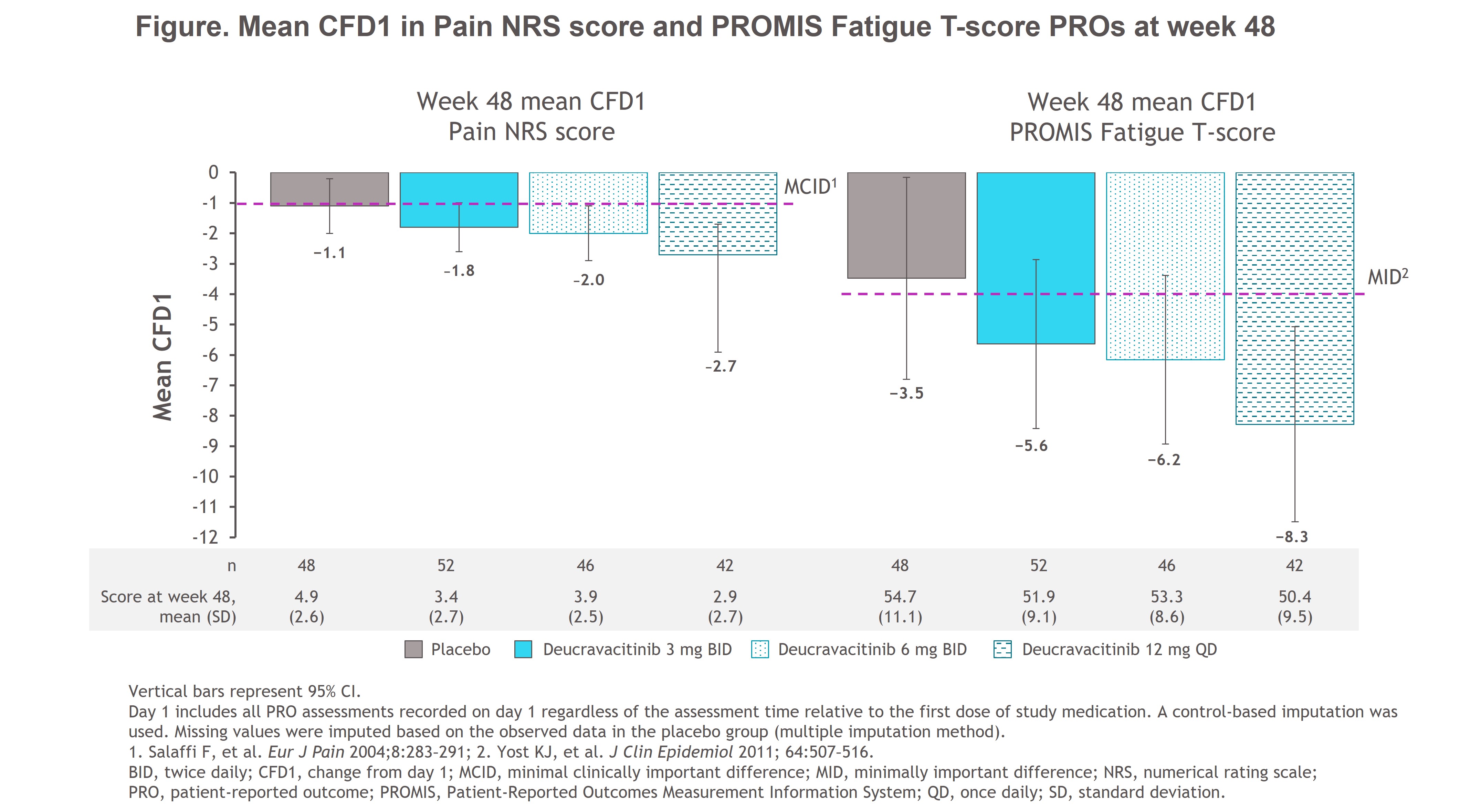
Methods: In PAISLEY, patients with active SLE received placebo (PBO; n = 90) or deucravacitinib 3 mg BID (n = 91), 6 mg BID (n = 93), or 12 mg once daily (QD; n = 89). Patients with a positive anti-Ro/SSA antibody test result at baseline were included in this post hoc analysis (PBO, n = 48; deucravacitinib 3 mg BID, n = 52; 6 mg BID, n = 46; 12 mg QD, n = 42). Clinical efficacy outcome response rates, including those for SLE Responder Index-4 (SRI[4]) and British Isles Lupus Assessment Group–based Composite Lupus Assessment (BICLA), were reported with a prespecified nonresponder imputation. Mean change from day 1 (CFD1) at week 48 in PROs, including the Pain numerical rating scale (NRS) scored from 0 to 10 and Patient-Reported Outcomes Measurement Information System (PROMIS) Fatigue 7a short form, was calculated using a control-based pattern imputation for missing data. Results were descriptive. 

Results: At week 48, patients with SLE who were anti-Ro/SSA positive and receiving deucravacitinib had increased response rates vs those receiving PBO for SRI(4) (3 mg BID, 65.4%; 6 mg BID, 43.5%; 12 mg QD, 54.8%; PBO, 33.3%) and BICLA (3 mg BID, 51.9%; 6 mg BID, 32.6%; 12 mg QD, 42.9%; PBO, 25.0%). Greater mean CFD1 in pain and fatigue PROs was reported in all patients receiving deucravacitinib vs PBO; more patients receiving deucravacitinib reported improvements greater than or equal to the minimal clinically important differences of −1 for Pain and −4 for Fatigue T-score (Figure). Patients receiving deucravacitinib had numerical improvements in mean Pain NRS score and Fatigue T-score at week 48 vs those receiving PBO (Figure).

Conclusion: In a subpopulation of patients from PAISLEY with active SLE who were anti-Ro/SSA positive, those receiving deucravacitinib had improvements in key clinical outcomes, pain, and fatigue vs those receiving PBO. Results were consistent with those in the overall PAISLEY population. These findings warrant investigation of deucravacitinib for the treatment of SjD based on the similarities between SjD and SLE.  
Supporting image 1


Disclosures: B. Fisher: Bristol Myers Squibb, 2, Galápagos, 2, 12, Research funding, Janssen, 2, 12, Research funding, Novartis, 2, Roche, 2, Sanofi, 2, Servier Laboratories, 2, 12, Research funding, UCB, 2; H. Bootsma: Argenx, 2, AstraZeneca, 2, 12, Funding, Bristol Myers Squibb, 2, 12, Funding, Galapagos, 2, Novartis, 2, 12, Funding, Roche, 2, 12, Funding, Sanofi, 2, UCB, 2; V. Strand: AbbVie, 1, 2, Alpine Immune Sciences, 1, 2, Alumis, 1, 2, Amgen, 1, 2, AstraZeneca, 1, 2, Bayer, 1, 2, Blackrock Pharmaceuticals, 1, 2, Boehringer Ingelheim, 1, 2, Bristol Myers Squibb, 1, 2, Celltrion, 1, 2, Citryll, 1, 2, Contura, 1, 2, Equillium, 1, 2, Fortress Biotech, 1, 2, Genentech/Roche, 1, 2, GSK, 1, 2, Inmedix, 1, 2, Janssen, 1, 2, Kiniksa, 1, 2, Lilly, 1, 2, Novartis, 1, 2, Omeros, 1, 2, Pfizer, 1, 2, Priovant Therapeutics, 1, 2, Rapt Therapeutics, 1, 2, Regeneron, 1, 2, R-Pharm, 1, 2, Samsung, 1, 2, Sandoz, 1, 2, Sanofi, 1, 2, Scipher, 1, 2, SetPoint Medical, 1, 2, Sobi, 1, 2, Spherix, 1, 2, SynAct Pharma, 1, 2, Takeda Pharmaceuticals, 1, 2; W. Ng: Argenx, 2, Bristol Myers Squibb, 2, Flagship, 2, IQVIA, 2, Janssen, 2, Novartis, 2, Resolve Therapeutics, 2, Sanofi, 2; T. Wegman: Bristol Myers Squibb, 3, 8; B. Becker: Bristol Myers Squibb, 3, 12, Shareholder; J. Choi: Bristol Myers Squibb, 3, 12, Shareholder, Johnson & Johnson, 12, Shareholder; A. Sreih: Bristol Myers Squibb, 3, 12, Shareholder; L. Chen: Syneos Health, 3, 12, Providing statistical services to Bristol Myers Squibb; A. Christodoulou: Bristol Myers Squibb, 3, 12, Shareholder; E. Morand: AbbVie, 5, Amgen, 5, AstraZeneca, 1, 2, 5, 6, Biogen, 2, 5, Bristol Myers Squibb, 2, 5, Dragonfly, 2, Eli Lilly, 5, EMD Serono, 2, 5, Genentech, 2, 5, Gilead, 2, GSK, 2, 5, Janssen, 5, Novartis, 2, 5, RemeGen, 2, Roche, 5, 6, Takeda, 2, 5, UCB, 5, Zenas, 2.

To cite this abstract in AMA style:

Fisher B, Bootsma H, Strand V, Ng W, Wegman T, Becker B, Choi J, Sreih A, Chen L, Christodoulou A, Morand E. Clinical Efficacy and Patient-Reported Outcomes in Anti-Ro/Sjögren’s Syndrome–Related Antigen a Antibody–Positive Patients with Active SLE Treated WithDeucravacitinib in the Phase 2 PAISLEY Trial [abstract]. Arthritis Rheumatol. 2024; 76 (suppl 9). https://acrabstracts.org/abstract/clinical-efficacy-and-patient-reported-outcomes-in-anti-ro-sjogrens-syndrome-related-antigen-a-antibody-positive-patients-with-active-sle-treated-withdeucravacitinib-in-the-ph/. Accessed .
  • Tweet
  • Email a link to a friend (Opens in new window) Email
  • Print (Opens in new window) Print

« Back to ACR Convergence 2024

ACR Meeting Abstracts - https://acrabstracts.org/abstract/clinical-efficacy-and-patient-reported-outcomes-in-anti-ro-sjogrens-syndrome-related-antigen-a-antibody-positive-patients-with-active-sle-treated-withdeucravacitinib-in-the-ph/

Advanced Search

My Favorites

Save and print abstracts during your browser session by clicking the “Favorite” button at the bottom of any abstract (must have cookies enabled in browser). See saved favorites.

Abstract Policies

  • ACR Convergence Abstract Embargo Policies
  • ACR Convergence Abstract Permissions & Reprints
  • PRSYM Abstract Policies

ACR Convergence. Where Rheumatology Meets

ACR Convergence 2026

Join us November 6-11 in Orlando, Florida.
See Registration Information

  • Contact ACR
  • Privacy Policy
  • ACR Policies
  • Cookie Preferences

© Copyright 2026 American College of Rheumatology