
Session Information
Date: Tuesday, November 15, 2016
Title: Spondylarthropathies Psoriatic Arthritis – Pathogenesis, Etiology I
Session Type: ACR Concurrent Abstract Session
Session Time: 2:30PM-4:00PM
Background/Purpose:
Psoriatic arthritis (PsA) is an inflammatory joint disease that affects over 650,000 Americans. Bone damage occurs in half of these patients within the first 2 years of disease, which impacts the quality of life and function. Dysregulation of osteoclasts (OC), the only cells known to erode bone, is responsible for bone damage in PsA. Our study is centered on DC-STAMP, a transmembrane signaling protein essential for OC development. DC-STAMP-/- osteoclast precursors (OCP) fail to fuse and develop into mature OC with bone erosion activity. Although DC-STAMP is preferentially expressed by monocytes, intriguingly, we identified a unique DC-STAMP+ T cell subset in a small cohort of PsA patients but not in healthy controls. Given that Th17 and FoxP3(+) Treg T cell subsets are known to promote or suppress OC differentiation, respectively, we hypothesize that DC-STAMP+ T cells are a specialized T cell subset in PsA with Th17- or Treg-like properties.
Methods:
We analyzed the frequencies of DC-STAMP+ populations by 12-color cell lineage-specific flow cytometry, and determined OCP frequency by TRAP-based OC enumeration on 102 psoriasis (Ps), 41 PsA patients and 25 healthy controls (HC). The Spearman correlation analysis was performed to test the correlation between the frequencies of OCP and DC-STAMP+ T cells. 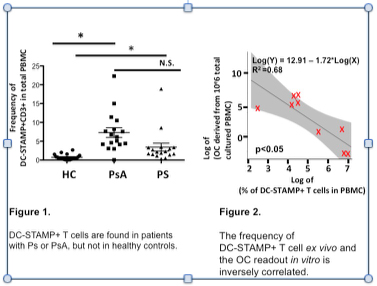
Results:
Data from 143 patients (102 Ps & 41 PsA) and 25 HC demonstrated that DC-STAMP is primarily expressed by CD14+ monocytes in HC, whereas its expression on T cells was only observed in 22% of the Ps & PsA patient cohorts (21/67, 6/44 and 5/32 respectively in 3 separate clinical studies). DC-STAMP+ T cells were significantly elevated in Ps and PsA patients than HC (Figure 1). Flow cytometry analysis revealed that DC-STAMP+ T cells were CD3+CD4+CD8-CCR4-CCR6+ T cells, and 68% of circulating DC-STAMP+CD3+ T cells had detectable intracellular IL-4 expression ex vivo. An inverse correlation between the frequency of DC-STAMP+CD3+ T cells (ex vivo) and OC frequency (in vitro) (the correlation between OC and 1/ (T cell frequency) was 0.73, p=0.04) was confirmed by Spearman analysis (Figure 2).
Conclusion:
The presence of DC-STAMP+ T cells in Ps or PsA patients but not in HC suggests that this T cell subset is induced to proliferate in the inflammatory conditions of psoriatic disease. An inverse correlation between the ex vivo frequency of DC-STAMP+CD3+ T cells and in vitro OC generation together with detectable intracellular IL-4 expression ex vivo suggest that DC-STAMP+ T cells suppress OCP differentiation in vitro and in vivo. Modulating T cell activities toward OC-promoting Th17-like or OC-suppressive Treg-like properties remains an attractive option for the treatment of psoriatic disease.
To cite this abstract in AMA style:
Chiu YG, Schwarz E, Bell R, Li D, Huertas N, Bell C, Moorehead S, Campbell D, Feng C, Ritchlin CT. Characterization of DC-STAMP+ T Cells, a CD3+CD4+ T Cell Subset Uniquely Present in Patients with Psoriatic Disease [abstract]. Arthritis Rheumatol. 2016; 68 (suppl 10). https://acrabstracts.org/abstract/characterization-of-dc-stamp-t-cells-a-cd3cd4-t-cell-subset-uniquely-present-in-patients-with-psoriatic-disease/. Accessed .« Back to 2016 ACR/ARHP Annual Meeting
ACR Meeting Abstracts - https://acrabstracts.org/abstract/characterization-of-dc-stamp-t-cells-a-cd3cd4-t-cell-subset-uniquely-present-in-patients-with-psoriatic-disease/