
Session Information
Session Type: Poster Session A
Session Time: 8:30AM-10:30AM
Background/Purpose: To assess if a combination of two questions (Functional Arthritis Screening with Two Questions – FAST index) can detect and roughly estimate the degree of disability in children with juvenile idiopathic arthritis (JIA) when compared to the 30-item Childhood Health Assessment Questionnaire Disability Index (CHAQ).
Methods: Children newly diagnosed with JIA enrolled in the Canadian Alliance of Pediatric Rheumatology Investigators (CAPRI) Registry from February 2017 to December 2018 formed a development cohort, while children diagnosed from January 2019 to February 2020 formed a validation cohort. At enrolment and at 1y parents completed the CHAQ. At every clinic visit they answered two questions: 1) Is it hard for your child to run and play because of arthritis? (HARD), 2) Does your child usually need help from you or another person because of arthritis? (HELP). Responses were scored on 21-point horizontal numerical rating scales from 0 to 10 at 0.5 intervals. We explored >20 different models for combining the two questions to estimate CHAQ scores, using cross-validation to measure performance in subjects not used in model development. Model performance was assessed by concordance with measured CHAQ scores (Kappa using quadratic weights or custom weights selected a priori), mean squared prediction error (MSPE), and the proportion of estimated scores within 0.125 units of the measured CHAQ (CLOSE). The selected model will be validated in the validation cohort.
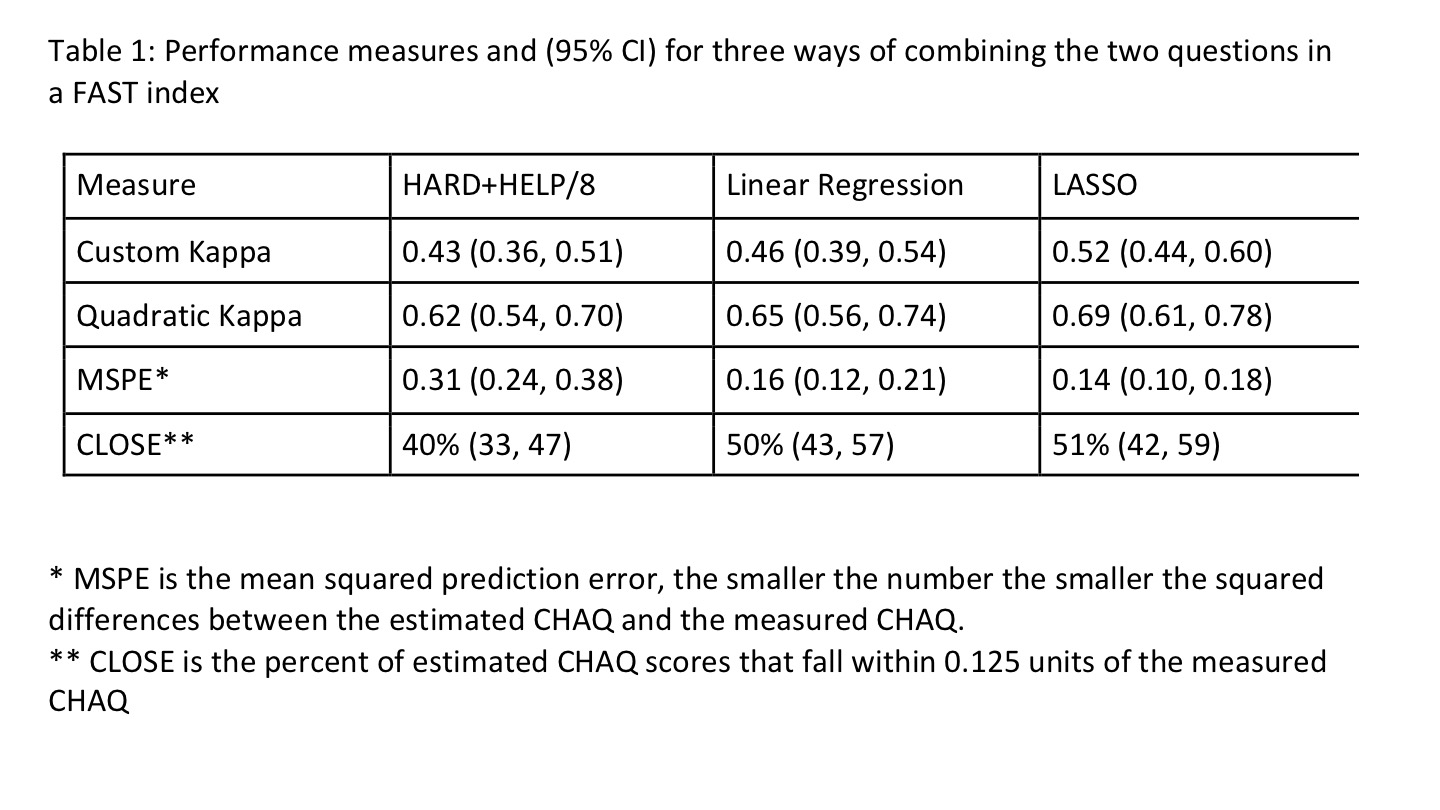
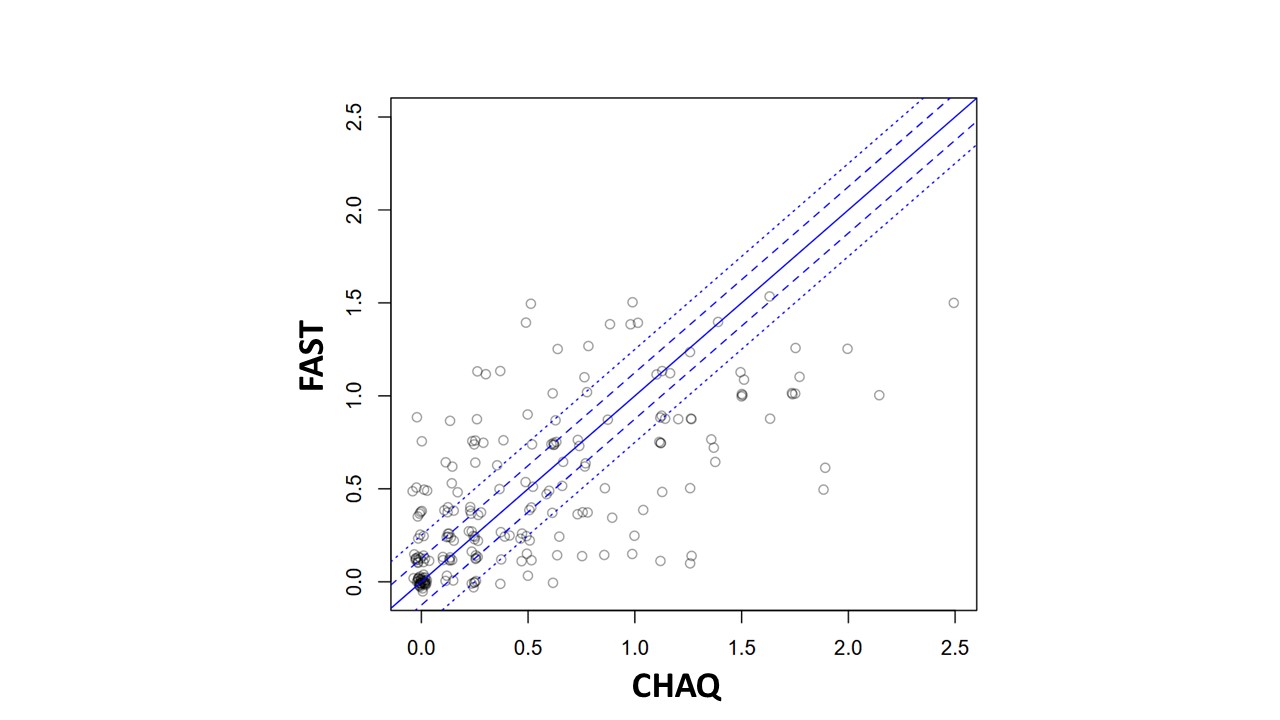
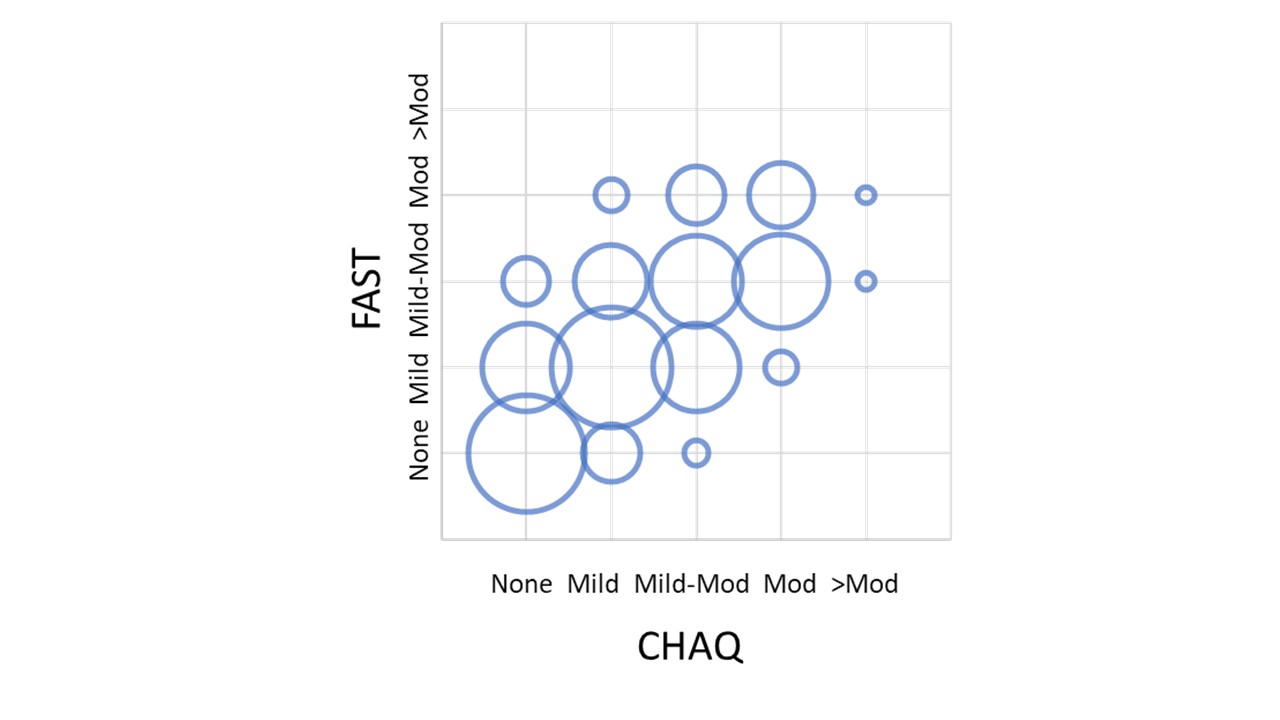
Results: The development cohort included 216 children at enrolment and 159 at 1y. Both questions correlated with the CHAQ at enrolment (Spearman correlation 0.65 for HARD and 0.64 for HELP) and their scores (0 to 10) were stable in patients deemed unchanged by their parents; mean change -0.16 (95%CI -0.5, 0.1) for HARD, -0.3 (-0.5, -0.03) for HELP. Relative to simply adding the two question scores and dividing by 8, a linear regression model including only HARD and HELP decreased the MSPE by half (Table 1). Using a Least Absolute Shrinkage and Selection Operator (LASSO) to add other patient characteristics led to further improvements. The best LASSO model combined HARD and HELP with age, JIA category, number of active joints and pain intensity to estimate CHAQ scores. We selected the FAST linear regression model for its balance of simplicity and performance. Figure 1 shows the concordance of this model with the measured CHAQ. Sensitivity to detect any disability (CHAQ >0) was 0.94 with a specificity of 0.56. FAST detected some disability in 27/61 (44%) of patients with a CHAQ of zero and often reported higher levels of disability than the CHAQ at lower CHAQ scores (Figure 2). Responsiveness (SRM, mean change from enrolment to 1y divided by the standard deviation) was 0.52 for FAST and 0.40 for CHAQ. Validation cohort analyses are underway.
Conclusion: This FAST index seems highly sensitive to detect disability in children with JIA and often detects unmeasured disability in patients with a CHAQ of zero. It had moderate concordance with levels of disability assessed by CHAQ, but greater sensitivity to change. It could be used as a quick and simple screen for disability at every clinic visit.
To cite this abstract in AMA style:
McPherson M, Houghton K, Surjanovic N, Loughin T, Berard R, Proulx-Gauthier J, Chedeville G, Rumsey D, Schmeling H, Luca N, Johnson N, Gerschman T, Miettunen P, Rozenblyum E, Tam H, Lim L, Morishita K, Scuccimarri R, Roth J, Duffy C, Tucker L, Feldman B, Guzman J. Can We Assess Disability in Juvenile Idiopathic Arthritis with Two Simple Questions? Results from the CAPRI Registry [abstract]. Arthritis Rheumatol. 2021; 73 (suppl 9). https://acrabstracts.org/abstract/can-we-assess-disability-in-juvenile-idiopathic-arthritis-with-two-simple-questions-results-from-the-capri-registry/. Accessed .« Back to ACR Convergence 2021
ACR Meeting Abstracts - https://acrabstracts.org/abstract/can-we-assess-disability-in-juvenile-idiopathic-arthritis-with-two-simple-questions-results-from-the-capri-registry/