ACR Meeting Abstracts

ACR Meeting Abstracts

  • Meeting Abstracts
    • All Meetings
    • PRSYM 2026
    • ACR Convergence 2025
    • Download Abstract Supplements
  • Keyword Index
  • My Favorites
    • View & print my favorites
  • Search

Home » Meeting Abstracts » ACR Convergence 2024

Abstract Number: 2625

Brain Injury Markers Correlate with Impaired Executive Function and Disease Activity in Children with Systemic Lupus Erythematosus

Oscar Mwizerwa1, Justine Ledochowski2, Tala El Tal3, Ganesh Ramanathan2, Sarah Mossad4, Ibrahim Mohamed5, Joanna Law6, Lawrence Ng2, Paris Moaf2, Asha Jeyanathan1, Adrienne Davis7, Ann Yeh2, Linda Hiraki2, Deborah Levy2, Zahi Touma8, Joan Wither9, Busi Zapparoli10, Ashley Danguecan11 and Andrea Knight12, 1The Hospital for Sick Children, Division of Rheumatology, Department of Paediatrics, University of Toronto, The Hospital for Sick Children, Neurosciences and Mental Health, Research Institute, Toronto, ON, Canada, 2The Hospital for Sick Children, Toronto, ON, Canada, 3The Hospital For Sick Children & Children's Hospital of Eastern Ontario (CHEO), Ottawa, ON, The Hospital for Sick Children, Division of Rheumatology, Department of Paediatrics, University of Toronto, Toronto, ON, Canada, 4Hospital for Sick Children, Toronto, ON, Canada, 5The Hospital for Sick Children, Brampton, ON, Canada, 6The Hospital for Sick Children, Division of Rheumatology, Department of Paediatrics, University of Toronto, Toronto, ON, Canada, 7Division of Pediatric Emergency Medicine, Department of Pediatrics, Hospital for Sick Children and University of Toronto, Toronto, ON, Canada, 8University of Toronto, Toronto, ON, Canada, 9University Health Network, Toronto, ON, Canada, 10The Hospital for Sick Children, Etobicoke, ON, Canada, 11The Hospital for Sick Children, Department of Psychology, University of Toronto, Toronto, ON, Canada, 12Division of Rheumatology, The Hospital for Sick Children; Neurosciences and Mental Health, SickKids Research Institute; Department of Paediatrics, University of Toronto, Toronto, ON, Canada

Share on X (Twitter) Share on Facebook Share on LinkedIn Share on Email
Print

Meeting: ACR Convergence 2024

Keywords: Cognitive dysfunction, Pediatric rheumatology, Systemic lupus erythematosus (SLE)

Session Information

Date: Monday, November 18, 2024

Title: Abstracts: Pediatric Rheumatology – Clinical II

Session Type: Abstract Session

Session Time: 3:00PM-4:30PM

Background/Purpose: Patients with childhood-onset systemic lupus erythematosus (cSLE) commonly experience impaired executive function (EF), and attribution to neuropsychiatric lupus (NPSLE) is challenging. Serum markers of brain injury may be potential biomarkers for EF impairment due to SLE. We investigated the relationship between serum brain injury markers, EF and disease characteristics in cSLE. 

Methods: We utilized prospectively-collected cross-sectional data from children with SLE (ages 12-17 years) recruited from the Lupus Clinic at a Canadian tertiary children’s hospital from January 2020–December 2023 and age-, sex-matched healthy controls. Serum brain injury marker levels for serum neurofilament light chain (sNFL), glial fibrillary acidic protein (GFAP), and Tau were quantified using the Simoa Human Neurology 4–Plex B assay (Quanterix, Billerca, MA, USA). EF was assessed using the Delis Kaplan Executive Function System (DKEFS) Color Word Interference test (CWIT) which measures the ability to inhibit an automatic response and switch between competing demands. A scaled score is generated for each of 4 tasks on the DKEFS CWIT. We defined impairment as a DKEFS score < = 1 SD below the mean (scaled score=7). Disease variables included disease activity (SLEDAI-2K), damage (SLICC damage index, SDI >0) and glucocorticoid (GC) exposure (prednisone-equivalent). We used non-parametric tests to compare brain injury marker levels and low EF status between the cSLE and control groups; and to examine correlations between the markers and i) DKEFS scores and ii) cSLE disease characteristics.

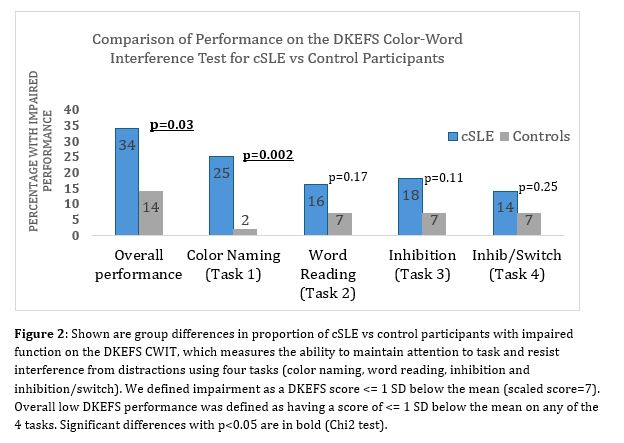
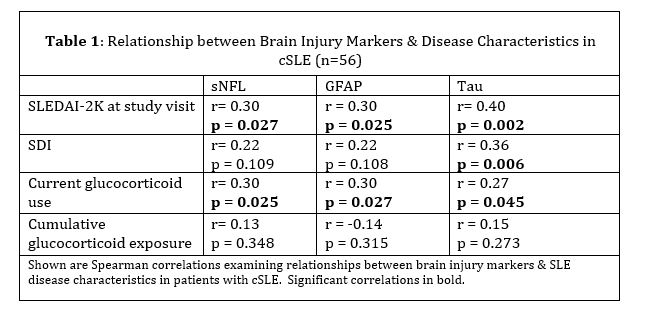
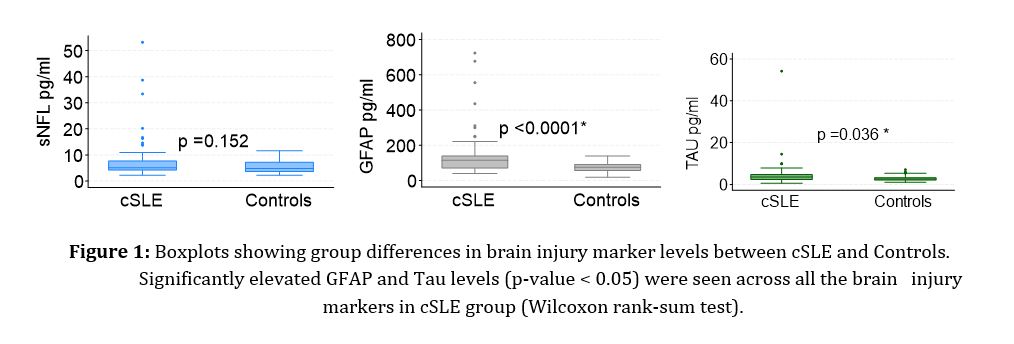
Results: Participants included 56 children with cSLE (mean age=15.1 years ± SD 1.8, 86% female) and 43 healthy controls (mean age=15.1 years ± 1.7, 81% female). For cSLE, the median disease duration was 22.6 months (IQR, 12.5-43.9), median SLEDAI-2K was 2.5 (IQR, 2-5.5), 13% had disease damage, and median cumulative GC dose (grams) was 1.85 (IQR, 0.6-6.9). One patient had a NPSLE diagnosis. There was a statistically significant difference between GFAP and Tau serum levels in cSLE vs controls (Figure 1). A higher proportion of children with cSLE vs controls (34% vs 14%, p=0.027) had low overall DKEFS performance, particularly for the color naming task (25% vs 2%, p=0.002 (Figure 2). In the cSLE group, worse DKEFS inhibition scores correlated with higher sNFL (r=-0.33, p=0.014) and Tau (r=- 0.26, p=0.057). In the cSLE group, higher levels of all three brain injury markers were significantly correlated with disease activity and current GC dose, and Tau showed a significant association with disease damage (Table 1).

Conclusion: Our study showed higher levels of brain injury markers and worse performance on the DKEFS in children with cSLE compared to controls. Brain injury markers correlated with impaired EF on the DKEFS inhibition task, as well as worse disease markers in the cSLE group. Further analyses will investigate the relationship between inflammation, brain injury and cognitive function in cSLE over time.  
Supporting image 1

Figure 1: Boxplots showing group differences in brain injury marker levels between cSLE and Controls.

Supporting image 2

Figure 2: Comparison of Performance on the DKEFS Color-Word Interference Test for cSLE vs Control Participants

Supporting image 3

Relationship between Brain Injury Markers & Disease Characteristics in cSLE (n=56)


Disclosures: O. Mwizerwa: None; J. Ledochowski: None; T. El Tal: None; G. Ramanathan: None; S. Mossad: None; I. Mohamed: None; J. Law: None; L. Ng: None; P. Moaf: None; A. Jeyanathan: None; A. Davis: None; A. Yeh: Alexion, 12, site PI clinical trial, Biogen, 5, horizon, 12, site PI clinical trial, Roche, 12, clinical trial site PI; L. Hiraki: Janssen, 2; D. Levy: AbbVie, 5, AstraZeneca, 5, Roche, 5, SOBI, 5; Z. Touma: None; J. Wither: AstraZeneca, 6, Pfizer, 12, Indirect salary support through a Chair award to the Division of Rheumatology at the University of Toronto; B. Zapparoli: None; A. Danguecan: None; A. Knight: Pfizer, 6.

To cite this abstract in AMA style:

Mwizerwa O, Ledochowski J, El Tal T, Ramanathan G, Mossad S, Mohamed I, Law J, Ng L, Moaf P, Jeyanathan A, Davis A, Yeh A, Hiraki L, Levy D, Touma Z, Wither J, Zapparoli B, Danguecan A, Knight A. Brain Injury Markers Correlate with Impaired Executive Function and Disease Activity in Children with Systemic Lupus Erythematosus [abstract]. Arthritis Rheumatol. 2024; 76 (suppl 9). https://acrabstracts.org/abstract/brain-injury-markers-correlate-with-impaired-executive-function-and-disease-activity-in-children-with-systemic-lupus-erythematosus/. Accessed .

ACR Meeting Abstracts - https://acrabstracts.org/abstract/brain-injury-markers-correlate-with-impaired-executive-function-and-disease-activity-in-children-with-systemic-lupus-erythematosus/

My Favorites

Save and print abstracts during your browser session by clicking the “Favorite” button at the bottom of any abstract (must have cookies enabled in browser). See saved favorites.

Abstract Policies

  • ACR Convergence Abstract Embargo Policies
  • ACR Convergence Abstract Permissions & Reprints
  • PRSYM Abstract Policies

ACR Convergence. Where Rheumatology Meets

ACR Convergence 2026

Join us November 6-11 in Orlando, Florida.
See Registration Information

  • Contact ACR
  • Privacy Policy
  • ACR Policies
  • Cookie Preferences

© Copyright 2026 American College of Rheumatology