ACR Meeting Abstracts

ACR Meeting Abstracts

  • Meeting Abstracts
    • All Meetings
    • PRSYM 2026
    • ACR Convergence 2025
    • Download Abstract Supplements
  • Keyword Index
  • Search
  • My Favorites
    • View and print all favorites
    • Clear all favorites

Abstract Number: 9

Biologically-Based Approach for Classifying Chronic Childhood Arthritis

Elham Rezaei1, Daniel Hogan2, Brett Trost2, Anthony Kusalik2, Susanne Benseler3, Gilles Boire4, David A. Cabral5, Bonnie Cameron6, Sarah Campillo7, Gaëlle Chédeville8, Paul Dancey9, Ciarán M. Duffy10, Karen N Watanabe Duffy11, Janet Ellsworth12, Simon Eng13, Brian M. Feldman14, John Gordon2, Jaime Guzman15, Kristin Houghton16, Adam Huber17, Quaid Morris13, Bianca Lang18, Deborah M. Levy19, Loren Matheson20, Kiem Oen21, Ross Petty22, Suzanne Ramsey23, Johannes Roth24, Dax Rumsey25, Claire Saint-Cyr26, Rayfel Schneider27, Rosie Scuccimarri28, Earl Silverman19, Lynn R. Spiegel29, Elizabeth Stringer18, Shirley M.L. Tse30, Lori Tucker31, Rae S.M. Yeung32 and Alan Rosenberg1, 1Pediatrics, University of Saskatchewan, Saskatoon, SK, Canada, 2University of Saskatchewan, Saskatoon, SK, Canada, 3Pediatric Rheumatology, University of Calgary, Alberta Children's Hospital, Calgary, AB, Canada, 4Rheumatology Division, CHUS - Sherbrooke University, Sherbrooke, QC, Canada, 5Pediatrics/Rm K4-121, BC Children's Hospital, Vancouver, BC, Canada, 6The Hospital for Sick Children, Toronto, ON, Canada, 7Montreal Children's Hospital, Montreal, QC, Canada, 8Rheumatology, McGill University, Montreal, QC, Canada, 9Pediatrics, Janeway Children's Hospital, St. John's, NL, Canada, 10Children's Hospital of Eastern Ontario and University of Ottawa, Ottawa, ON, Canada, 11Rheumatology, Children's Hospital of Eastern Ontario and University of Ottawa, Ottawa, ON, Canada, 12University of Alberta, Edmonton, AB, Canada, 13University of Toronto, Toronto, ON, Canada, 14Rheumatology, The Hospital for Sick Children, Toronto, ON, Canada, 15Rheumatology, BC Children's Hospital, Vancouver, BC, Canada, 16Rheumatology/Pediatrics, British Columbia Childrens Hos, Vancouver, BC, Canada, 17IWK Health Centre, Halifax, NS, Canada, 18Dalhousie University, Halifax, NS, Canada, 19Division of Rheumatology, The Hospital for Sick Children, Toronto, ON, Canada, 20University of Saskatchewan, Ottawa, ON, Canada, 21University of Manitoba, Winnipeg, MB, Canada, 22Pediatric Rheumatology, Division of Rheumatology, BC Children's Hospital, Vancouver, BC, Canada, 23Pediatric Rheumatology, IWK Health Centre, Halifax, NS, Canada, 24Pediatric Rheumatology, Children's Hospital Eastern On, Ottawa, ON, Canada, 25Stollery Children's Hospital, Edmonton, AB, Canada, 26Pediatrics, CHU Sainte-Justine, Montreal, QC, Canada, 27Division of Rheumatology, Hospital for Sick Children, Toronto, ON, Canada, 28Division of Pediatric Rheumatology, Montreal Children's Hospital/McGill University Health Centre, Montreal, QC, Canada, 29Rheumatology/Pediatrics, The Hospital for Sick Children, Toronto, ON, Canada, 30Rheumatology, The Hospital for Sick Children and University of Toronto, Toronto, ON, Canada, 31Pediatric Rheum/Rm K4-120, BC Childrens Hospital, Vancouver, BC, Canada, 32Paediatrics, Immunology and Medical Science, The Hospital for Sick Children, University of Toronto, Toronto, ON, Canada

Meeting: Pediatric Rheumatology Symposium 2017

Keywords: Biomarkers, cytokines, Data analysis, juvenile idiopathic arthritis (JIA) and pediatric rheumatology

  • Tweet
  • Email a link to a friend (Opens in new window) Email
  • Print (Opens in new window) Print
Session Information

Date: Saturday, May 20, 2017

Title: Plenary Abstract Session 3

Session Type: Abstract Submissions

Session Time: 2:30PM-3:00PM

Background/Purpose: Juvenile Idiopathic Arthritis (JIA) comprises a heterogeneous group of conditions that share chronic arthritis as a common characteristic. International uniformity in classifying JIA, based predominantly on clinical characteristics at onset, has helped propel collaborative efforts to improve understanding of subset-specific pathophysiology, treatment responses, and outcomes. The purpose of this study was to consider the added value of combining biomarker-based attributes with clinical characteristics to classify chronic childhood arthritis in a biologically-based context.
Methods: Data were derived from a prospective, nation-wide, longitudinal cohort study titled Biologically-Based Outcome Predictors in JIA (The BBOP Study). Newly diagnosed, treatment naïve children with JIA were evaluated at baseline and after six months. Data included clinical manifestations and plasma inflammation-related biomarkers. Categorical (nonlinear) principal component analysis (CAT-PCA), factor analysis of mixed data (FAMD), and probabilistic principal component analysis (PPCA) were used for dimensionality reduction purposes. To identify groups in the data, K-medoids clustering and Gaussian mixture modeling (GMM) were applied. Four common metrics were used to validate the clustering configurations: Davies–Bouldin, Dunn2, average silhouette width, and Calinski and Harabasz indices. The results were compared with the JIA subgroups defined by International League of Associations for Rheumatology criteria.

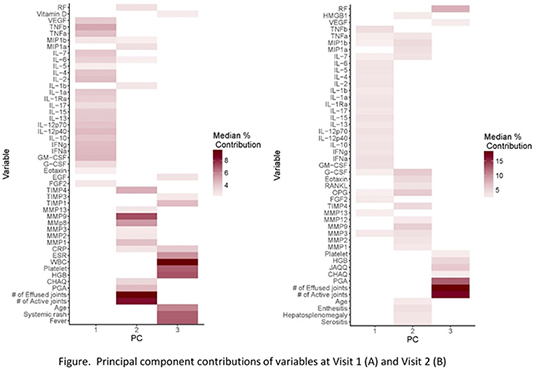
Results: A total of 150 JIA patients were enrolled. Data consisted of 191 variables. PCA reduced variables into 3 clinically relevant principal components (PCs) (Figure). Using PCs, three clusters were identified at baseline by both methods. At six months, three clusters were identified by K-medoids, and GMM recognized five clusters; new clusters were also revealed at six months (Figure). PCs recovered 33% and 47% of variance in the patient profiles in visit 1 and 2, respectively. Clustering validation indices showed that PPCA-GMM is the most reliable clustering method. At first presentation, clusters revealed in this analysis exposed different and more homogenous subgroups compared to the seven JIA ILAR subgroups. A large subset of patients with oligoarthritis and rheumatoid factor negative polyarthritis grouped into one cluster.

Conclusion: Using data-driven, unsupervised machine learning algorithms these analyses recognized distinctive patterns that provide insight into the underlying biology of chronic childhood arthritis and enable categorization of disease based on a combination of clinical and biomarker profiling.    


Disclosure: E. Rezaei, None; D. Hogan, None; B. Trost, None; A. Kusalik, None; S. Benseler, None; G. Boire, None; D. A. Cabral, None; B. Cameron, None; S. Campillo, None; G. Chédeville, None; P. Dancey, None; C. M. Duffy, None; K. N. Watanabe Duffy, None; J. Ellsworth, None; S. Eng, None; B. M. Feldman, None; J. Gordon, None; J. Guzman, None; K. Houghton, None; A. Huber, None; Q. Morris, None; B. Lang, None; D. M. Levy, None; L. Matheson, None; K. Oen, None; R. Petty, None; S. Ramsey, None; J. Roth, None; D. Rumsey, None; C. Saint-Cyr, None; R. Schneider, None; R. Scuccimarri, None; E. Silverman, None; L. R. Spiegel, None; E. Stringer, None; S. M. L. Tse, None; L. Tucker, None; R. S. M. Yeung, None; A. Rosenberg, None.

To cite this abstract in AMA style:

Rezaei E, Hogan D, Trost B, Kusalik A, Benseler S, Boire G, Cabral DA, Cameron B, Campillo S, Chédeville G, Dancey P, Duffy CM, Watanabe Duffy KN, Ellsworth J, Eng S, Feldman BM, Gordon J, Guzman J, Houghton K, Huber A, Morris Q, Lang B, Levy DM, Matheson L, Oen K, Petty R, Ramsey S, Roth J, Rumsey D, Saint-Cyr C, Schneider R, Scuccimarri R, Silverman E, Spiegel LR, Stringer E, Tse SML, Tucker L, Yeung RSM, Rosenberg A. Biologically-Based Approach for Classifying Chronic Childhood Arthritis [abstract]. Arthritis Rheumatol. 2017; 69 (suppl 4). https://acrabstracts.org/abstract/biologically-based-approach-for-classifying-chronic-childhood-arthritis/. Accessed .
  • Tweet
  • Email a link to a friend (Opens in new window) Email
  • Print (Opens in new window) Print

« Back to Pediatric Rheumatology Symposium 2017

ACR Meeting Abstracts - https://acrabstracts.org/abstract/biologically-based-approach-for-classifying-chronic-childhood-arthritis/

Advanced Search

My Favorites

Save and print abstracts during your browser session by clicking the “Favorite” button at the bottom of any abstract (must have cookies enabled in browser). See saved favorites.

Abstract Policies

  • ACR Convergence Abstract Embargo Policies
  • ACR Convergence Abstract Permissions & Reprints
  • PRSYM Abstract Policies

ACR Convergence. Where Rheumatology Meets

ACR Convergence 2026

Join us November 6-11 in Orlando, Florida.
See Registration Information

  • Contact ACR
  • Privacy Policy
  • ACR Policies
  • Cookie Preferences

© Copyright 2026 American College of Rheumatology