
Session Information
Date: Tuesday, November 14, 2023
Title: (2257–2325) SLE – Diagnosis, Manifestations, & Outcomes Poster III
Session Type: Poster Session C
Session Time: 9:00AM-11:00AM
Background/Purpose: Cognitive dysfunction (CD) is a common and often deleterious manifestation of systemic lupus erythematosus (SLE). CD is usually operationalized on the American College of Rheumatology Neuropsychological Battery (ACR-NB) as any z-score of ≤-1.5 on ≥2 domains or z ≤-2 in ≥1 domain; this approach necessarily omits information regarding affected cognitive domains. Using each individual ACR-NB z-scores, the aim of this study was to assess in further detail the association of azathioprine (AZA) and mycophenolate (MMF) use with performance in specific cognitive domains given that these medications have demonstrated overall neuroprotective qualities in prior studies.
Methods: Consecutive, adult SLE patients presenting to a single tertiary care center were considered for participation, providing demographic, clinical and psychiatric data, at multiple visits (0, 6, 12 months). Bayesian longitudinal item response theory (IRT) modelling using the cumulative dose of AZA and MMF, demographic and clinical variables as fixed effects and tests/domains and time/participant as random effects were undertaken to assess ACR-NB z-scores over time. Model One was fitted with an easiness parameter that was estimated for each domain and for each test nested within each domain (higher values represent a higher mean z-scores which represents better cognition). Model Two used the same structure as Model One but added a random slope for the cumulative dose of AZA to vary amongst domain and tests. Finally, leave-one-out cross-validation (loo-cv) was used to determine the best statistical model for our data.
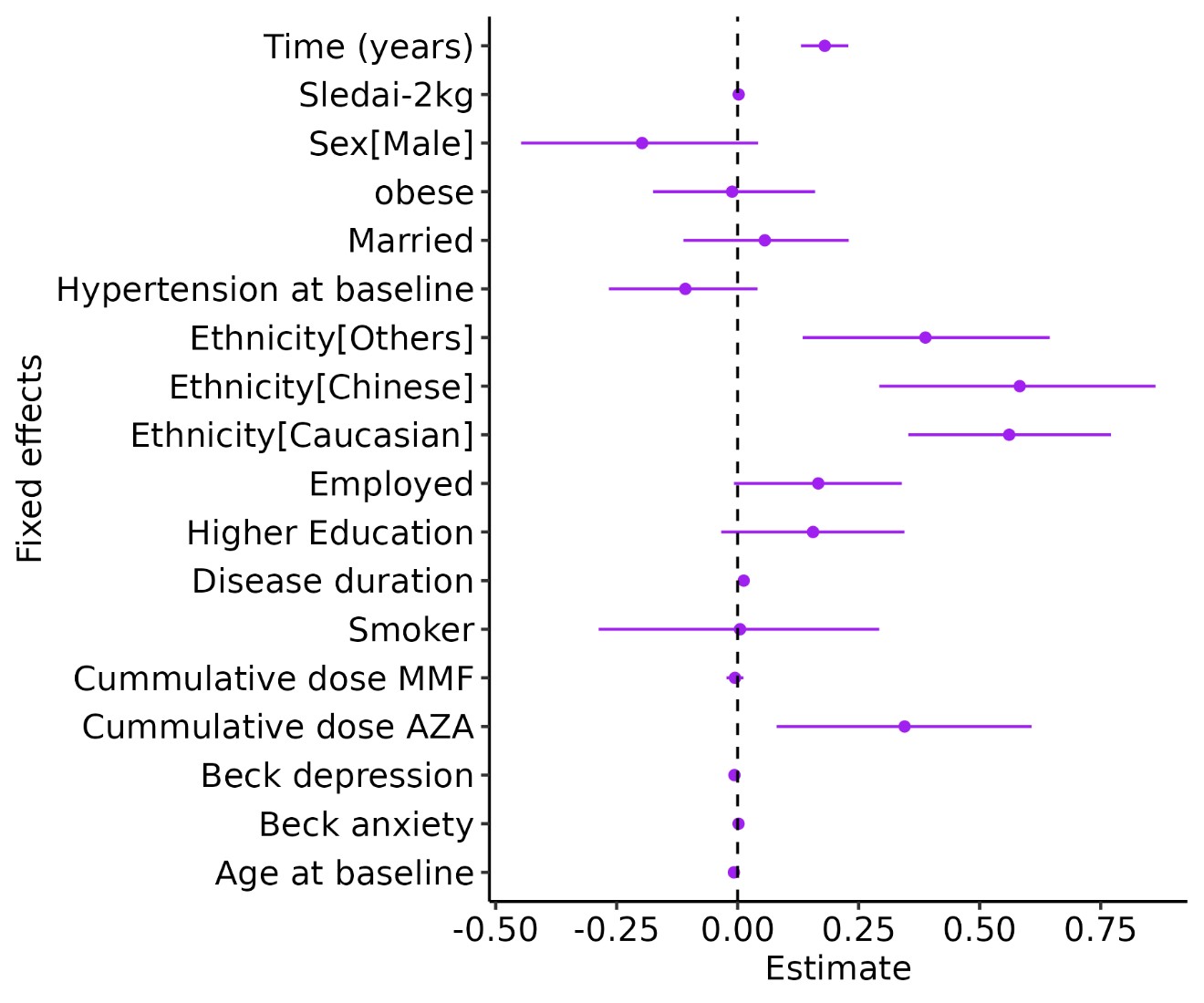
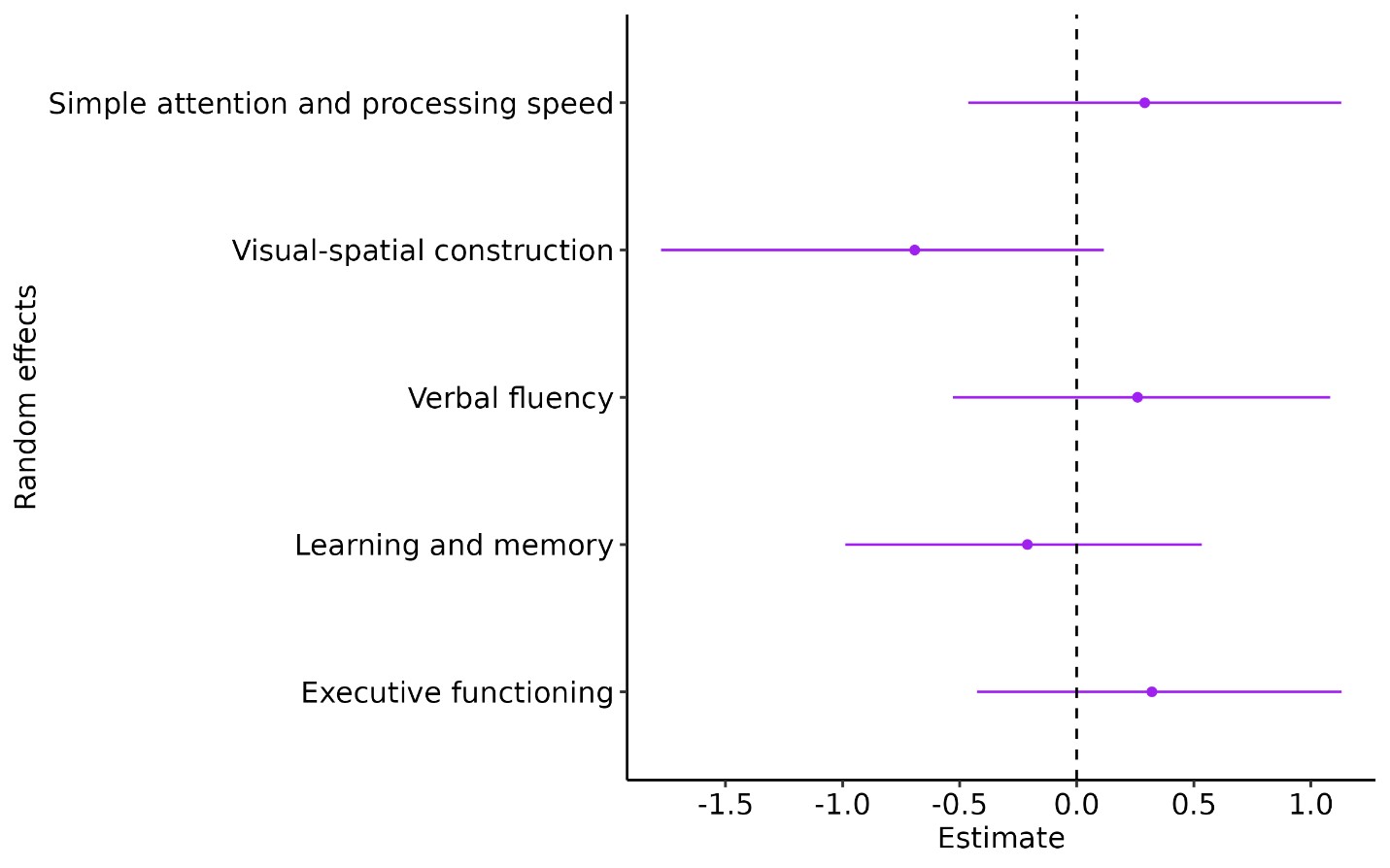
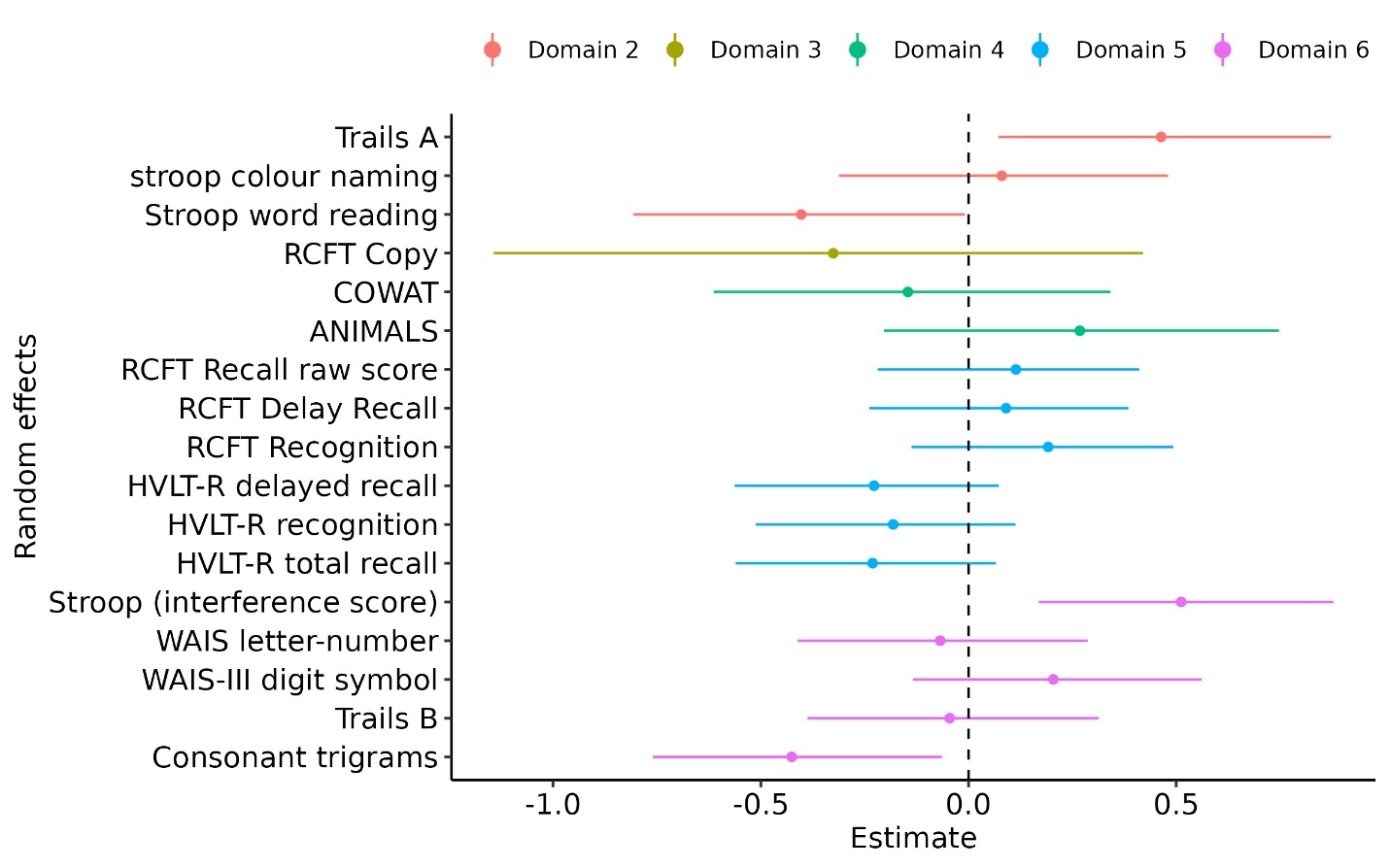
Results: Three hundred participants representing 676 patient visits completed the study. The mean overall z-score with all covariates set to zero (ie. intercept) was -0.84 (95% CrI -1.73, 0.04). Cumulative AZA dose (decigrams/kg) was associated with a z-score increase of 0.34 (95% CrI -0.08, 0.61) on average (Figure 1). Time was also associated with a z-score increase, meaning that on average, z-scores improved as time passed. MMF use was not associated with a protective effect against CD (Figure 1). The easiness parameters for visual-spatial construction domain had the lowest estimate (Figure 2). On average, this domain decreased the z-score by -0.69 (95% CrI -1.77, 0.11). Of note, we found that simple attention and processing speed had a null effect on the mean z-score (Figure 2) but when examining each test within this domain we found that Trails A had a positive effect while STROOP word reading decreased the mean z-score (Figure 3). Loo-cv showed Model One (without adding cumulative AZA dose as a random slope) to be the best fit for our data.
Conclusion: This analysis demonstrated that cognition may improve over time in patients with SLE. It also highlighted which cognitive domains and tests on the ACR-NB are more likely to be affected. Similar to our prior study, increasing cumulative AZA dose was associated with a protective effect against CD, while MMF use was not. This is the first longitudinal IRT model that examines trajectories of individual ACR-NB z-scores and relationship with immunosuppressant use. Additional studies are warranted to further investigate visual-spatial function in SLE, as well as the relationship of AZA and SLE-CD.
To cite this abstract in AMA style:
Dobrowolski C, Diaz Martinez J, Barraclough M, Kretzmann R, Marzouk S, Bingham K, Ruttan L, Beaton D, Wither J, Tartaglia C, Katz P, Kakvan M, Anderson N, Bonilla D, Touma Z. Association of Mycophenolate and Azathioprine Use with Cognitive Function in Systemic Lupus Using a Bayesian Longitudinal Item-response Theory Model [abstract]. Arthritis Rheumatol. 2023; 75 (suppl 9). https://acrabstracts.org/abstract/association-of-mycophenolate-and-azathioprine-use-with-cognitive-function-in-systemic-lupus-using-a-bayesian-longitudinal-item-response-theory-model/. Accessed .« Back to ACR Convergence 2023
ACR Meeting Abstracts - https://acrabstracts.org/abstract/association-of-mycophenolate-and-azathioprine-use-with-cognitive-function-in-systemic-lupus-using-a-bayesian-longitudinal-item-response-theory-model/