
Session Information
Date: Monday, November 18, 2024
Title: Patient Outcomes, Preferences, & Attitudes Poster III
Session Type: Poster Session C
Session Time: 10:30AM-12:30PM
Background/Purpose: ActiGraph is a gold standard for MVPA assessment with several counts per minute (CPM) validated thresholds proposed to measure MVPA. Historically, these thresholds have been derived in the general population. Older persons exert more energy performing similar tasks compared to younger persons and may require an age specific MVPA threshold. Triaxial accelerometry can measure sources of MVPA other than walking. We sought to evaluate the variability of MVPA defined by various thresholds and to determine the association among walking-based and CPM-defined MVPA.
Methods: We analyzed data from persons undergoing eligibility assessment for the 5-center Knee Arthroplasty Activity Trial, which recruits patients scheduled to undergo total knee arthroplasty. We asked individuals to wear an ActiGraph GT3X on their hip for 7 days. We included data from persons who wore an ActiGraph for 4+ days with 10+ hours/day. We considered several validated CPM thresholds and one step-based threshold, defining MVPA as tasks performed at >3 Metabolic Equivalent of Tasks (METs). Thresholds included both triaxial vector-magnitude-based (VM) for the general (Freedson, 2690 CPM) and older (Barnett, 1924 CPM) populations, and vertical axis-based (VA) MVPA for the general (Troiano, 2020 CPM) and older (Barnett, 1013 CPM) populations. We established individualized step-based MVPA thresholds for each participant using their measured step length and used a validated threshold of 2.5 km/h as the velocity consistent with exerting energy at 3 METs in older people. We calculated weekly MVPA for each threshold and examined linear correlations across different thresholds. We used multivariable linear regressions adjusting for age, sex, step length, and BMI to examine the association between step-based MVPA and VM CPM MVPA. We estimated levels of adherence to CDC PA guidelines (>150 min of MVPA) for each threshold.
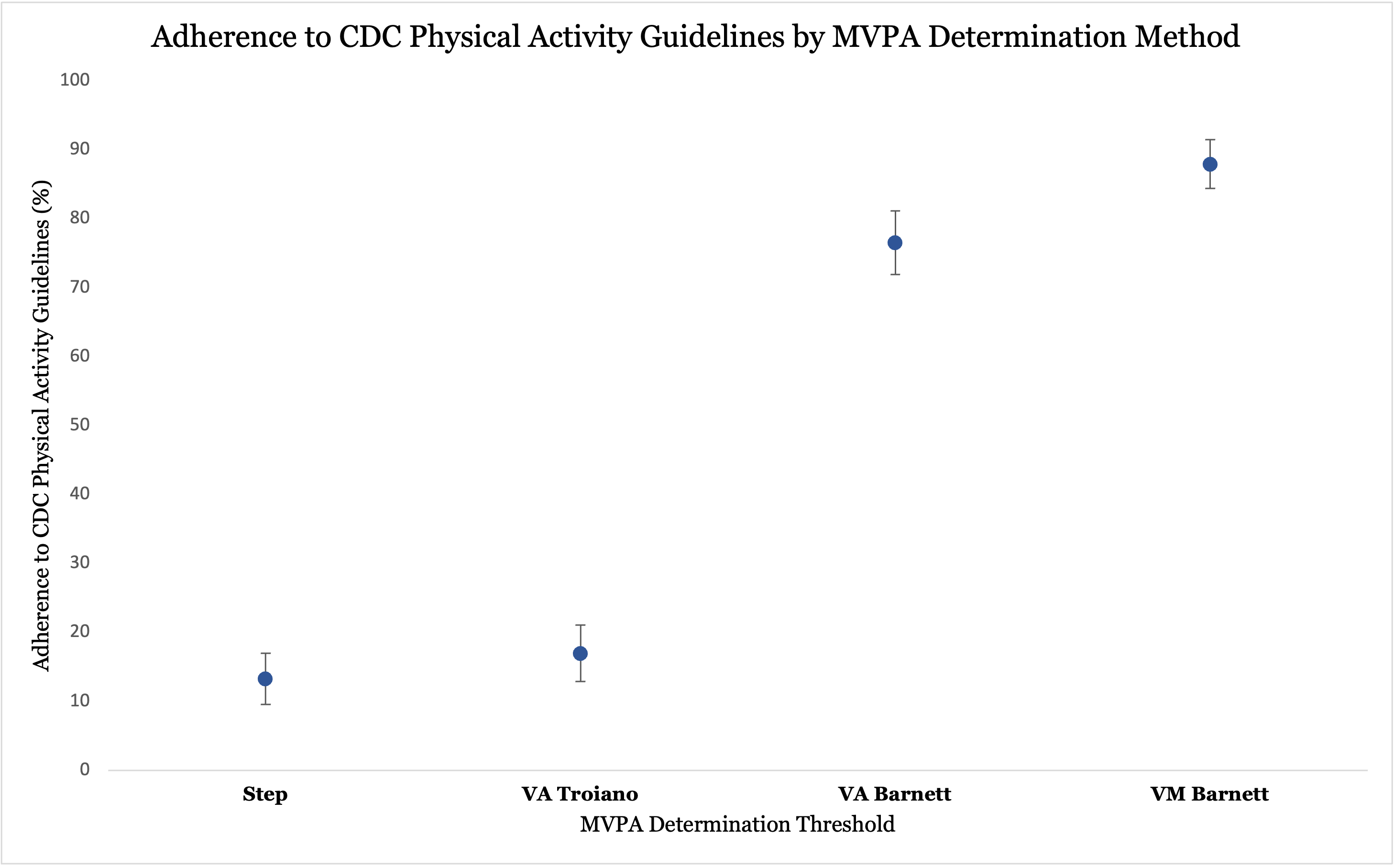
Results: Among 324 individuals, mean age was 65.9 years (SD 7.9), 61.4% were females, mean BMI was 31.0 kg/m2 (6.1), and average daily step count was 4738 (2372). Minutes per week of MVPA varied depending on the threshold used, with lowest amount from the step-based method – mean 63.2 (91.9) to the highest using VM for older persons – 459.0 (278.4). The Pearson correlation among MVPA defined by alternative thresholds ranged from 0.55 (Barnett, VA and step-based) to 0.94 (Barnett and Freedson, VM). The figure describes adherence to CDC PA guidelines using alternative thresholds. We found that every 30 min increase in VM CPM MVPA for older persons was associated with an increase in step-based MVPA of 4.7 min, and for every increase of 1000 steps/day, step-based MVPA increased by 26 min. Among persons with < 30 min of step-based MVPA (~50% of the sample), VM CPM MVPA averaged at 138 (135) min (Freedson) and 338 (231) min (Barnett).
Conclusion: Time spent in MVPA is highly sensitive to the MVPA threshold used. Walking-based MVPA represents only a small proportion of MVPA defined by CPM. In persons scheduled for TKA, most ambulation appears to occur at energy expenditures lower than 3 METs. For studies or interventions focused on increased walking/ambulation, investigators may consider using step-based thresholds.
To cite this abstract in AMA style:
Chin S, Collins J, Katz J, Dunlop D, Mitchell L, Chang R, James K, Pellegrini C, Kim J, Fox K, Holleman A, Losina E. An MVPA Is MVPA Is MVPA, or Is It? Impact of the Definition of Moderate to Vigorous Physical Activity (MVPA) on Its Amount in Persons with Advanced Knee Osteoarthritis [abstract]. Arthritis Rheumatol. 2024; 76 (suppl 9). https://acrabstracts.org/abstract/an-mvpa-is-mvpa-is-mvpa-or-is-it-impact-of-the-definition-of-moderate-to-vigorous-physical-activity-mvpa-on-its-amount-in-persons-with-advanced-knee-osteoarthritis/. Accessed .ACR Meeting Abstracts - https://acrabstracts.org/abstract/an-mvpa-is-mvpa-is-mvpa-or-is-it-impact-of-the-definition-of-moderate-to-vigorous-physical-activity-mvpa-on-its-amount-in-persons-with-advanced-knee-osteoarthritis/