
Session Information
Session Type: Poster Session C
Session Time: 10:30AM-12:30PM
Background/Purpose: Serum autoantibodies, such as ACPA and RF, are commonly detectable prior to the development of seropositive clinical RA; however, not all individuals with these autoantibodies progress to RA. Understanding the genetic factors influencing progression to RA may enhance risk prediction. The HLA-DRB1 shared epitope (SE) is the strongest genetic risk factor for RA. While RA polygenic risk scores (PRS) have been developed to distinguish RA cases from individuals without RA, it is not known whether an RA PRS can distinguish between those who will and will not progress to RA in an ACPA positive population. We applied a PRS that had been generated from non-HLA genetic risk variants identified in a genome-wide association study of seropositive clinical RA (Ishigaki 2022) to a prospective cohort to determine if an RA PRS was associated with progression from ACPA positivity to clinical RA.
Methods: Targeting Immune Responses for Prevention of Rheumatoid Arthritis (TIPRA) is a prospective cohort of 77 ACPA positive individuals (based on serum CCP3 IgG) without inflammatory arthritis (IA) at enrollment, who were followed for a mean of 1.8 years for progression to clinical RA defined as onset of a swollen joint consistent with IA. Individuals were genotyped using the Illumina MEGA chip, and additional variants were imputed using TOPMed to apply the PRS. Multivariable Cox proportional hazard models were used to test factors in ACPA positive individuals associated with progression to RA. We included an interaction term to determine if the PRS is modified by SE. Receiver Operating Characteristic (ROC) analyses were employed to explore the PRS’s discriminative ability through the comparison of the area under the curve (AUC) between models with and without the PRS, using the DeLong statistic.
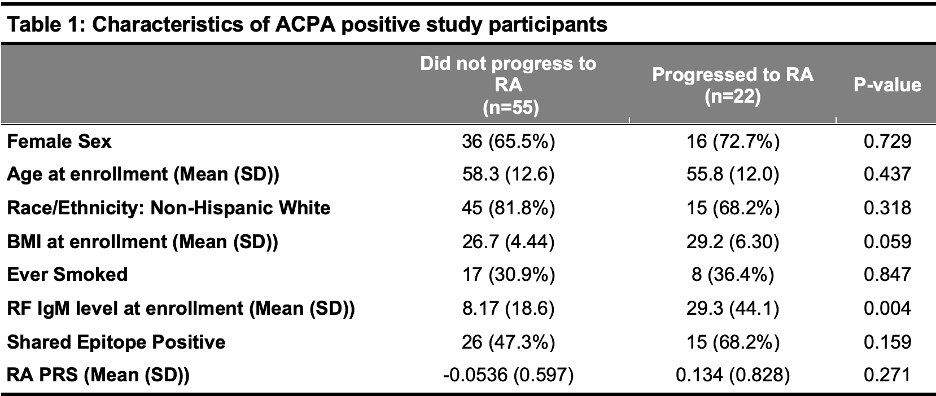
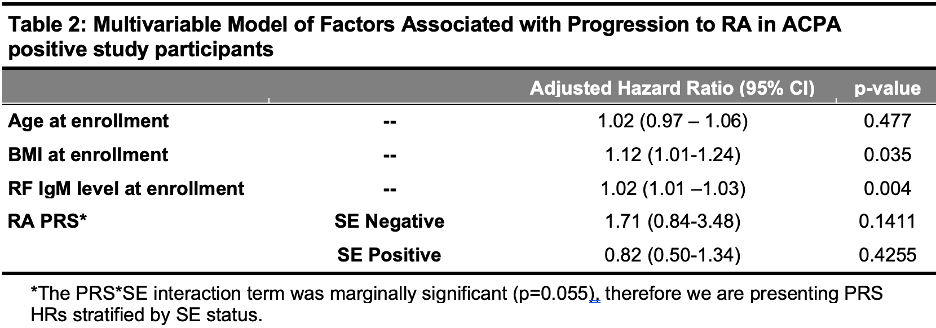
Results: Characteristics of those who progressed to clinical RA (n=22) and those who did not RA (n=55) are in Table 1. Adjusting for age, higher RF IgM (p=0.004) and higher BMI (p=0.035) were associated with a greater hazard of progressing to RA (Table 2). SE may modify the association between the PRS and RA (interaction p-value = 0.055), where a higher PRS was associated with increased hazard of progression to RA in SE negative individuals, and a slightly decreased hazard of progression to RA in SE positive individuals, although these were not statistically significant.
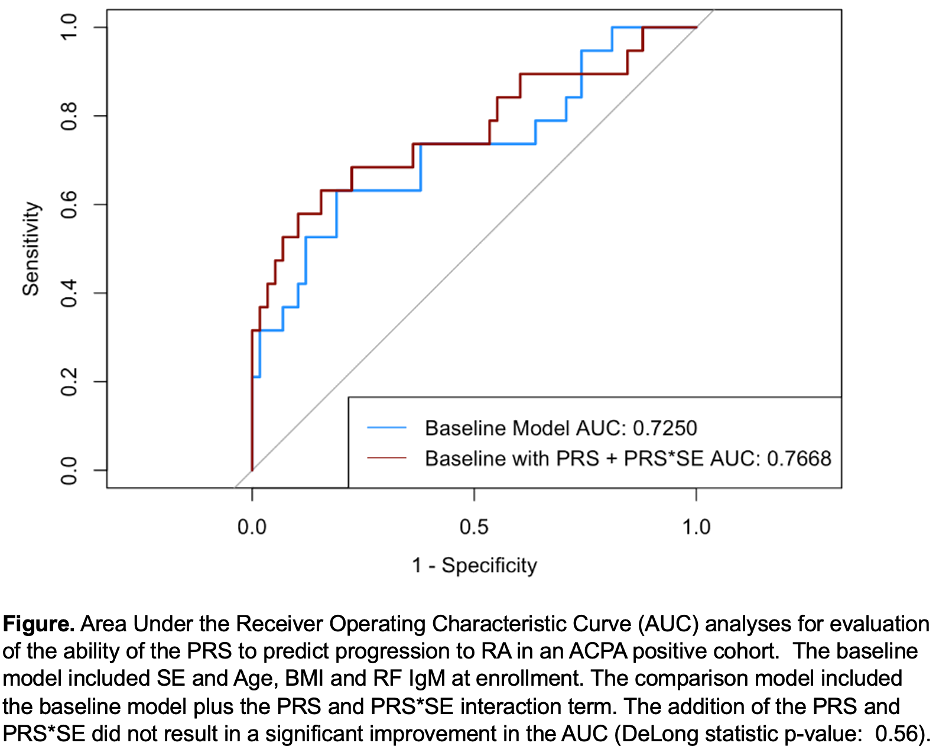
The PRS alone did not predict progression to RA (AUC: 0.5989). Moreover, the PRS did not significantly improve prediction of RA progression when added to a baseline model of age, RF IgM, BMI and SE (Figure).
Conclusion: An RA PRS generated from a study of patients with seropositive clinical RA does not improve the prediction of progressing to RA in an ACPA positive population over more traditional factors such as RF IgM level, BMI and SE. The observation that the PRS may be more strongly associated with progression from ACPA positivity to RA in SE negative individuals may suggest different genetic pathways and should be confirmed. This also suggests that the PRS, or its individual components, could primarily affect other stages of RA natural history. We are currently investigating this RA PRS in two additional ACPA positive prospective cohorts.
To cite this abstract in AMA style:
Vargas T, Vanderlinden L, Carry P, Demoruelle K, Feser M, Kechris K, Buckner J, Robinson W, Firestein G, Holers M, Deane K, Norris J. A Seropositive RA Polygenic Risk Score Does Not Predict Progression to RA in an ACPA Positive Population [abstract]. Arthritis Rheumatol. 2024; 76 (suppl 9). https://acrabstracts.org/abstract/a-seropositive-ra-polygenic-risk-score-does-not-predict-progression-to-ra-in-an-acpa-positive-population/. Accessed .« Back to ACR Convergence 2024
ACR Meeting Abstracts - https://acrabstracts.org/abstract/a-seropositive-ra-polygenic-risk-score-does-not-predict-progression-to-ra-in-an-acpa-positive-population/