
Session Information
Date: Monday, November 18, 2024
Title: Osteoporosis & Metabolic Bone Disease – Basic & Clinical Science Poster
Session Type: Poster Session C
Session Time: 10:30AM-12:30PM
Background/Purpose: Osteoporosis increases morbidity and mortality of vulnerable individuals and adds to healthcare costs. The United States Preventive Services Task Force (USPSTF) recommends universal screening of women ≥ 65 years by dual-energy X-ray absorptiometry (DEXA) scan. The national osteoporosis screening rate is 12% – 56%, but it is lower in resident-led primary care clinics. Our project aimed to improve the osteoporosis screening rate by DEXA scan among eligible patients in resident clinics at a safety net hospital by 25% in 3 months by January 2024 by implementing electronic medical records (EMR) modification, resident education, and clinic reminders.
Methods: Inclusion criteria: Female patients ≥ 65 years old seen by internal medicine residents in primary care clinics in a university-based safety net hospital from July 2023 through January 2024. Interventions: EMR modification to consistently display DEXA scan orders in the health maintenance tab; resident education via educational lectures, posters, patient handouts, social media posts; and clinic reminder stickers. The primary outcome measure was the DEXA screening rate, measured by the proportion of DEXA scans ordered among all eligible patients. The monthly DEXA scan order rates were recorded as a run chart. Anonymized REDCap surveys conducted before and after intervention assessed resident knowledge about osteoporosis screening. The number of DEXA scans ordered was also a process measure.
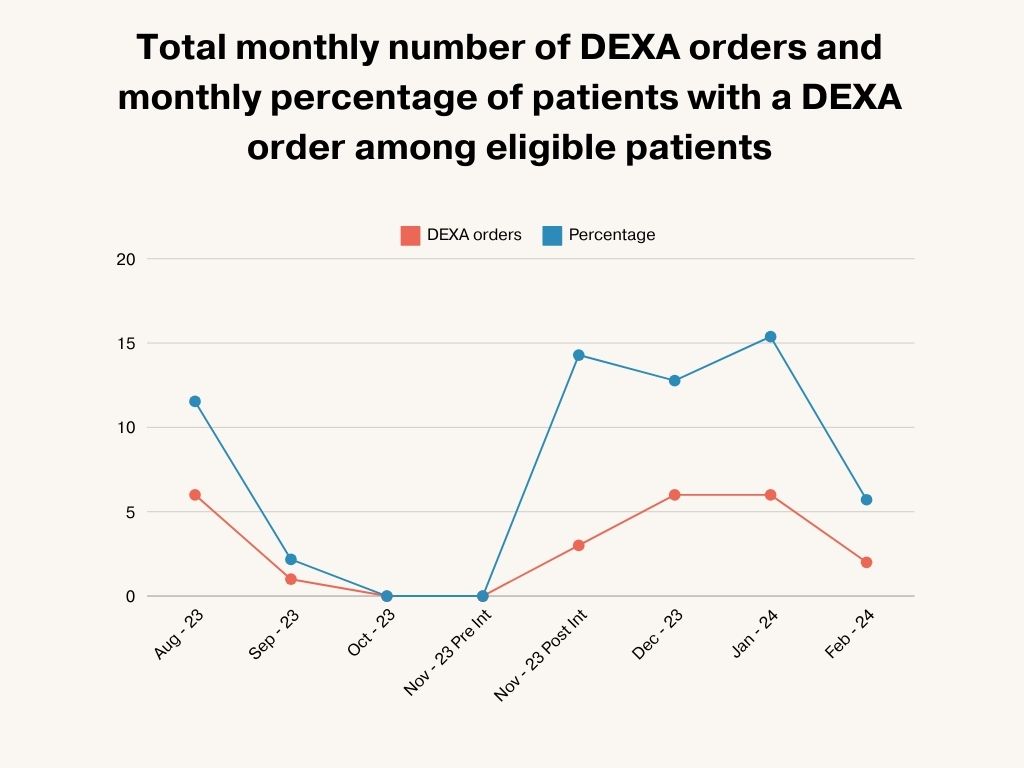
Results: The rate of DEXA scan orders for eligible patients increased from 4.8% (7/147) during pre-intervention to 12% (17/142) post-intervention, representing a 60% relative increase (Figure 1).
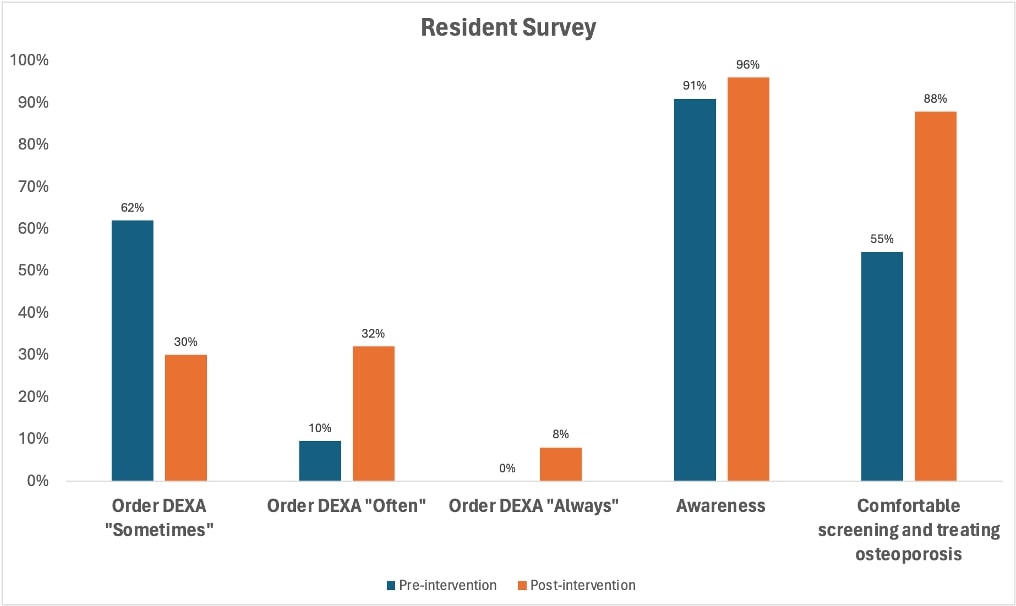
In the pre-intervention survey, 61.9% residents sometimes ordered a DEXA. 90.9% residents were aware of the screening modalities, and treatment options, and 54.5% were comfortable with screening and treatment for osteoporosis. Post-intervention, 30% residents sometimes ordered a DEXA scan, 32% often ordered it and 8% residents always ordered a DEXA scan for their eligible patients. Resident knowledge improved, with 95.9% participants being aware of screening criteria and treatment options, and 87.8% were comfortable in screening and treating osteoporosis for their patients (Figure 2).
Clinic visit time constraints (63.6%), DEXA scan low on the priority list (63.6%), and uncertainty about patient preferences and resources (31.8%) were the commonly reported barriers to ordering a DEXA scan. Patient nonadherence (59.1%) was the most common barrier to completion of a DEXA scan.
Conclusion: There was an increase in the rate of DEXA scan orders in resident clinics at a university-based safety net hospital in 3 months through the implementation of EMR modification, resident education, and clinic reminders. This was the first plan-do-study-act (PDSA) cycle of the quality improvement initiative, and further implementation of these interventions in primary care clinics can improve patient care. This project draws relevance to the patients in rheumatology clinics with elevated risk of osteoporosis due to steroid use and other risk factors, and implementation of similar interventions in further PDSA cycles can enhance patient outcomes for rheumatologists.
To cite this abstract in AMA style:
Madan U, Tselovalnikova T, Yordi S, Gupta K, Baniowda M, Pavlisin M, Adam M, Banderas J, Ifteqar S, Wooldridge D. A Quality Improvement Initiative to Increase Osteoporosis Screening in Internal Medicine Resident Led Primary Care Clinics [abstract]. Arthritis Rheumatol. 2024; 76 (suppl 9). https://acrabstracts.org/abstract/a-quality-improvement-initiative-to-increase-osteoporosis-screening-in-internal-medicine-resident-led-primary-care-clinics/. Accessed .« Back to ACR Convergence 2024
ACR Meeting Abstracts - https://acrabstracts.org/abstract/a-quality-improvement-initiative-to-increase-osteoporosis-screening-in-internal-medicine-resident-led-primary-care-clinics/