
Session Information
Session Type: Poster Session A
Session Time: 10:30AM-12:30PM
Background/Purpose: Gout is sub-optimally managed with under-prescribed urate lowering therapy (ULT) leading to frequent flares, increased healthcare utilization and cost.
- To study the burden of gout and quality of care using validated indices with real time data visualization.
- To propose a novel quality index, the “ULT to Acute Treatment ratio” (ULTrA), defined as the ratio of discrete ULT to acute anti-inflammatory prescriptions.
- To study the association of various quality indices with hospital admission for gout.
Methods: Retrospective study using electronic health records from 1 January 2022 to 31 December 2023 from the National University Health System Value Driven Outcomes database, integrating clinical and administrative data. We included patients age ≥ 21 years from 3 public acute hospitals and 7 public primary care clinics in western Singapore. Those with at least 1 gout-related healthcare encounter in 2022 (prevalent patients) and with at least 1 year of follow-up formed the derivation cohort, while those with a first encounter in 2023 (incident patients) formed the validation cohort.
An Emergency Department (ED) visit was defined by an International Classification of Diseases 10th Edition or SNOMED diagnosis of gout AND prescription of acute anti-inflammatory drugs (nonsteroidal anti-inflammatory drugs, colchicine and/ or glucocorticoids). An inpatient or outpatient encounter was included if gout was the primary or secondary diagnosis.
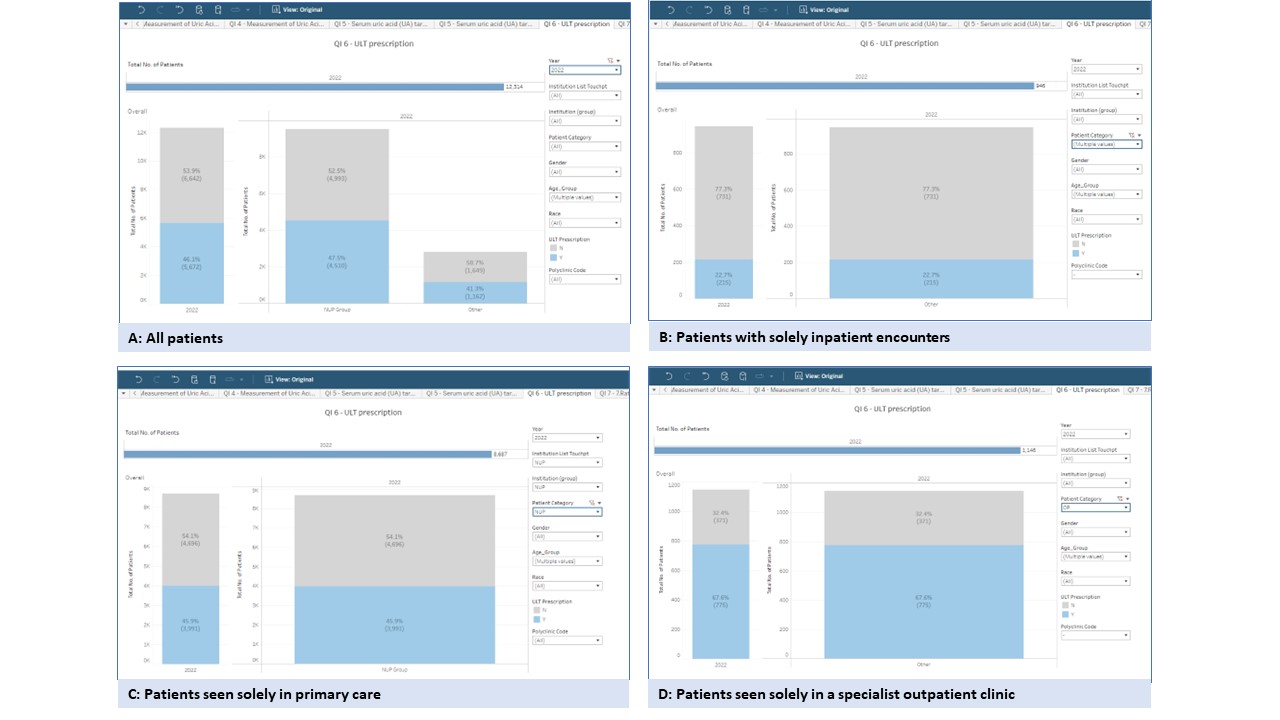
Data were visualized using Tableau (Figure 1) and analyses were performed using Microsoft SQL and Stata V18.
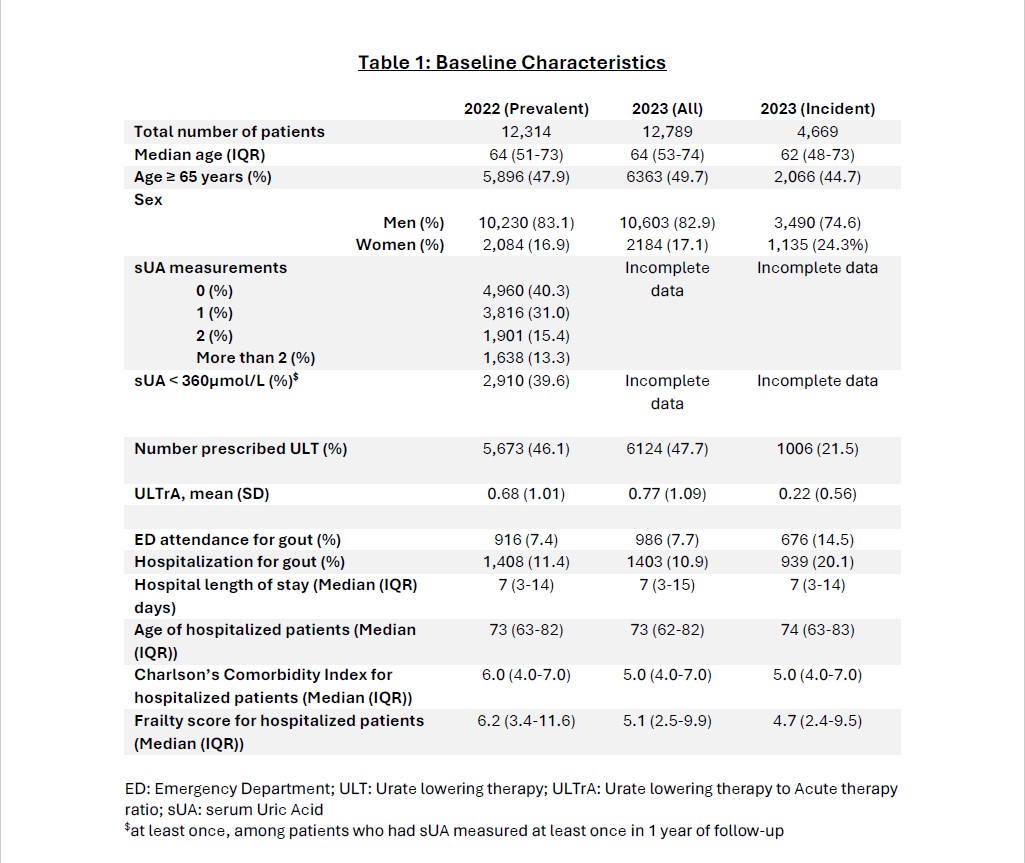
Results: In 2022, of 12,314 unique patients; 10,230 (83.1%) were men, median (IQR) age 64 (51-73) years (Table 1). 3,539 (28.7%) had serum uric acid (sUA) measured at least twice per year (sUA indicator). Of 7355 patients with sUA measured at least once, 2,910 (39.6%) achieved target sUA ≤360 µmol/L at least once. 5,673 (46.1%) were prescribed ULT (allopurinol, febuxostat, probenecid or benzbromarone) at least once. Mean (SD) ULTrA index was 0.68 (1.01). 916 (7.4%) had ED visits for gout. 1,408 (11.4%) were hospitalized, median (IQR) length of stay 7 (3-14) days. Annual cost of gout care (healthcare systems’ perspective) was USD 1882 per patient (USD 13667 per patient for those hospitalized vs. USD 278 for others).
In 2023, among 12,789 unique patients, 4,669 were new, with more women, fewer ULT prescriptions, more ED visits and more frequent hospitalizations (Table 1). The ULTrA index for these newly presenting patients was lower at 0.22 (0.56).
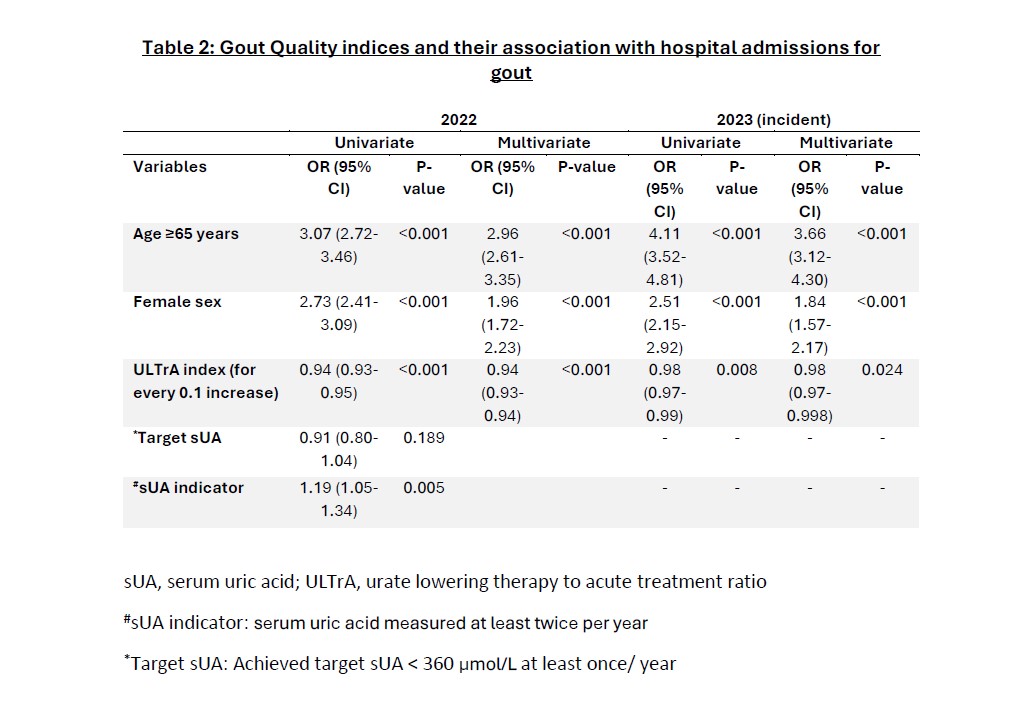
Older age (≥65 years), women and sUA indicator were associated with increased hospitalization (Table 2). ULTrA index was inverserly associated with hospitalization, OR 0.94 (95% CI 0.93-0.95), p< 0.001 for prevalent patients in 2022; OR 0.98 (0.97 - 0.99), p = 0.02 for incident patients in 2023, after adjusting for age and sex.
Conclusion: The ULTrA is an easy to measure index which was inversely associated with hospital admissions. This is unlikely to be solely explained by higher number of acute prescriptions in patients who are hospitalized, as the association was weaker in the 2023 incident cohort with more frequent hospitalizations. The impact of real time visualization of ULTrA on prescriber behavior and hospitalization should be studied.
To cite this abstract in AMA style:
Tang M, Tay F, Santosa A, Kumari S, Lim P, Aung H, Thinn S, Cheung P, Lahiri M. Urate Lowering Therapy to Acute Treatment Ratio (ULTrA) Index – a Novel Quality Indicator Associated with Reduced Hospital Admissions for Gout [abstract]. Arthritis Rheumatol. 2024; 76 (suppl 9). https://acrabstracts.org/abstract/urate-lowering-therapy-to-acute-treatment-ratio-ultra-index-a-novel-quality-indicator-associated-with-reduced-hospital-admissions-for-gout/. Accessed .« Back to ACR Convergence 2024
ACR Meeting Abstracts - https://acrabstracts.org/abstract/urate-lowering-therapy-to-acute-treatment-ratio-ultra-index-a-novel-quality-indicator-associated-with-reduced-hospital-admissions-for-gout/