
Session Information
Date: Monday, November 9, 2020
Session Type: Abstract Session
Session Time: 11:00AM-11:50AM
Background/Purpose: SLE disproportionately strikes Latinos, who are also at high risk for poor outcomes. Self-efficacy (SE) to manage chronic disease correlates with outcomes through self-management behavior. Illness perceptions (IP) are modifiable mental representations that vary among populations and may impact SE. This study aimed to explore IP and SE in this population and determine if one IP domain, emotional distress, increases the odds of low SE to manage symptoms.
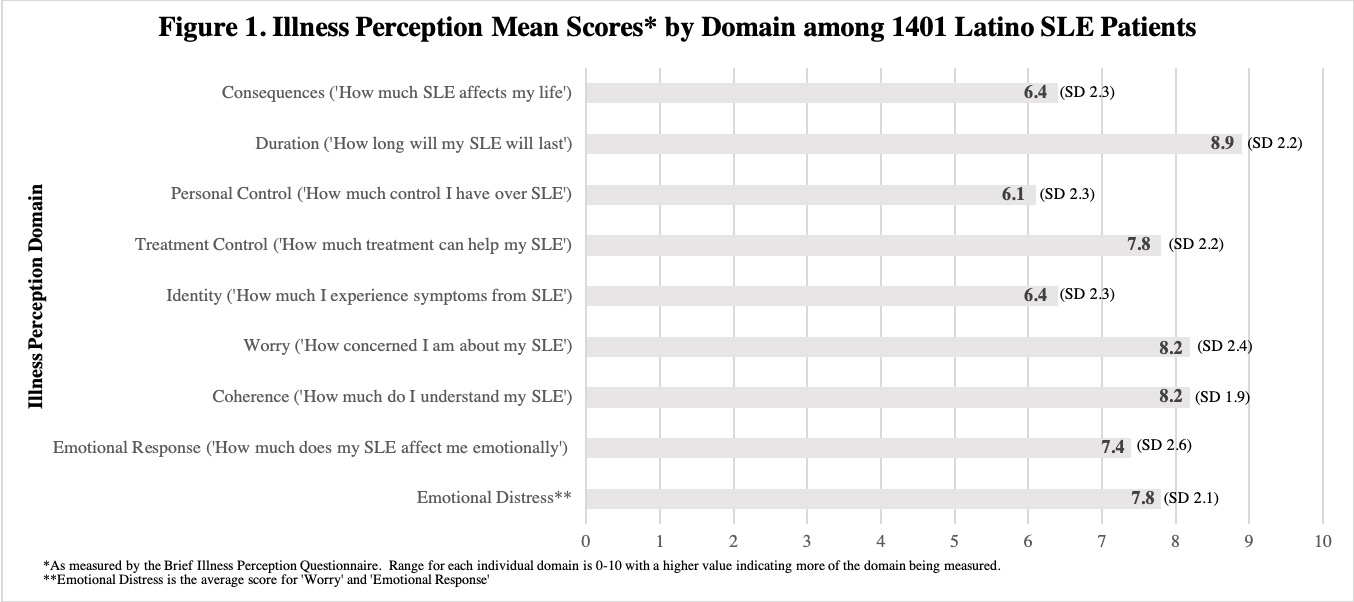
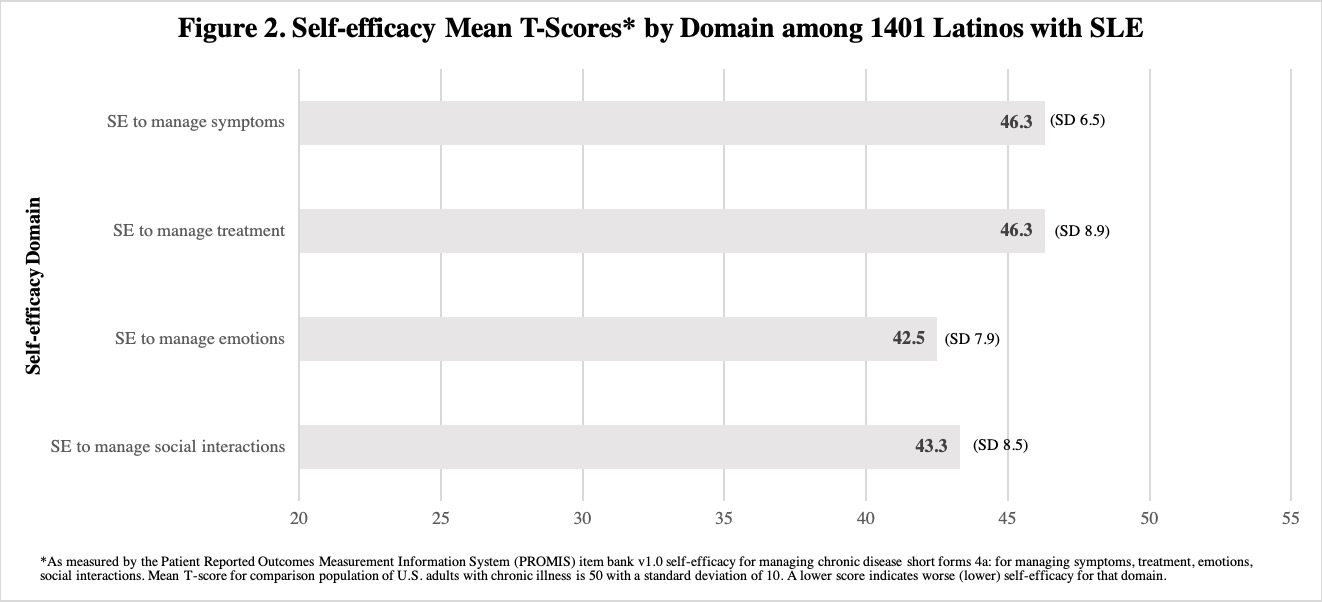
Methods: We collected self-reported measures through an anonymous survey posted on the Hablemos de Lupus (Let’s Talk about Lupus) education Facebook page (followed by 74,000 Spanish-speakers). Participants were eligible if they were 18 or older, located in the American continent and self-reported a SLE diagnosis by a physician. The Brief Illness Perception Questionnaire (BIPQ) Likert scale was used to assess IP and the Patient Reported Outcomes Measurement Information System (PROMIS) to assess SE (to manage symptoms, treatment, emotions and social interactions). A higher BIPQ score (range 0-10) indicates more of the IP domain being measured, and a lower SE T-score indicates worse SE. We reported the mean score and SD of each BIPQ question; emotional distress IP was calculated using the average score of ‘worry’ and ‘emotional response’ questions. SE domains were reported as mean T-scores and SD, with the U.S. population with chronic illnesses as reference. Logistic regression was used to examine the association of emotional distress IP and low SE to manage symptoms (defined as a T-score ≤40) after controlling for confounders.
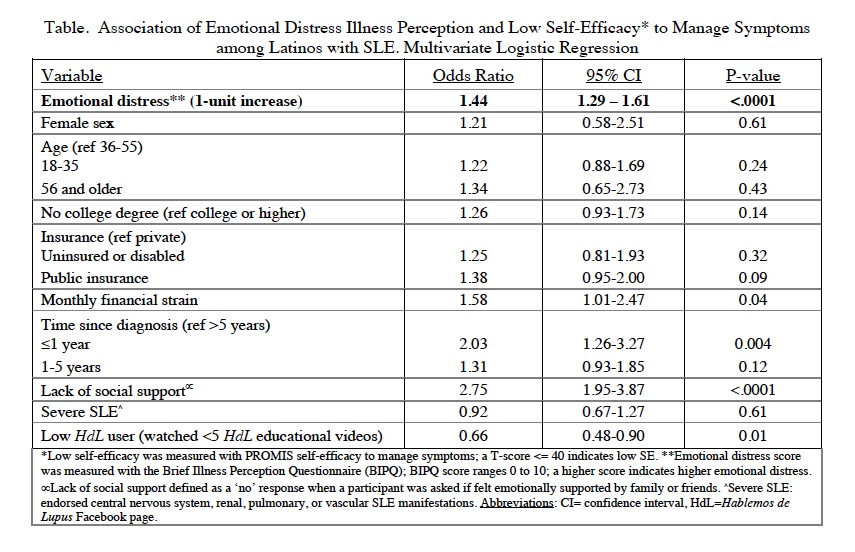
Results: There were 1401 eligible participants who started the survey and 100% completed. Participants were from 19 countries; ages 18-80; 95% females; 33% diagnosed in past 3 years; 46% reported renal, neurologic, vascular or pulmonary SLE manifestations, and 79% were under the care of a rheumatologist. Figures 1 and 2 depict mean IP and SE scores, with perceived emotional distress of 7.8 (SD 2.1). SE mean T-scores were lower than the reference population (T-score=50), ranging between 42.5 for managing emotions to 46.3 for treatment and symptom management (Figure 2). Per 1-unit increase of emotional distress the OR of low SE to manage symptoms was 1.44 [95% CI 1.29-1.61], after controlling for covariates (Table). Lack of social support and recent diagnosis were independently associated with low SE to manage symptoms in the multivariate model (Table).
Conclusion: Our findings underscore high illness-related emotional distress in Latinos with SLE, despite reporting relatively high understanding of SLE and its treatment. Moreover, SE levels in Latinos with SLE were below the average U.S. population across multiple domains. We found that those who perceive SLE as more emotionally distressing had lower SE to manage symptoms, suggesting that emotional illness perception may be a promising target for Latino SLE interventions. Our data also suggest that patients recently diagnosed or lacking social support may benefit from SE interventions. Education to modify perceived SLE emotional distress may improve SE to manage symptoms among Latino patients, potentially contributing to better patient-centered and clinical outcomes in this population.
To cite this abstract in AMA style:
Crosley E, Elera-Fitzcarrald C, Ferreyra Garrot L, Fuentes-Silva Y, Ibañez S, Pons-Estel B, Reátegui-Sokolova C, Drenkard C. Understanding the Relationship Between Illness Perceptions and Self-Efficacy Among Latin Americans with SLE Through the Hablemos De Lupus Facebook Page [abstract]. Arthritis Rheumatol. 2020; 72 (suppl 10). https://acrabstracts.org/abstract/understanding-the-relationship-between-illness-perceptions-and-self-efficacy-among-latin-americans-with-sle-through-the-hablemos-de-lupus-facebook-page/. Accessed .ACR Meeting Abstracts - https://acrabstracts.org/abstract/understanding-the-relationship-between-illness-perceptions-and-self-efficacy-among-latin-americans-with-sle-through-the-hablemos-de-lupus-facebook-page/