
Session Information
Session Type: Poster Session C
Session Time: 8:30AM-10:30AM
Background/Purpose: Musculoskeletal point of care ultrasound (MSK POCUS) can assess for joint effusions, synovitis and crystalline arthropathy and is increasingly utilized by generalists working in various clinical settings. Generalists are able to perform focused ultrasound (US) exams to answer specific clinical questions with accuracy similar to that of experts after brief instruction, although it is estimated that 2/3 of internal medicine (IM) programs lack a formal US curriculum. At our institution, a 2-week POCUS elective is available for IM residents, however MSK POCUS has not been formally incorporated. A needs assessment survey of residents who previously completed the POCUS elective found that 92% of residents wanted to learn POCUS to assess for joint inflammation or crystalline arthropathy. As the onset of the COVID-19 pandemic necessitated physical distancing, an online electronic learning (eLearn) module was developed to train residents to acquire and interpret MSK POCUS images of the knee. Here we present preliminary results of this model of MSK POCUS instruction for teaching IM residents.
Methods: Three high yield US views of the knee were chosen for their ability to show pathology and ease in demonstrating transducer placement pictorially including the suprapatellar long and short axis views with the knee in neutral position (for joint effusion and synovial thickening) and suprapatellar short axis view with the knee in maximal flexion (for crystalline arthropathy and osteoarthritis changes). The module was developed in Adobe Captivate, hosted on the institution’s learning management system (LMS) and made available to residents in the POCUS elective. US images in each view showing normal anatomic landmarks were coupled with graphics to show transducer placement. Common pathology in each view was shown in interactive exercises. US physics, pertinent artifacts, and indications for use were reviewed. To reinforce learning, the module featured interactive elements including simulated transducer placement and point-and-click structure identification items as well as traditional quizzing elements such as drag and drop and matching exercises to provide immediate feedback to learners. Results of a pre and post test were exported to the LMS.
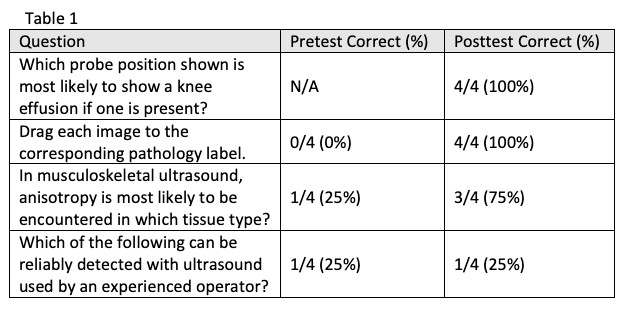
Results: Four residents completed the module between February and May 2021 and serve as a validation cohort. Post-test data show 100% of participants were able to identify correct transducer placement for the highest yield US view to assess for knee effusion and were also able to accurately identify images showing effusion, OA, the double contour sign of gout, and chondrocalcinosis (Table 1).
Conclusion: We present a novel eLearn module to teach targeted MSK POCUS of the knee to IM residents within the context of an existing POCUS elective. The module was effective in teaching appropriate transducer placement and image interpretation in a validation cohort. Future work will assess effects on image acquisition with observed scanning sessions after module completion, demonstrate effect in increasing MSK POCUS utilization among residents over time, and expand this model to additional joint regions and to pediatric subjects.
To cite this abstract in AMA style:
Long A, Marston B, Rahimi H, Madsen N, Novak W. Ultrasound Online: A Novel Approach to Teaching Rheumatology Focused Musculoskeletal Ultrasonography to Resident Physicians in Training [abstract]. Arthritis Rheumatol. 2021; 73 (suppl 9). https://acrabstracts.org/abstract/ultrasound-online-a-novel-approach-to-teaching-rheumatology-focused-musculoskeletal-ultrasonography-to-resident-physicians-in-training/. Accessed .« Back to ACR Convergence 2021
ACR Meeting Abstracts - https://acrabstracts.org/abstract/ultrasound-online-a-novel-approach-to-teaching-rheumatology-focused-musculoskeletal-ultrasonography-to-resident-physicians-in-training/