
Session Information
Session Type: Poster Session B
Session Time: 8:30AM-10:30AM
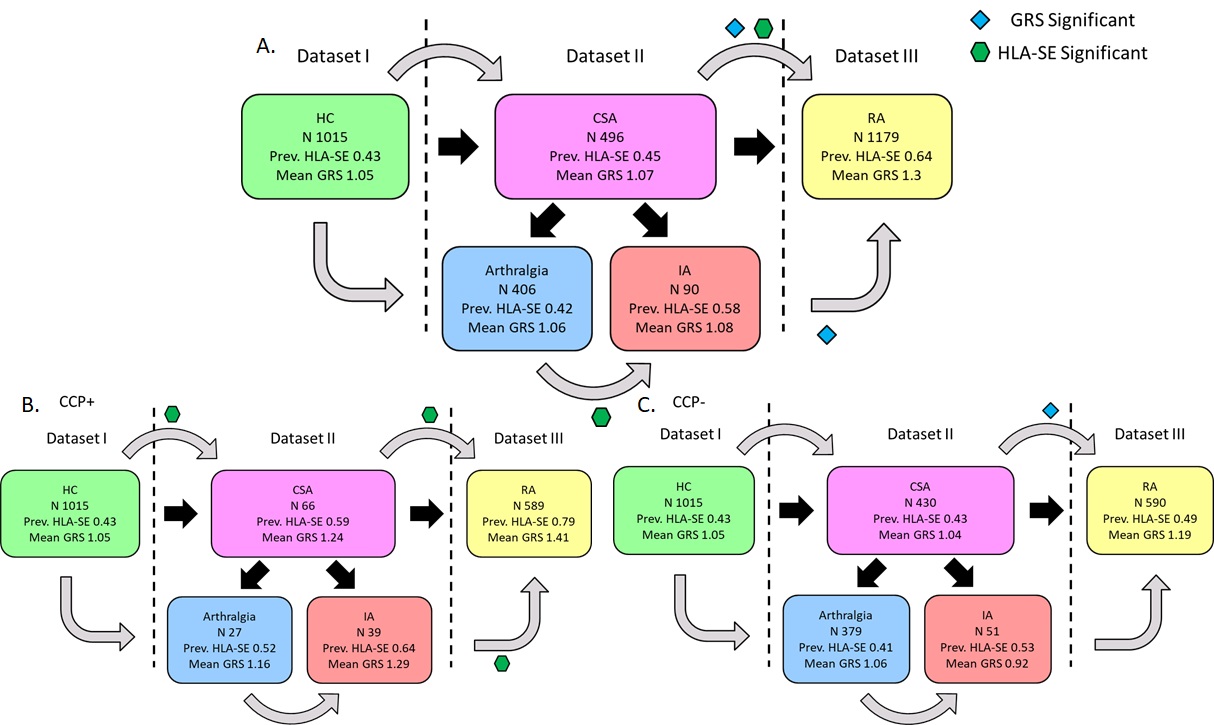
Background/Purpose: The identification of a pre-RA stage of patients with clinically suspect arthralgia (CSA) has proven to be beneficial in the early detection of Rheumatoid disease. Similarly, genetic susceptibility studies have identified important genetic risk factors for the development of (CCP positive) RA.1 The question that arises is whether these findings represent independent etiological pathways and could therefore be complimentary in the early diagnosis of RA. We therefore aimed to corroborate the knowledge of genetic differences between HC and RA patients and extend it to include the CSA stage of disease.
Methods: We used three datasets sampled from the same region: 1,085 healthy controls (HC), 530 CSA and 1,277 RA patients. CSA patients were monitored for a median of 2 years for conversion into clinically apparent inflammatory arthritis (CSAc) or not (CSAnc).2 Genotype data of all individuals was identically processed, including separate imputation of the HLA region using SNP2HLA with the T1DGC panel. A Genetic Risk Score (GRS) consisting of 85 RA risk SNP’s derived from literature was calculated for all samples.3 HLA-SE positivity was defined as the presence of at least 1 of the HLA-DRB1 alleles.
We assessed the association of the GRS and HLA-SE with disease stage using logistic regression in the full data and in the CCP+ and CCP- strata of the CSA and RA populations.
Results: The GRS increased with disease stage, from 1.05 in HC to 1.3 in established RA cases. This was significant between CSA and RA (OR: 1.36, 95%CI: 1.21 – 1.53, P-value: < .001), and CSAc and RA (OR: 1.29, 95%CI: 1.02 – 1.64, P-value: .037). HLA-SE prevalence also differed significantly between CSA and RA (OR: 2.59, 95%CI: 2.07 – 3.24, P-value: < .001), which could be attributed to the difference between CSAnc and CSAc (OR: 1.88, 95%CI: 1.18 – 2.99, P-value: .007). (Fig. 1A) In CCP+ patients only the differences in SE between HC and CSA (OR: 1.89, 95%CI: 1.14 – 3.13, P-value: .014), CSA and RA (OR: 2.6, 95%CI: 1.53 – 4.41, P-value: < .001) and CSAc and RA (OR: 2.1, 95%CI: 1.06 – 4.16, P-value: .033) were significant. (Fig. 1B) The increase in GRS from CSA to RA, observed in the full datasets, remained significant in the CCP- strata (OR: 1.21, 95%CI: 1.04 – 1.42, P-value: .013). (Fig. 1C).
Conclusion: The current results seem to indicate a role for HLA-SE in the development of arthritis, whereas the GRS more specifically associates with the development of RA. This latter association was also observed in the CCP- CSA and established RA populations. We can conclude that known RA genetics distinguish progressed disease from earlier stages independently of CCP, even when taking the at-risk stage of CSA into consideration.
References:
1. van der Helm-van Mil, A. H., et al. Arthritis and rheumatism, 2006. 54(4): p. 1117–1121.
2. van Steenbergen, H.W., et al. Ann Rheum Dis, 2017. 76(3): p. 491-496.
3. Knevel, R., et al. Sci Transl Med, 2020. 12(545): eaay1548.
To cite this abstract in AMA style:
Maurits M, Wouters F, Niemantsverdriet E, Huizinga T, van der Helm-van Mil A, Knevel R. The Relationship of Genetics and Clinically Suspect Arthralgia in RA Development Assessed Using HC, CSA and RA Patients [abstract]. Arthritis Rheumatol. 2021; 73 (suppl 9). https://acrabstracts.org/abstract/the-relationship-of-genetics-and-clinically-suspect-arthralgia-in-ra-development-assessed-using-hc-csa-and-ra-patients/. Accessed .« Back to ACR Convergence 2021
ACR Meeting Abstracts - https://acrabstracts.org/abstract/the-relationship-of-genetics-and-clinically-suspect-arthralgia-in-ra-development-assessed-using-hc-csa-and-ra-patients/