
Session Information
Date: Monday, October 22, 2018
Session Type: ACR Poster Session B
Session Time: 9:00AM-11:00AM
Background/Purpose:
The most common type of inflammatory arthritis in Germany is gout, however the last epidemiological study was done a decade ago (Annemanns, 2007). This study aimed to provide an uptodate analysis on the prevalence and incidence of gout, associated comorbidities, and current treatment patterns.
Methods:
The InGef research database, comprising a sample of ~4 million healthcare claims, was used for the analyses. Patients were included based on hospital discharge or ambulatory diagnoses of gout (ICD10 M10) or hyperuricemia (E79.0) in combination with uric acid tests, prescription of urate lowering therapy (ULT), and treatment of gout flare. Prevalent gout cases were analysed according to comorbidities and pharmacological treatment. Additionally, a comparison to an age- and sex-matched control group without gout was performed.
Results:
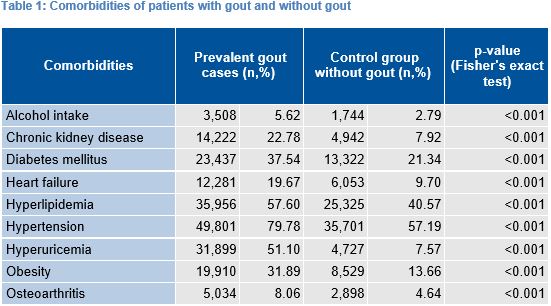
The study included 62,425 gout claims. Prevalence was 1.63% (standardized), corresponding to 1.325 million gout patients in Germany. Incidence was 0.45% (standardized). Male-to-female ratio was 3.2 for prevalence and 2.7 for incidence. The mean age of diagnosis was 66 years. Gout patients suffered significantly more from comorbidities than patients without gout (Table 1). The most common comorbidities were hypertension (80%), hyperlipidemia (58%), diabetes (38%), and obesity (32%). About 70% of gout patients received ULT (63% Allopurinol, 6% Febuxostat, 0.6% Benzbromaron). Overall, gout patients received an average of 8.7 (SD: 5.5) medications; 44% took ≥9 different medications in comparison to 20% of patients without gout (Table 2). Most common medications were NSAIDs (49%) and beta blocking agents (49%), lipid lowering drugs (35%), and antidiabetic drugs (23%). Accordingly, mean costs for drug treatment were substantially higher (1,148€ vs. 815€). About 29% of gout patients had ≥1 hospital visits in 2016 compared to only 21% of patients without gout (p<0.001).
Conclusion:
The prevalence of gout (1.63%) was slightly higher compared to a previous analysis of German claims data (1.4%; Annemanns, 2007). This study confirms that gout patients suffer from more comorbidities with a high need for multiple medications, resulting in significantly greater mean drug costs compared to patients without gout.

To cite this abstract in AMA style:
Kiltz U, Perez-Ruiz F, Uhlig T, Jansen TL, Karra Gurunath R, Schmedt N, Galetzka W, Petersen G, Schoenfelder T, Tausche AK. The Prevalence and Incidence of Gout, Its Associated Comorbidities and Treatment Pattern: An Epidemiological Study from Germany [abstract]. Arthritis Rheumatol. 2018; 70 (suppl 9). https://acrabstracts.org/abstract/the-prevalence-and-incidence-of-gout-its-associated-comorbidities-and-treatment-pattern-an-epidemiological-study-from-germany/. Accessed .« Back to 2018 ACR/ARHP Annual Meeting
ACR Meeting Abstracts - https://acrabstracts.org/abstract/the-prevalence-and-incidence-of-gout-its-associated-comorbidities-and-treatment-pattern-an-epidemiological-study-from-germany/