
Session Information
Date: Sunday, November 10, 2019
Title: RA – Diagnosis, Manifestations, & Outcomes Poster I: Risk Factors, Predictors, & Prognosis
Session Type: Poster Session (Sunday)
Session Time: 9:00AM-11:00AM
Background/Purpose: Disease activity of patients with rheumatoid arthritis should be assessed equally independent of gender, age, or disease duration. However, at present, they are not taken into account consideration in the calculation of any composite measure indices. The aim of this study is to clarify how “gender” affect DAS28-ESR, DAS28-CRP, SDAI and CDAI.
Methods: We analyzed 15056 of patients with rheumatoid arthritis registered in the nationwide observational cohort database(National Database of Rheumatic Diseases in Japan; NinJa) in 2017. We performed regression analysis in each disease activity category (remission, low disease activity, moderate disease activity, high disease activity) for all of DAS28-ESR, DAS28-CRP, SDAI and CDAI using generalized liner model with gamma distribution and identity link: each disease activity indices as a dependent variable and duration of disease, gender, number of artificial joints, BMI, Stage, HAQ-DI, HADS-A and smoking as independent variables. The results of regression analysis are dually confirmed in complete case analysis(listwise deletion) and dataset imputed by chained equation(iteration number:100 × sample size:15056 = 1505600).
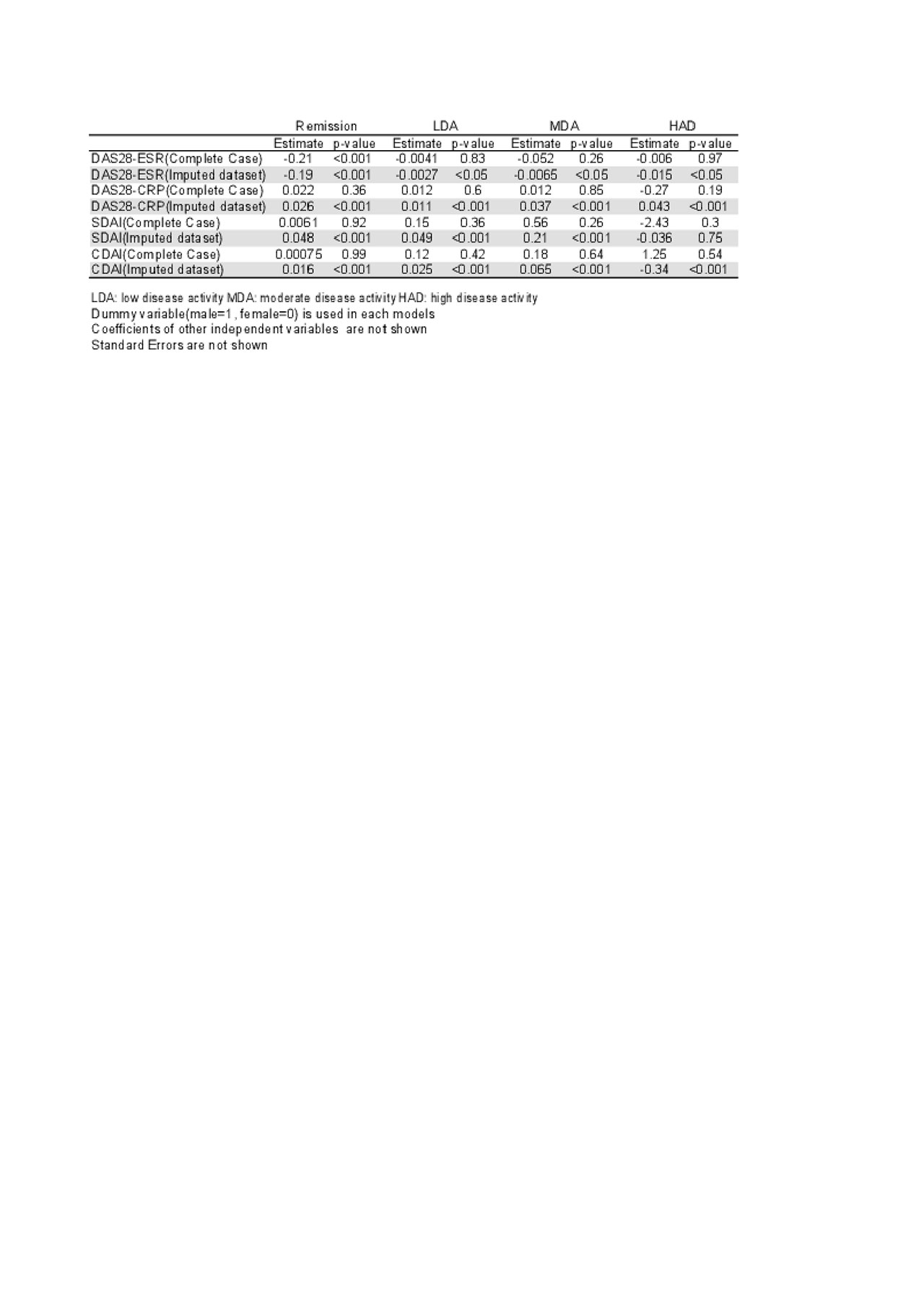
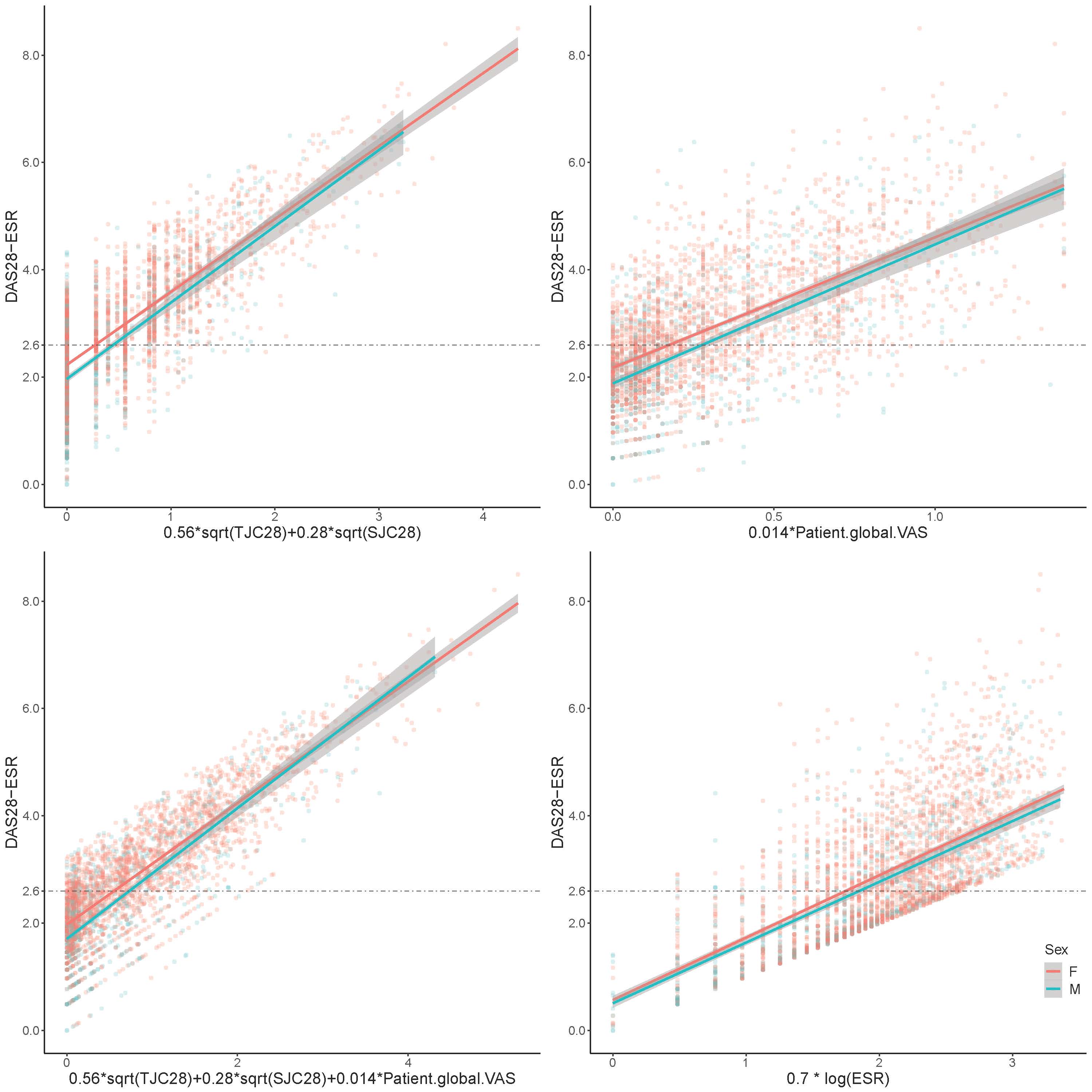
Results: In complete case analysis, coefficients of gender in each disease activity category are not significant, except for remission based on DAS28-ESR: -0.21 (Table). In analysis using dataset imputed by chained equation, all coefficients of gender in each disease activity category are significant, except for high disease activity based on SDAI. From the view of clinical knowledge, only the coefficient value of remission based on DAS28-ESR:-0.19 is large enough to affect interpretation of disease activities. To investigate the reason of discrepancy by gender in remission based on DAS28-ESR, we drew scatter plots in complete case with regression line(gamma distribution and identity link):DAS28-ESR as a dependent variable and components of DAS28-ESR as independent variables respectively(Figure). Discrepancy by gender in remission is negligible only in scatter plot of ESR as an independent variable, suggesting gender difference of ESR mainly contribute to the discrepancy. Additionally, we calculated the number of male patients who achieve remission criteria defined as 2.4 for male in DAS28-ESR on the assumption that gender difference is at least -0.2 from the coefficient values. As a result, remission criteria as 2.6 may be overestimated by about 10% in male.
Conclusion: This study indicates we may have to pay attention to gender only when assessing remission based on DAS28-ESR. Considering the current treatment strategy targeting “remission” by composite measures in rheumatoid arthritis, the influence of gender on remission assessed by DAS28-ESR cannot be ignored.
ACRtablerevision
ACRfigurever2
To cite this abstract in AMA style:
NIshino T, Hasimoto A, Tohma S, Matsui T. The Influence of Gender on Composite Disease Activity Indices for Rheumatoid Arthritis [abstract]. Arthritis Rheumatol. 2019; 71 (suppl 10). https://acrabstracts.org/abstract/the-influence-of-gender-on-composite-disease-activity-indices-for-rheumatoid-arthritis/. Accessed .« Back to 2019 ACR/ARP Annual Meeting
ACR Meeting Abstracts - https://acrabstracts.org/abstract/the-influence-of-gender-on-composite-disease-activity-indices-for-rheumatoid-arthritis/