
Session Information
Date: Monday, November 11, 2019
Title: Epidemiology & Public Health Poster II: Spondyloarthritis & Connective Tissue Disease
Session Type: Poster Session (Monday)
Session Time: 9:00AM-11:00AM
Background/Purpose: Autoimmune rheumatic diseases (ARDs) are associated with adverse pregnancy outcomes (APOs). There are only a small number of studies that have looked at the association of race with APOs, especially in women of Asian race/ethnicity. Black race has been associated with worse APOs in women with ARDs when compared to Non-Hispanic White populations in a small number of studies. The aim of our study is to evaluate the impact of race and rheumatic disease on birth outcomes including preterm birth (PTB), congenital anomalies, low birth weight (LBW), and small for gestational age (SGA) in a large multiethnic cohort of women.
Methods: Birth records linked to hospital discharge data of singleton births in California from 2007 to 2012 were leveraged for a retrospective cohort study including women at least 18 years old diagnosed with ARD. International classification of diseases, ninth revision codes were used to identify women with ARD, as well as PTB, LBW, SGA and congenital anomalies among infants. Race/ethnicity was abstracted from birth record data. The odds of PTB, LBW, SGA and congenital anomalies were estimated in separate logistic regression models and models were adjusted for maternal age, education, insurance and parity.
Results: Among women with an ARD diagnosis (rheumatoid arthritis, systemic lupus erythematosus, antiphospholipid syndrome, psoriatic arthritis, ankylosing spondylitis, juvenile idiopathic arthritis) who met our eligibility criteria, Black women had a two-fold increased odds of PTB when compared to Non-Hispanic White women (OR 2.09, 95% CI 1.72-2.53). Additionally, Asian (OR 1.63, 95% CI 1.35-1.96) and Hispanic (OR 1.33, 95% CI 1.16-1.52) women were also more likely to give birth preterm. In women with RA, increased OR of PTB was only significant in Black women compared to Non-Hispanic White women. The odds of SGA were significantly increased for Asian (OR 2.33, 95% CI 1.92-2.83), Black (OR 2.24, 95% CI 1.89-2.89) and Hispanic women with any ARD compared with Non-Hispanic White women and remained significant for those with RA and SLE. Among women with any diagnosis of an ARD, race was not significantly associated with premature rupture of membranes except for Black women (OR 1.53, 95% CI 1.04-2.24).
Conclusion: Our findings support previous work that among women with an ARD diagnosis, minority race is a risk factor for adverse pregnancy outcomes including PTB and SGA. Although the etiology of this increased risk is not fully understood socioeconomic and genetic contributions have been proposed in prior work. Our study is the first study with a large group of women with Asian race/ethnicity and found that this group, along with Hispanic and Black women, have an increased risk of adverse pregnancy outcomes when compared with Non-Hispanic White women. Asian, Black, and Hispanic women with ARDs should undergo increased monitoring during pregnancies.
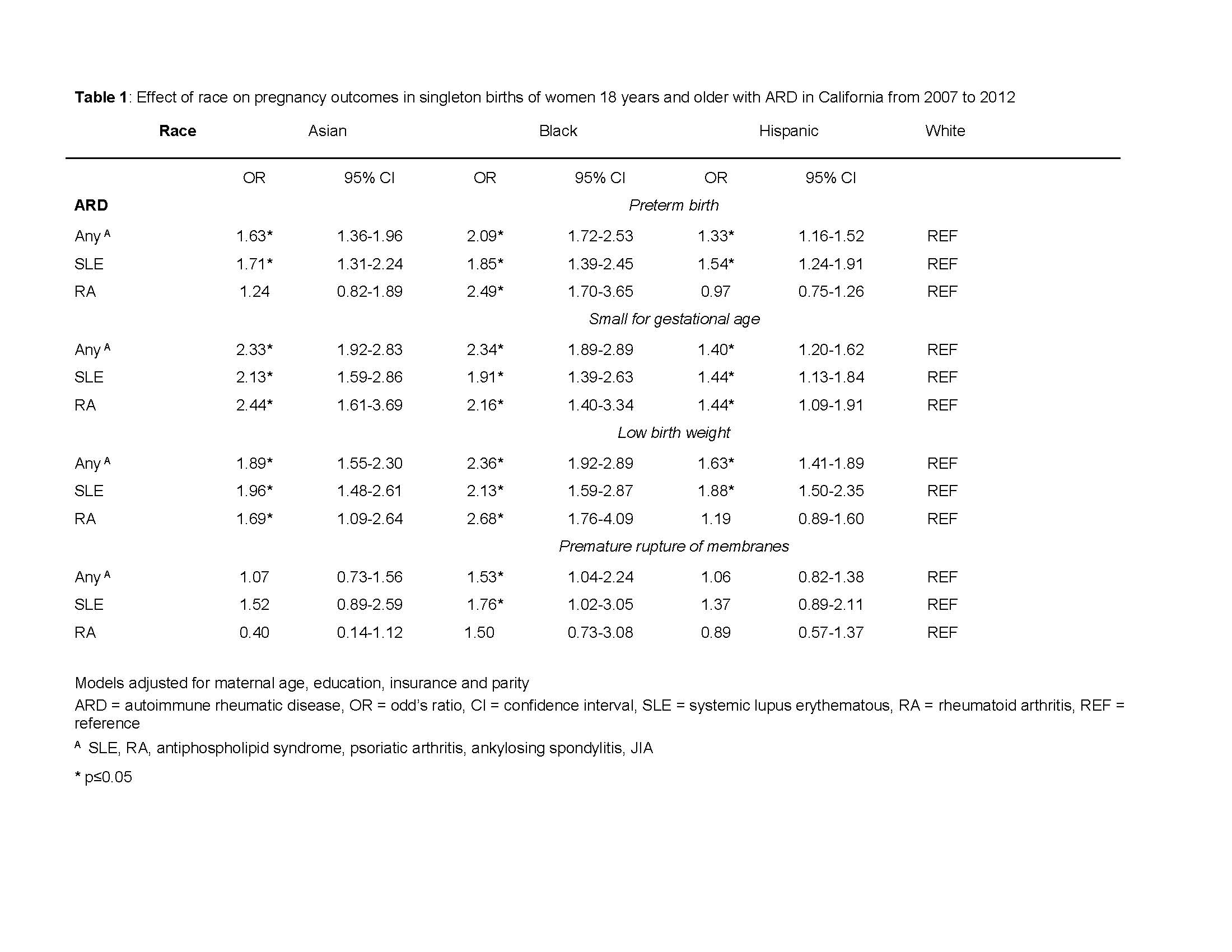
ARD PTB Table 1 060419
To cite this abstract in AMA style:
Sabih L, Strouse J, Nidey N, Bandoli G, Baer R, Feuer S, Jelliffe-Pawlowski L, Chambers C, Ryckman K, Singh N. The Impact of Race on Birth Outcomes Among Women with Autoimmune Rheumatic Diseases [abstract]. Arthritis Rheumatol. 2019; 71 (suppl 10). https://acrabstracts.org/abstract/the-impact-of-race-on-birth-outcomes-among-women-with-autoimmune-rheumatic-diseases/. Accessed .« Back to 2019 ACR/ARP Annual Meeting
ACR Meeting Abstracts - https://acrabstracts.org/abstract/the-impact-of-race-on-birth-outcomes-among-women-with-autoimmune-rheumatic-diseases/