
Session Information
Session Type: Abstract Submissions (ACR)
Background/Purpose
Flares, potentially disabling and disease worsening even when a patient is in low disease activity, are common features in patients with rheumatoid arthritis (RA) that may escape the routine clinical control. Consequently the current treat-to-target goal to achieve remission or low disease activity fails to take into account the potential of flares to represent the persistence of disease activity and it remains unknown whether these flares can worsen radiographic joint damage. The aim of this study was to see whether transient flares increase the risk for radiographic progression.
Methods
From 287 patients included in the AMBRA trial, 276 RA patients with low disease activity (DAS28-CRP < 3.2, and no swollen joints at baseline) with radiographs available at baseline and data about flares, were followed for two years. An annual clinical evaluation was performed by a senior rheumatologist and at the same occasion the patients were asked to recall the occurrence of flares during the past year, according to: No flares, transient flares or persistent joint complaints with tender and swollen joints. X-rays of hands and feet were performed at baseline and after two years and scored according to the Sharp/van der Heijde method. The change in Total Sharp Score (TSS) and its components (Joint Space Narrowing (JSN) and Erosions (E)) were calculated. The proportion of patients who progressed (ΔTSS/ ΔJSN/ ΔE > 0 units) across the three groups were compared using Chi-square test and interpreted based on Relative Risks (RR).
Results
70% of patients were women, median age [IQR] was 63 years [55;70], 73% were rheumatoid factor positive, 71% anti-CCP positive and all had established RA (median [IQR] 7 years [4;13]). In total 268 out of the 276 patients had two year radiographic scores: Radiographic progression depicted by either ΔTSS, D JSN, or DE, respectively, was seen in 33%, 7%, and 28% of no-flares group (n=82); 36%, 17%, and 31% of patients with transient flares (n=144) and in 46%, 24%, and 34% of patients with persistent joint complaints (n=50). Only differences in worsening of JSN (Figure 1) were statistically significant (P=0.026): RR was 2.37 for the transient flares group and 3.28 for the group with persistent joint complaints compared to the no flares group. Worsening of TSS and E showed some tendencies according to the flare phenotype, but they were not statistically significant.
Conclusion
RA patients with established low active disease, who report transient flares or persistent joint complaints with tender and swollen joints, have more radiographic damage on JSN (which has recently been reported as the main driver of physical disability) in comparison to no-flares patients.
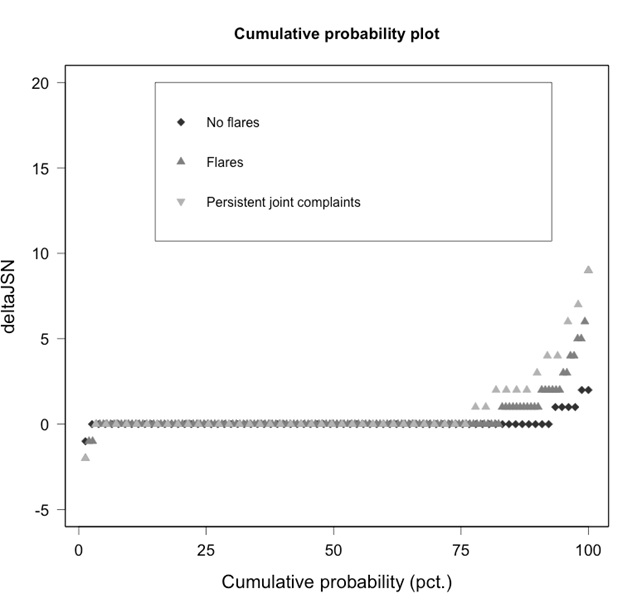
Figure 1: Cumulative probability plot of the three flare phenotypes (no flares; flares; persistent joint complaints) for delta JSN
Disclosure:
D. Kuettel,
None;
J. Primdahl,
None;
L. M. Ørnbjerg,
None;
H. C. Horn,
None;
R. Christensen,
None;
K. Hørslev-Petersen,
None.
« Back to 2014 ACR/ARHP Annual Meeting
ACR Meeting Abstracts - https://acrabstracts.org/abstract/the-impact-of-patient-reported-flares-on-radiographic-progression-in-rheumatoid-arthritis-patients-with-low-disease-activity-secondary-analyses-from-a-randomized-trial/