
Session Information
Session Type: Poster Session B
Session Time: 9:00AM-11:00AM
Background/Purpose: Tissues containing muscle cells are affected in systemic sclerosis (SSc) patients in different organ systems: skeletal muscle, cardiac muscle and gastrointestinal (GI) smooth muscle. Prior small cohort studies have shown separate associations between skeletal muscle with cardiac and GI involvement. Our objective was to further evaluate the relationship between skeletal muscle involvement and severe or end-stage cardiac and GI involvement in systemic sclerosis (SSc).
Methods: We used an observational SSc cohort from a US Scleroderma Center to perform a case-control study. We included patients seen for an initial visit between 2000-2015 with 2 or more follow up visits at least 4 months apart and continued follow up through at least 3 years after first SSc visit or death. Skeletal muscle cases were identified as those with objective proximal muscle weakness and either CPK level 2 times upper limit of normal, EMG findings of myositis or myopathy, or positive muscle biopsy. Controls included patients that did not meet case identification criteria over a 3-year period. Controls were matched 2:1 with cases and were the next two consecutive SSc initial visits. Disease severity was assessed using the Medsger Severity Scale. Statistical analysis was performed using SAS 9.4 (Cary, NC).
Results: 101 muscle cases and 202 controls were identified. Baseline demographics are shown in Table 1. Cases were significantly younger (p=0.01), more frequently non-Caucasian (p< 0.001), and had a higher frequency of both diffuse skin disease (p=0.02) and joint contractures (p< 0.001). As expected, autoantibody profiles were different between cases and controls, with cases having higher frequencies of antibodies associated with myopathy (Table 1): anti-U1RNP, PMScl, Ku, RUV-BL1/2, and U3-RNP antibodies. 23% of cases vs 14% of controls (p=0.07) had severe or end-stage GI muscle disease and 18% of cases vs. 13% of controls (p=0.30) had severe or end-stage cardiac muscle disease. Cases and controls were treated differently with cases significantly more frequently treated with methotrexate (49% vs 13%, p< 0.0001) and prednisone (83% vs 48%, p< 0.0001) (Table 2). Overall, cases had a better 5-year survival from first SSc symptom onset when adjusted for age and race (Fig 1).
Conclusion: Severe and end-stage GI and cardiac disease occur at higher frequencies in patients with myopathy, although not statistically significant. Patients with myopathy have a lower rate of 5-year survival. Although the overall frequency of severe and end-stage GI or cardiac disease is low at < 20%, given the poor prognosis of severe GI tract and cardiac involvement, SSc patients with skeletal muscle disease should be followed carefully for these serious complications.
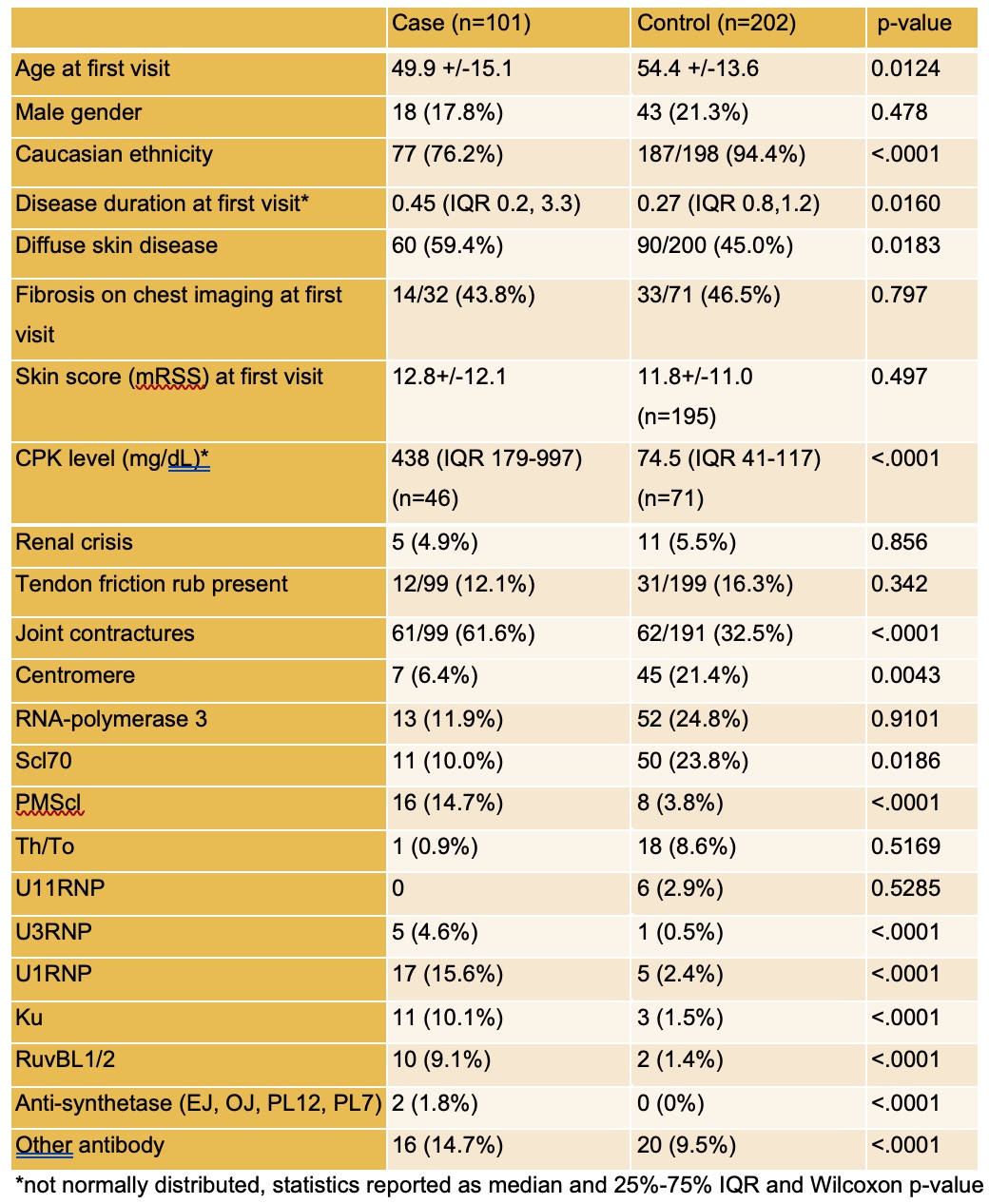 Baseline Demographics, Disease Characteristics, and Clinical Features
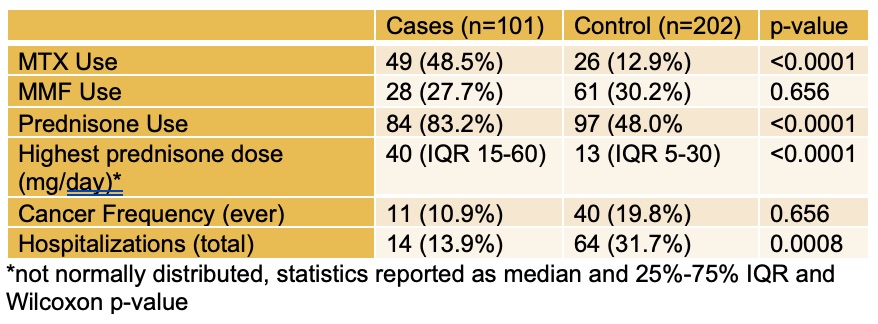 Table 2. Follow-Up After First Visit
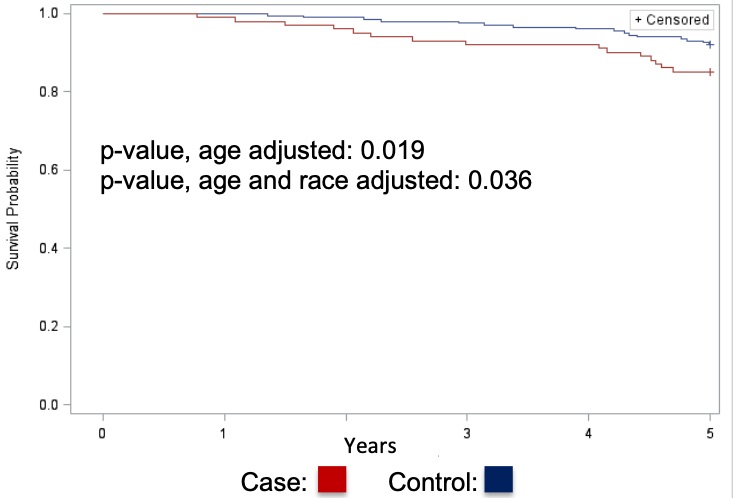 Figure 1. 5-year Survival from First SSc Symptom Onset
To cite this abstract in AMA style:
Mahmud R, Zhu L, Laffoon M, Medsger T, Domsic R. Skeletal Muscle Involvement in Systemic Sclerosis Predisposes to Severe Gastrointestinal Tract and Cardiac Muscle Disease [abstract]. Arthritis Rheumatol. 2020; 72 (suppl 10). https://acrabstracts.org/abstract/skeletal-muscle-involvement-in-systemic-sclerosis-predisposes-to-severe-gastrointestinal-tract-and-cardiac-muscle-disease/. Accessed .« Back to ACR Convergence 2020
ACR Meeting Abstracts - https://acrabstracts.org/abstract/skeletal-muscle-involvement-in-systemic-sclerosis-predisposes-to-severe-gastrointestinal-tract-and-cardiac-muscle-disease/