
Session Information
Date: Monday, November 8, 2021
Title: Health Services Research Poster II: Care Models and Innovation (1061–1082)
Session Type: Poster Session C
Session Time: 8:30AM-10:30AM
Background/Purpose: Gout is a form of inflammatory arthritis that can be “cured” with appropriate urate-lowering therapy to achieve a goal uric acid of 6mg/dL or lower. Rheumatology specialty care is associated with improved control, however access to specialty care for rural Veterans can be a challenge. Our objectives were to explore factors associated with poorly controlled gout among rural Veterans and the impact of dose among those receiving allopurinol.
Methods: Veterans residing in VISN 20 in rural areas were identified using the Corporate Data Warehouse (CDW). Inclusion criteria: in 2019, Veterans: 1) received care from VA, 2) had ≥ 2 ICD codes for gout, 3) were age 18 years or older, and 4) had at least 1 serum uric acid (sUA) measurement. Data on gender, age, race/ethnicity, body mass index (BMI), and visit type (primary care or rheumatology) were extracted from CDW. Controlled status over the course of a panel-year was determined as follows: no sUA elevation (≤6 mg/dl) and no diagnosis code for tophus. Gout medications included any receipt of urate lowering therapy (allopurinol or febuxostat), colchicine, prednisone and non-steroidal anti-inflammatories (NSAIDs) within 2019. Descriptive statistics are presented for patient characteristics. Mixed logistic regression models with clustering for site were run to examine the association between age, race/ethnicity, BMI, and controlled gout.
Results: A total of 2,421 Veterans were identified as having gout and received care at VA in 2019 with VISN 20, 896 (37%) of whom resided in a rural area. Among rural-residing Veterans, 311 (35%) met the definition of controlled gout compared with 31% of urban Veterans. The majority of the rural population were male (98%), between 65 and 80 years old (55%), white (82%) and overweight or obese (68%). In a model with age, race, and BMI, rural Veterans in all age groups over 50 years old were significantly more likely to have controlled gout compared with those under 50 years old (predicted percentage (PP) controlled gout (95% CI): Age < =50 years: 23.3% (14.3-32.2); Age >80 years: 37.8% (28.2-47.4); p= 0.03). There was no significant variation by race or BMI category. Urate lowering therapy with allopurinol was common (76.0%) among rural Veterans with many fewer receiving febuxostat (6.4%). In an unadjusted model, Veterans with receipt of any allopurinol in 2019 had a significantly higher likelihood of controlled gout compared to those without any allopurinol receipt (PP 17% (95% CI 10.3, 23.7).
Conclusion: Conclusions: In this study of rural Veterans who receive care in VA, only one third had controlled gout using serum urate levels. Interventions that share rheumatology best practices and expertise for managing gout with VA primary care teams, such as the VA Rheumatology ECHO program and expansion of telehealth within VA rheumatology, should be developed and tested to enhance quality of care for rural Veterans.
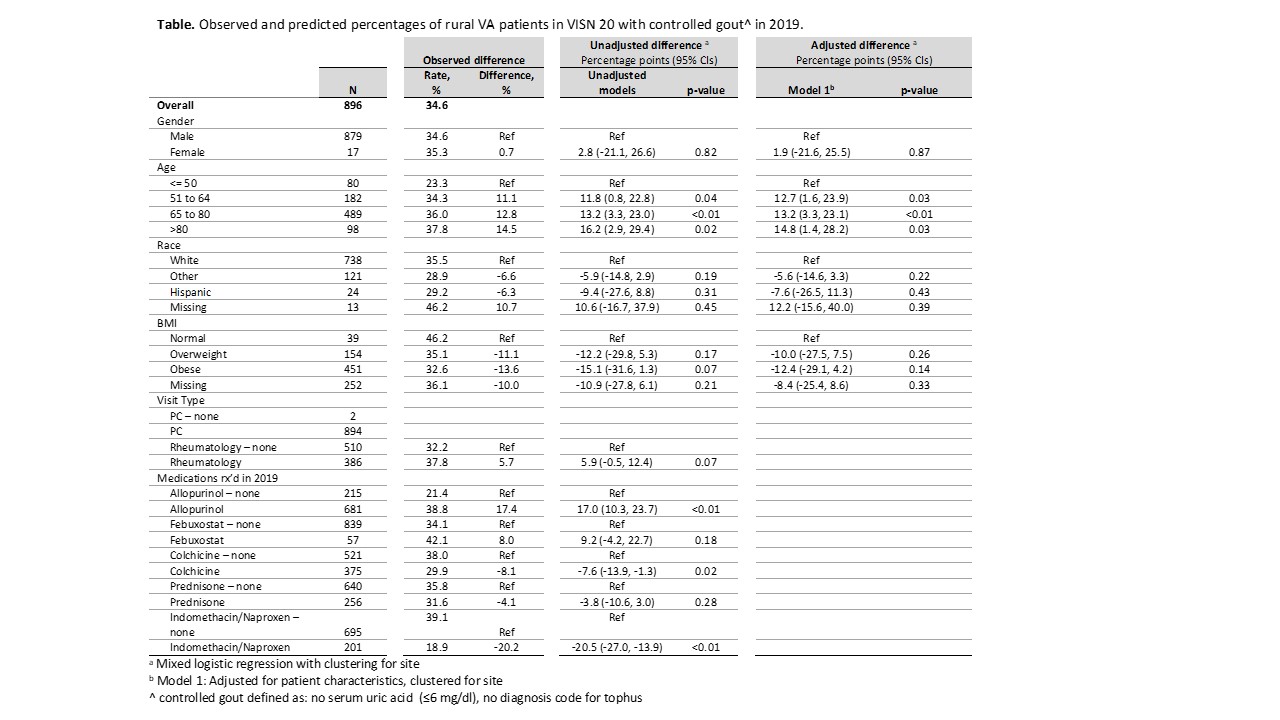 Table. Observed and predicted percentages of rural VA patients in VISN 20 with controlled gout^ in 2019.
To cite this abstract in AMA style:
Barton J, Hooker E, Larsen C, Matsumoto R, O'Neill A. Rural Veterans with Gout – “Rheum” for Improvement [abstract]. Arthritis Rheumatol. 2021; 73 (suppl 9). https://acrabstracts.org/abstract/rural-veterans-with-gout-rheum-for-improvement/. Accessed .« Back to ACR Convergence 2021
ACR Meeting Abstracts - https://acrabstracts.org/abstract/rural-veterans-with-gout-rheum-for-improvement/