
Session Information
Session Type: Poster Session B
Session Time: 8:30AM-10:30AM
Background/Purpose: Health disparities exist among the uninsured and access to rheumatology is incredibly limited to this patient population. We reside in a state without Medicaid expansion and more than 19% of residents in our county are uninsured. In an effort to improve access, our clinic opened in a federally qualified health center in September 2018. In Travis County, uninsured low-income residents can apply for health care coverage through the medical access program (MAP), funded by tax payer dollars. Our division of 3 rheumatologists are the only caregivers in the area who accept MAP patients.
The purpose of this project was to gather baseline data by reviewing referrals and recognize characteristics of this underserved population. Our ultimate goal is to use this information to create future improvements in our clinic to promote health equity.
Methods: Chart review was done of all rheumatology referrals from 9/2018 – 11/2020. Using REDcap, we collected demographic data, referral information, patient characteristics and visit outcomes. For patients exhibiting active symptoms related to rheumatic disease, we used information noted in the “physical exam” of clinic notes to record the number of swollen/tender joints and disease activity. Using Google, we recorded the number of rheumatologists in each surrounding county and categorized them by main practice location.
Results: There were 1245 referrals by 11/2020 and 682 patients were seen in rheumatology clinic. Fifty-three patients declined appointment, 148 were no-shows, 178 were not able to be reached to schedule, 71 were incomplete and 113 had unknown referral status.
Table 1 reports demographic data. Five hundred forty-six patients (80%) were female, 458 (67.2%) Hispanic, 355 (52%) spoke English and 306 (44.9%) were Spanish speakers. The majority had health care coverage through MAP (53.2%).
Table 2 shows referral and patient information. The majority of patients were referred to establish care for a previously diagnosed rheumatic condition (320/682, 47%). Sixteen percent of referrals led to a new rheumatology diagnosis. Of patients with rheumatic disease, 78% (275/351) had active disease at initial visit. The majority of RA patients had >3 swollen/tender joints and had therapy started or escalated at first visit. Seventy-one RA patients (39%) had erosive disease at initial visit.
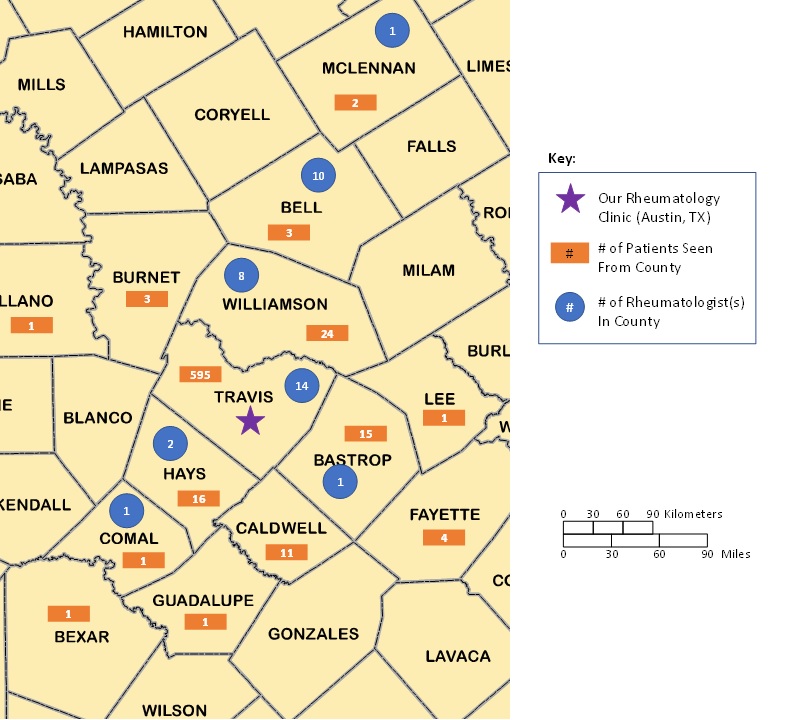
Thirteen percent of patients travelled from outside of Travis county for an appointment. Image 1 shows that many passed other rheumatologists in surrounding counties. The furthest patient travelled from Lubbock county 375 miles away.
Conclusion: This study showed our clinic provided access to a diverse underserved population in need of rheumatologic care. A large portion already held a rheumatic diagnosis and unfortunately many had active, and even erosive disease, at the time of initial visit. While the majority are Travis county residents with MAP coverage, there were many who travelled out of county to see us. To continue to promote health equity, areas identified for improvement include understanding why many patients did not come to their initial visit, accurate referral tracking, learning surrounding county charitable care options, and engaging local rheumatologists in this process.

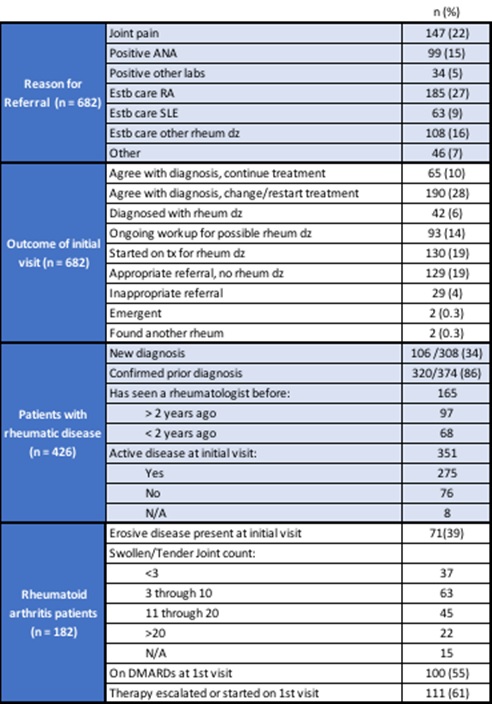
Of note, those marked “N/A” were telehealth visits and physical exams were not performed.
To cite this abstract in AMA style:
Patel V, Patel R, Hackshaw K. Rheumatology Care for the Underserved in Central Texas [abstract]. Arthritis Rheumatol. 2021; 73 (suppl 9). https://acrabstracts.org/abstract/rheumatology-care-for-the-underserved-in-central-texas/. Accessed .« Back to ACR Convergence 2021
ACR Meeting Abstracts - https://acrabstracts.org/abstract/rheumatology-care-for-the-underserved-in-central-texas/