
Session Information
Session Type: Poster Session C
Session Time: 10:30AM-12:30PM
Background/Purpose: Rheumatology is often viewed as a niche and intellectually demanding subspecialty in internal medicine (IM). Consequently, there is a trend toward lower In-Training Examination (ITE) scores in this area, which are predictive of American Board of Internal Medicine (ABIM) exam performance. Structured electives improve outcomes but are not mandatory, leading to variable rheumatology exposure. Traditional lectures dominate teaching, however, with a new generation of learners, gamification, described as the of applying game elements in education, has shown promise in enhancing engagement, motivation, and knowledge retention. To date, its application in rheumatology board preparation remains underexplored. We developed Rheum4Games (R4G), a Snakes-and-Ladders-style game to reinforce high-yield rheumatology concepts. We hypothesized that this format would enhance resident engagement, confidence, and ITE performance.
Methods: This pre-post intervention study examined the impact of a gamified rheumatology board review on resident satisfaction and ITE scores. Five IM residency programs (4 community, 1 university) incorporated R4G into their didactic curricula. A total of 12 sessions were conducted with 121 participants. A total of 45 questions with short explanations were developed using ABIM blueprint, reviewed by experts (5 rheumatologists, 2 internists), and piloted prior to implementation. Sessions included a pre-survey, R4G session, and post-survey. ITE scores and confidence levels were compared pre- and post-intervention utilizing Mann-Whitney U tests, while descriptive statistics were used for survey results.
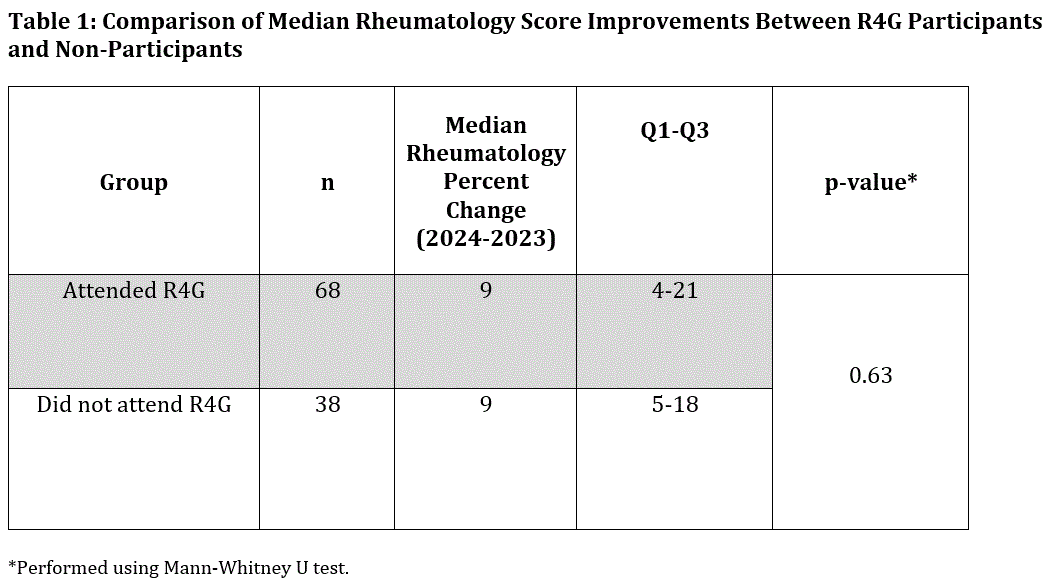
Results: A total of 121 residents participated, with high pre- and post-session survey completion rates (97.5% and 96.7%, respectively). Among the 106 residents with matched ITE data (defined as those with available scores for both the 2023 and 2024 ITE exams), there was no significant difference in the median score change between R4G participants and non-participants (Table 1). However, a subgroup analysis revealed that R4G participants from community-based programs demonstrated significantly greater score improvement compared to those from university settings. In addition, self-reported confidence in the rheumatology section of the ITE/ABIM improved significantly post-session (p < 0.0001; Figure 1). Residents rated the session highly for enjoyment, engagement, and educational value (Figure 2), and open-ended responses highlighted the activity’s interactivity, effectiveness, and novelty.
Conclusion: R4G effectively enhanced resident engagement, confidence, and satisfaction, as evidenced by high survey ratings and significant self-reported gains in preparedness for the ITE/ABIM rheumatology content. While overall ITE score improvements were not statistically significant, the greater gains observed in community programs suggest that R4G may be beneficial in settings with less structured rheumatology exposure. Further studies should explore the long-term retention effects of game-based learning as well as potential strategies to optimize its effectiveness in diverse training environments.
.gif)
.gif)
To cite this abstract in AMA style:
Kiwalkar S, Schermerhorn M, Donohue S, Sharkey C. Rheum4Games: A Game-Based Rheumatology Board Review for Internal Medicine Residents [abstract]. Arthritis Rheumatol. 2025; 77 (suppl 9). https://acrabstracts.org/abstract/rheum4games-a-game-based-rheumatology-board-review-for-internal-medicine-residents/. Accessed .« Back to ACR Convergence 2025
ACR Meeting Abstracts - https://acrabstracts.org/abstract/rheum4games-a-game-based-rheumatology-board-review-for-internal-medicine-residents/