
Session Information
Session Type: Poster Session (Tuesday)
Session Time: 9:00AM-11:00AM
Background/Purpose: Women of reproductive age with rheumatic diseases are often prescribed teratogenic medications; thus, reproductive counseling is important. A prior study demonstrated improvement in counseling documentation from 30% to 45% after a quality improvement (QI) initiative [1]. In this study, we aimed (1) to determine the rate of reproductive counseling documentation within an urban, academic teaching clinic and (2) to determine patient factors associated with a lack of reproductive counseling documentation in female patients with rheumatic disease who are prescribed teratogenic medications.
Methods: Patients were identified from the Rheumatology Fellows’ Teaching Clinic at the Hospital for Special Surgery, which serves individuals enrolled in Medicaid or Medicare. All patients who were female, 18 – 45 years-old, and prescribed mycophenolate mofetil, mycophenolic acid, methotrexate, leflunomide, or cyclophosphamide were included. The electronic medical record (EMR) was reviewed for age at last visit, self-reported race/ethnicity, rheumatic disease, duration of patient-physician relationship, marital status, and antiphospholipid (APL) antibody status. The outcome was reproductive counseling as documented in the EMR, defined as present if the physician referenced reproductive counseling in any encounter when the teratogen was prescribed. Patient characteristics were compared using Fisher’s exact, Chi-squared, Wilcoxon rank-sum, and t- tests where appropriate. Logistic regression was used to determine if age, teratogen prescribed, or disease type were independent predictors of counseling documentation status.
Results: 45 women (mean (SD) age 34 (6.76) years old) met inclusion criteria (Table 1). 47% were Hispanic, 30% were Black, and 40% were diagnosed with systemic lupus erythematosus. Reproductive counseling was documented in 73% of patients over a median [IQR] physician-patient relationship of 1.3 years [0.44, 1.74]. Of 12 patients without reproductive counseling documented, 5 (42%) were not using contraception. There was no statistically significant difference in race/ethnicity, language, disease, marital status, teratogen prescribed, APL status, disease duration, or age between those with or without documented counseling. By univariate analysis, disease type, teratogen prescribed, and age were not independent predictors of reproductive counseling documentation status (Table 2).
Conclusion: Reproductive counseling was documented in 73% of reproductive-aged women prescribed teratogenic medications. We identified no patient factors to predict the absence of counseling documentation in the remaining 27%. This underscores the need for additional work in larger samples to identify potential patient- and/or physician-related factors associated with a lack of reproductive counseling documentation as well as QI initiatives to improve documentation and counseling rates.
Reference: [1] Sadun RE, et al. Increasing contraception use among women receiving teratogenic medications in a rheumatology clinic. BMJ Open Quality 2018;7:e000269
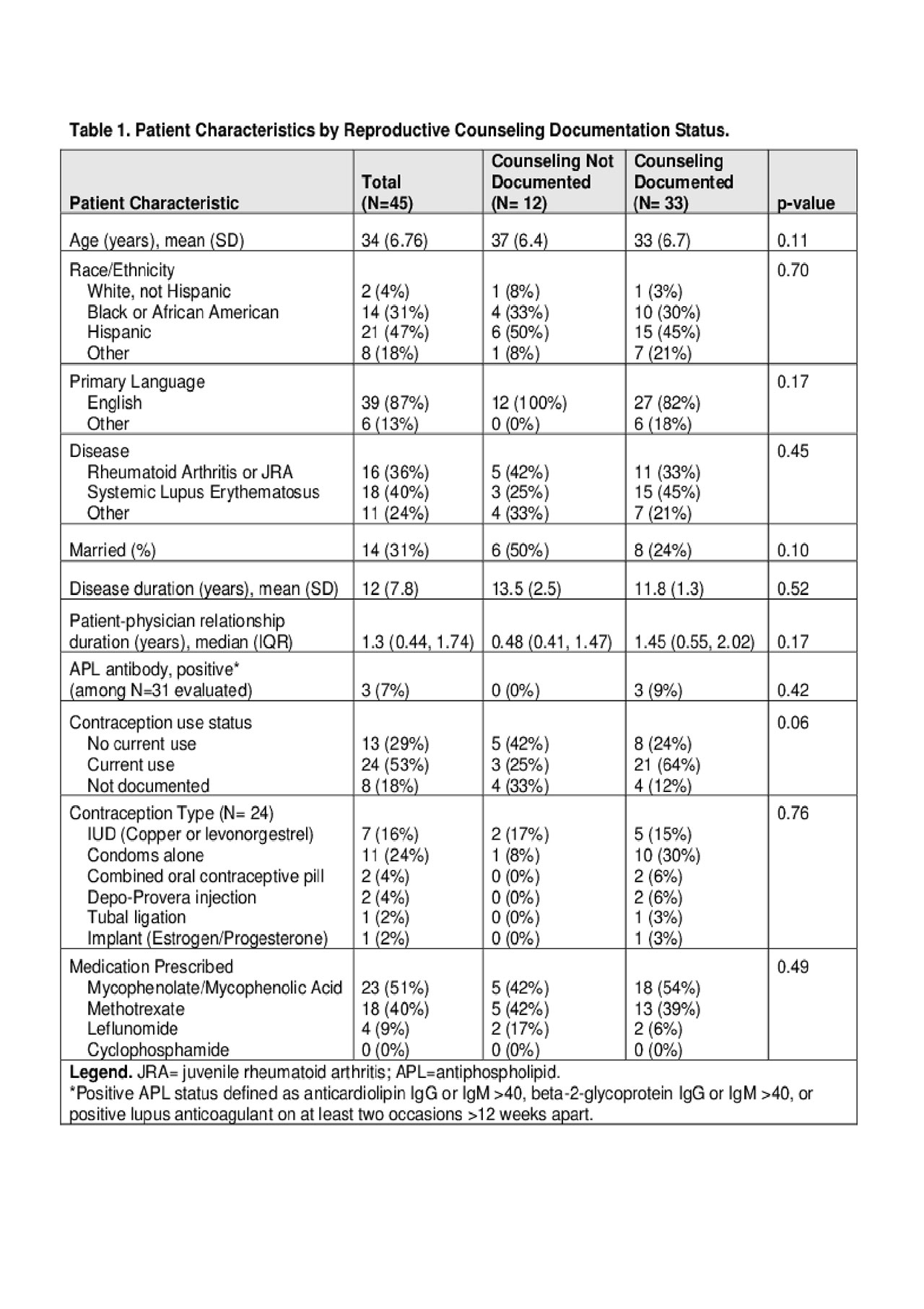
Table 1
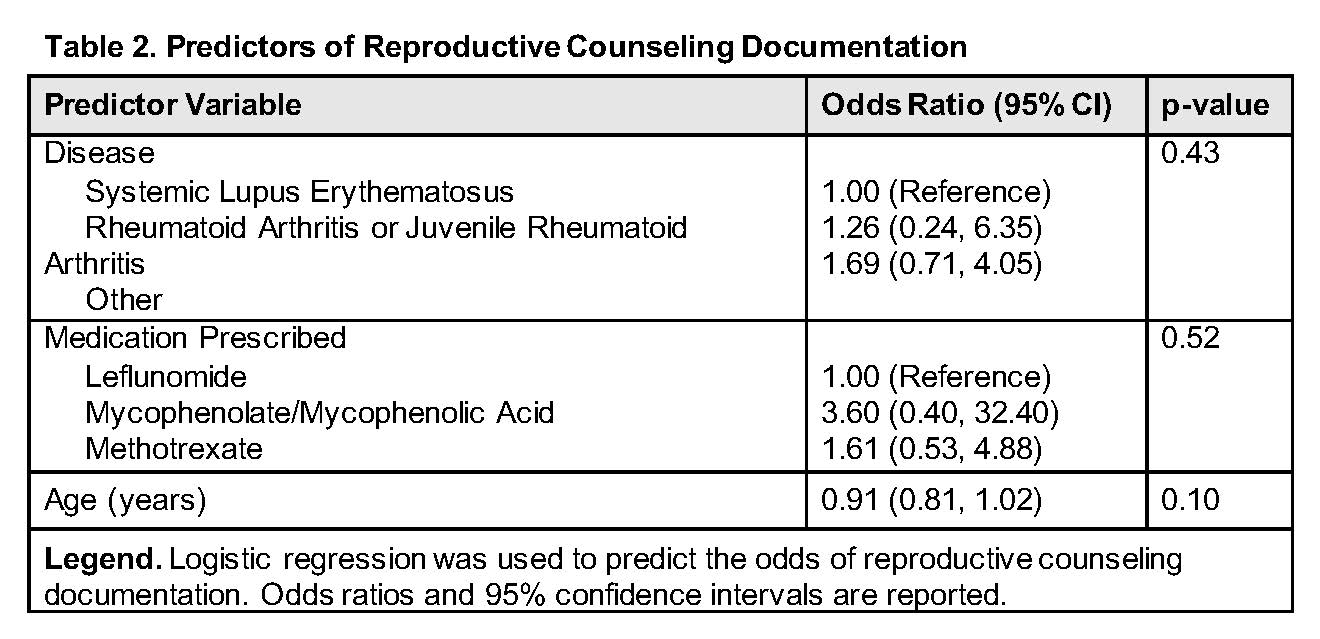
Table2_QI
To cite this abstract in AMA style:
Showalter K, Smith M, Cheah J, Ghosh N, Gkrouzman E, Lieber S, Sattui S, Schwartz N, Schwartzman M, Berman J, Sammaritano L, Bass A. Reproductive Counseling Documentation Practices for Women Receiving Teratogenic Medications in an Academic Rheumatology Clinic Serving a Medicaid/Medicare Patient Population [abstract]. Arthritis Rheumatol. 2019; 71 (suppl 10). https://acrabstracts.org/abstract/reproductive-counseling-documentation-practices-for-women-receiving-teratogenic-medications-in-an-academic-rheumatology-clinic-serving-a-medicaid-medicare-patient-population/. Accessed .« Back to 2019 ACR/ARP Annual Meeting
ACR Meeting Abstracts - https://acrabstracts.org/abstract/reproductive-counseling-documentation-practices-for-women-receiving-teratogenic-medications-in-an-academic-rheumatology-clinic-serving-a-medicaid-medicare-patient-population/