
Session Information
Title: Systemic Lupus Erythematosus - Clinical Aspects I - Renal, Malignancy, Cardiovascular Disease
Session Type: Abstract Submissions (ACR)
Background/Purpose: 25(OH)D deficiency has been associated with increased cardiovascular disease (CVD) in the general population. We investigated the relationship between 25(OH)D and CVD events in a large international inception cohort of women and men with Systemic Lupus Erythematosus (SLE).
Methods: Baseline data were collected from 890 patients enrolled in the Systemic Lupus International Collaborating Clinics (SLICC) inception cohort. Those with previous CVD events (N=2) or who were pregnant (N=13) were excluded. CVD events and dates were recorded between 2000-2011. The intraassay and interassay coefficients of variation for the 25(OH)D testing were 10.8% and 9.4%, respectively. Linear regression models of 25(OHD) in quartiles with risk factors were examined. These models were then adjusted for age, sex, race, season, and country, all with and without body mass index. Cox proportional hazards models were used to investigate the relationship between 25(OH)D levels and CVD events (stroke, congestive heart failure, myocardial infarction, transient ischemic attack, angina, peripheral vascular disease).
Results: Of the 875 included patients, 786 (89.2%) were female and 89 were male with a mean ± SD age of 38.9 ± 13.1 and 42.9 ± 16.4 years, respectively, and mean ± SD 25(OH)D level of 23.8 ± 13.4 ng/ml. The quartile ranges were: 1st quartile (Q1) 3.6 – <13.4 ng/ml, 2nd quartile (Q2) 13.4 – <21.6 ng/ml, 3rd quartile (Q3) 21.6 – <30.8 ng/ml, 4th quartile (Q4) 30.8 – <91.3 ng/ml. Corticosteroids were used in 67% at baseline with a mean dose of 23.3 ± 15.9 mg daily. Renal disease by ACR criteria was present in 26%, 32% were taking calcium and 25% vitamin D supplementation. Hypertension (HTN) and hyperlipidemia (HL) were present in 34% and 15.7%, respectively. Diabetes was present in 6.5%.
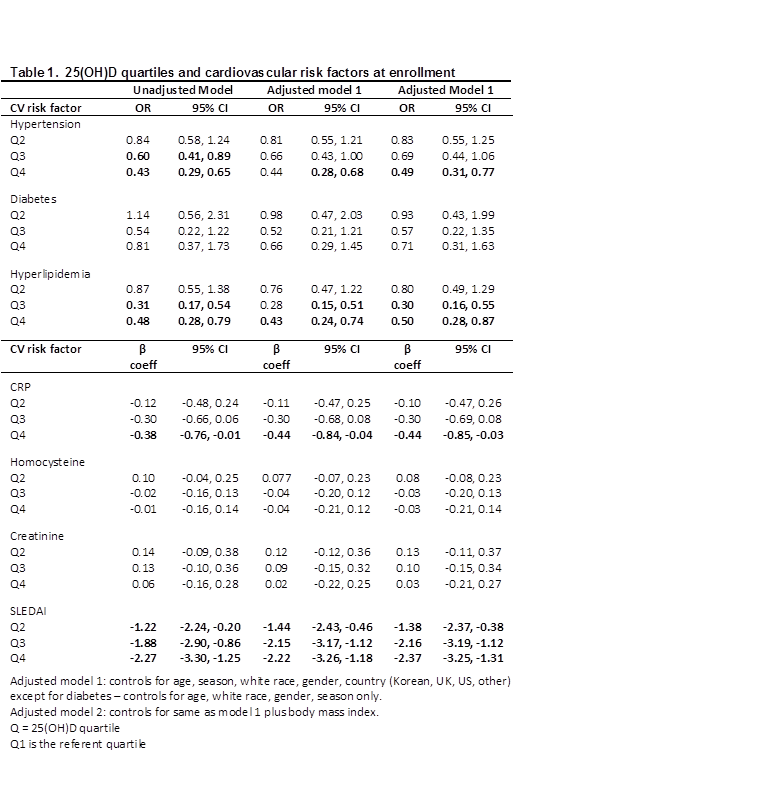
Compared with Q1, those in the higher quartiles of 25(OH)D were less likely to have HTN or HL (Table 1). Those in the highest quartile of 25(OH)D were more likely to have lower C-reactive protein levels when compared with Q1. Each successively higher quartile was more likely to have lower Systemic Lupus Erythematosus Disease Activity Index 2000 (SLEDAI-2K) compared with Q1.
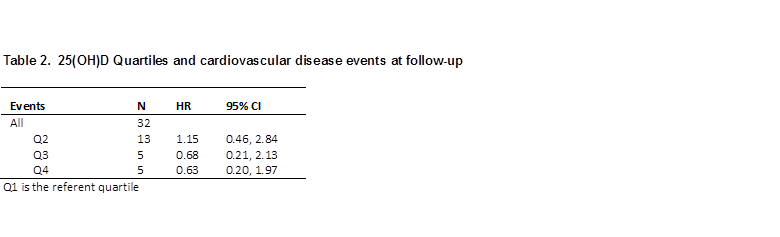
25(OH)D levels were not associated with occurrence of CVD events (Table 2). The hazard ratios for CV occurrence in Q3 and Q4 were lower when compared with Q1.
Conclusion: While higher levels of 25(OH)D are associated with lower likelihood of HTN and HL and less disease activity at baseline as measured by the SLEDAI-2K, 25(OH)D levels are not independently associated with likelihood of CVD events in patients with SLE. There may be a trend towards a lower likelihood of CVD events in those in the highest 25(OH)D quartiles.
Disclosure:
A. Lertratanakul,
None;
P. Wu,
None;
A. Dyer,
None;
D. D. Gladman,
None;
M. B. Urowitz,
None;
P. R. Fortin,
None;
D. Ibanez,
None;
R. Ramsey-Goldman,
None;
F. T. S. L. I. C. C. (SLICC),
None.
« Back to 2013 ACR/ARHP Annual Meeting
ACR Meeting Abstracts - https://acrabstracts.org/abstract/relationship-between-25-hydroxyvitamin-d-25ohd-and-risk-for-cardiovascular-events-in-systemic-lupus-erythematosus-over-11-years-in-an-inception-cohort/