
Session Information
Session Type: ACR Poster Session B
Session Time: 9:00AM-11:00AM
Background/Purpose: There is increasing evidence that allopurinol may be protective of kidney function among hyperuricemic subjects, though clinicians are often cautious about using allopurinol in renal insufficiency. Further, studies have been conflicting and few have involved patients with gout. We sought to evaluate the relation of allopurinol to kidney function among gout patients with chronic kidney disease (CKD) stage 3-4 at the start of therapy.
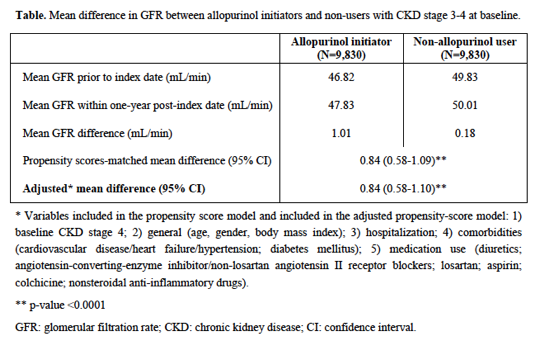
Methods: We conducted a time-stratified propensity score (PS)-matched cohort study in The Health Improvement Network (THIN), a general practitioner electronic medical records database representative of the UK general population. Our study sample included subjects 18-89 years-old with gout and CKD 3 or 4 who had not previously been on urate-lowering therapy. We used PS matching to minimize the effects of confounding by indication. Specifically, we identified new users of allopurinol among this cohort, and matched them 1:1 with an unexposed subject based on the PS using greedy matching within 1-year cohort accrual blocks. We computed the PS using logistic regression, with incident allopurinol use as the dependent variable and potential confounders that reflect indication for allopurinol use and/or risk of CKD (table) as the independent variables. Subjects were followed from the index date (date of 1st allopurinol prescription for the exposed, and randomly assigned date for the unexposed within the 1-year accrual block) until the last glomerular filtration rate (GFR) assessment within 1 year after the index date (before dialysis, kidney transplant, or death if they occurred), or end of study. We analyzed the relation of incident allopurinol use to the changes in GFR using linear regression adjusted for the potential confounders included in the PS model.
Results: Of those with a diagnosis of gout and CKD 3-4, we PS-matched 9,830 allopurinol initiators to 9,830 non-users, among whom 41% and 42% were female. Other covariates were also well-balanced, with mean age of 74 years, mean BMI of 30 kg/m2 and 9% of CKD4 subjects in both groups. Time to post-baseline GFR, and dialysis/transplant were similar in both groups. The mean GFR prior to study entry was 46.8 mL/min among allopurinol initiators and 49.8 mL/min among non-users, while the last GFR within one year was 47.8 and 50.0 mL/min, respectively. Allopurinol initiators had an adjusted mean increase in GFR that was 0.8 mL/min (95% CI 0.6-1.1) greater than that of the non-users (Table).
Conclusion: In this community-based cohort, allopurinol use appeared to confer a renoprotective effect among those with pre-existing CKD 3-4 and gout, suggesting that allopurinol does not contribute to worsening renal function among gout patients with renal insufficiency. Physicians should seek other contributors to renal function decline in patients on allopurinol with concomitant gout and CKD if renal function deteriorates.
To cite this abstract in AMA style:
Vargas-Santos AB, Peloquin C, Zhang Y, Neogi T. Protective Effect of Allopurinol Use on Kidney Function Among Patients with Gout and Chronic Kidney Disease [abstract]. Arthritis Rheumatol. 2017; 69 (suppl 10). https://acrabstracts.org/abstract/protective-effect-of-allopurinol-use-on-kidney-function-among-patients-with-gout-and-chronic-kidney-disease/. Accessed .« Back to 2017 ACR/ARHP Annual Meeting
ACR Meeting Abstracts - https://acrabstracts.org/abstract/protective-effect-of-allopurinol-use-on-kidney-function-among-patients-with-gout-and-chronic-kidney-disease/