
Session Information
Date: Sunday, November 13, 2016
Title: Metabolic and Crystal Arthropathies - Poster I: Clinical Practice
Session Type: ACR Poster Session A
Session Time: 9:00AM-11:00AM
Background/Purpose: Chronic hyperuricemia predisposes to deposition of monosodium urate (MSU) crystals in musculoskeletal and other tissues, causing chronic inflammation, acute gout flares, joint damage, and disfiguring tophi. Dual-energy computed tomography (DECT) is a useful imaging tool to detect and quantify MSU crystal deposits. This study assessed the evidence of MSU crystal deposition using DECT scanning among gout patients treated with allopurinol and the potential determinants associated with the observed deposits.
Methods: This multicenter DECT study recruited gout patients from the USA and New Zealand who were taking allopurinol at ≥300 mg daily for at least 3 months. MSU crystal deposition was measured using DECT in hands/wrists, knees, and feet/ankles bilaterally. The presence of MSU crystals as well as the total volume of crystals were assessed according to gout characteristics and serum uric acid (sUA) levels.
Results: Patients (N=147) were predominately male (91.8%), with mean (SD) age 58.7 (10.9) years and gout duration 15.3 (11.1) years. Mean sUA prior to scanning (within 1 month) was 6.0 (1.6) mg/dL, with approximately 46% of patients above the sUA target of 6.0 mg/dL. The median allopurinol dose was 300 mg (range, 300-700 mg) daily. 67.8% of patients had MSU crystal deposits with a total median crystal volume of 0.06 cm3 (range, 0 to 19.53 cm3). Those with sUA ≥6.0 mg/dL and palpable tophi showed the highest prevalence of urate deposits (88%), and those with sUA <6.0 mg/dL and no palpable tophi showed the lowest prevalence (47%). Those who reported a gout flare within the prior 3 months (versus none), were prescribed allopurinol doses >300 mg (versus 300 mg), and had palpable tophi (versus none) were more likely to have deposition.
Conclusion: Despite a stable dose of allopurinol for more than 3 months, and even with sUA at the target level, a substantial proportion of gout patients continue to have evidence of MSU crystal deposition by DECT scan. Patients with palpable tophi, sUA levels ≥6.0 mg/dL, and gout flares within the prior 3 months appear to have a higher frequency of MSU crystal deposition. These patients may need continuation and/or intensification of their urate-lowering therapy regimen. 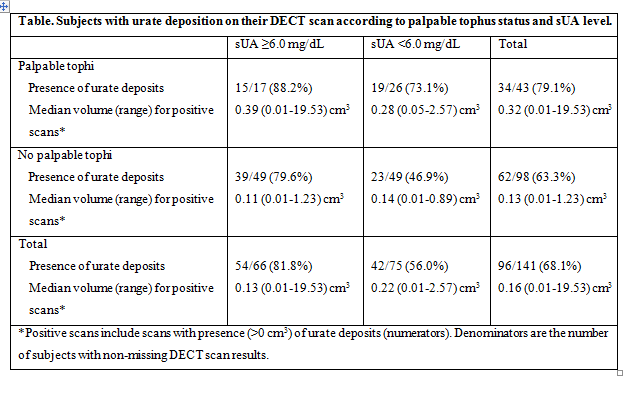
To cite this abstract in AMA style:
Dalbeth N, Nicolaou S, Baumgartner S, Hu J, Fung M, Choi HK. Presence of Monosodium Urate Crystals By Dual-Energy Computed Tomography in Gout Patients Treated with Allopurinol [abstract]. Arthritis Rheumatol. 2016; 68 (suppl 10). https://acrabstracts.org/abstract/presence-of-monosodium-urate-crystals-by-dual-energy-computed-tomography-in-gout-patients-treated-with-allopurinol/. Accessed .ACR Meeting Abstracts - https://acrabstracts.org/abstract/presence-of-monosodium-urate-crystals-by-dual-energy-computed-tomography-in-gout-patients-treated-with-allopurinol/