
Session Information
Session Type: Abstract Session
Session Time: 1:00PM-2:30PM
Background/Purpose: After knee replacement (KR), most adults fail to meet recommended levels of physical activity. Virtual options to promote physical activity in clinical populations have been explored; however, less is known about the promise of virtual programs for adults with KR. Therefore, this study conducted entirely remotely, examined the effects of a 12-week fully automated online physical activity program (Energize!) on ActiGraph-assessed physical activity and patient-reported outcomes in adults with KR.
Methods: Physically inactive adults (self-reporting < 60 min/week of exercise) with KR ≥1 year ago were recruited nationwide from ResearchMatch.org and were randomized to either start the Energize! program immediately or after 12 weeks (waitlist control). Energize! consists of weekly, behavioral-based video lessons and a website to plan and track weekly activity and receive automated feedback tailored to their weekly goals. Incremental moderate to vigorous intensity physical activity (MVPA) goals progressed from 75 min/week to 200 min/week. Weekly MVPA (≥2020 counts/min) and steps/day were assessed at baseline and 12 weeks with a waist-worn ActiGraph GT9x Link accelerometer for 7 days. Patient-reported outcomes including PROMIS physical function, pain interference, cognitive function, and pain intensity were also assessed at baseline and 12 weeks. Intent-to-treat (ITT) analysis using repeated measures ANOVA assessed changes and differences between groups in physical activity and self-reported outcomes at 12-weeks.
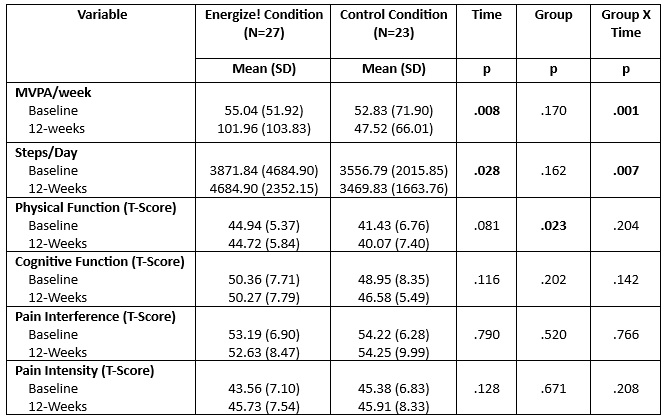
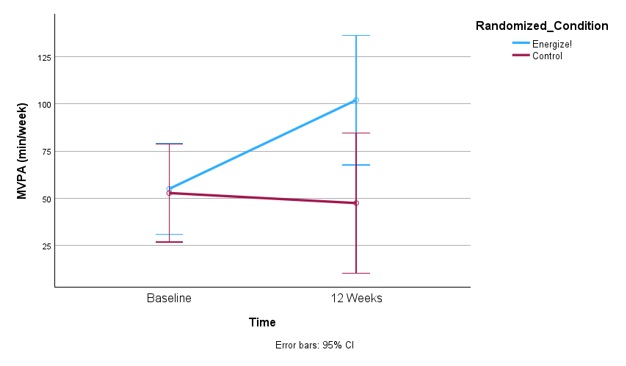
Results: Fifty participants representing 23 US States were recruited and randomized (80% female, 92% white, 68.0 ± 6.8 years, BMI 32.4 ± 6.6 kg/m2, 6.1 ± 5.1 years since KR surgery). Retention at 12 weeks was higher in the Control group (95.6%) than Energize! (70.2%, p=0.02). No adverse events were related to participation in the study. Weekly adherence among completers (n=19) to the Energize! online program was 93.4% for video lessons, 87.6% planning of physical activity, and 89.9% for logging physical activity. ITT analyses revealed a significant time (p< 0.05) and group by time interaction (p< 0.01) for MVPA (Figure 1) and steps/day. The change in physical activity from baseline to 12 weeks was significantly greater in Energize! (MVPA: 47.0 ± 68.5 min/week; steps: 813.1 ± 1165.1 steps/day) versus the Control group (MVPA: -5.3 ± 23.5 min/week; steps: -87.0 ± 1078.5 steps/day). There were no differences across time or between groups for pain interference, pain intensity, physical function, or cognitive function (Table 1).
Conclusion: A fully automated online program was effective at increasing physical activity levels in adults with KR at 12 weeks. Future studies should examine the long-term effects of this online program to examine maintenance of physical activity levels and potential improvements in patient-reported outcomes. Additionally, strategies to maintain engagement and retention in fully remote programs should be explored.
To cite this abstract in AMA style:
Jamieson S, Unick J, Horn K, Prine H, Yang C, Pellegrini C. Preliminary Effects of a Fully-Remote Online Physical Activity Program Following Knee Replacement [abstract]. Arthritis Rheumatol. 2024; 76 (suppl 9). https://acrabstracts.org/abstract/preliminary-effects-of-a-fully-remote-online-physical-activity-program-following-knee-replacement/. Accessed .« Back to ACR Convergence 2024
ACR Meeting Abstracts - https://acrabstracts.org/abstract/preliminary-effects-of-a-fully-remote-online-physical-activity-program-following-knee-replacement/