
Session Information
Date: Monday, November 8, 2021
Session Type: Poster Session C
Session Time: 8:30AM-10:30AM
Background/Purpose: The patient’s global assessment (PGA) and physician global assessment (PhGA) are important outcomes and commonly used in rheumatoid arthritis (RA) clinical practice. Both measures are included as a part of activity indices and core sets. Up to half of patients have been reported to have discordant results between the two measurements, depending on the cut-off value. PGA was usually higher than PhGA. Understanding the reasons of this discrepancy might be important to decide treatment strategy. We aim to evaluate frequency and predictors of discordance between PGA and PhGA in patients with RA.
Methods: Two hundred-thirty three consecutive RA patients were recruited to this single center cross-sectional study. All participants met the ACR 2010 classification criteria. Demographics, clinical parameters and laboratory data were collected by using a structured form. Tender (TJC) and swollen joint count (SJC) was assessed by the same rheumatologist. Disease activity was evaluated by using clinical disease activity index (CDAI) and disease activity score 28 -C-reactive protein (DAS28-CRP). PGA, PhGA and pain were measured on a visual analog scale (VAS) ranging between 0 to 100 mm. Discordance was defined as more than 30 mm differences between PGA and PhGA. Spearman correlation and logistic regression analyses were used for association and predictors of discordance. In the multivariable model, we used independent variables which were found to have a p value of < 0.20 in univariate analyses.
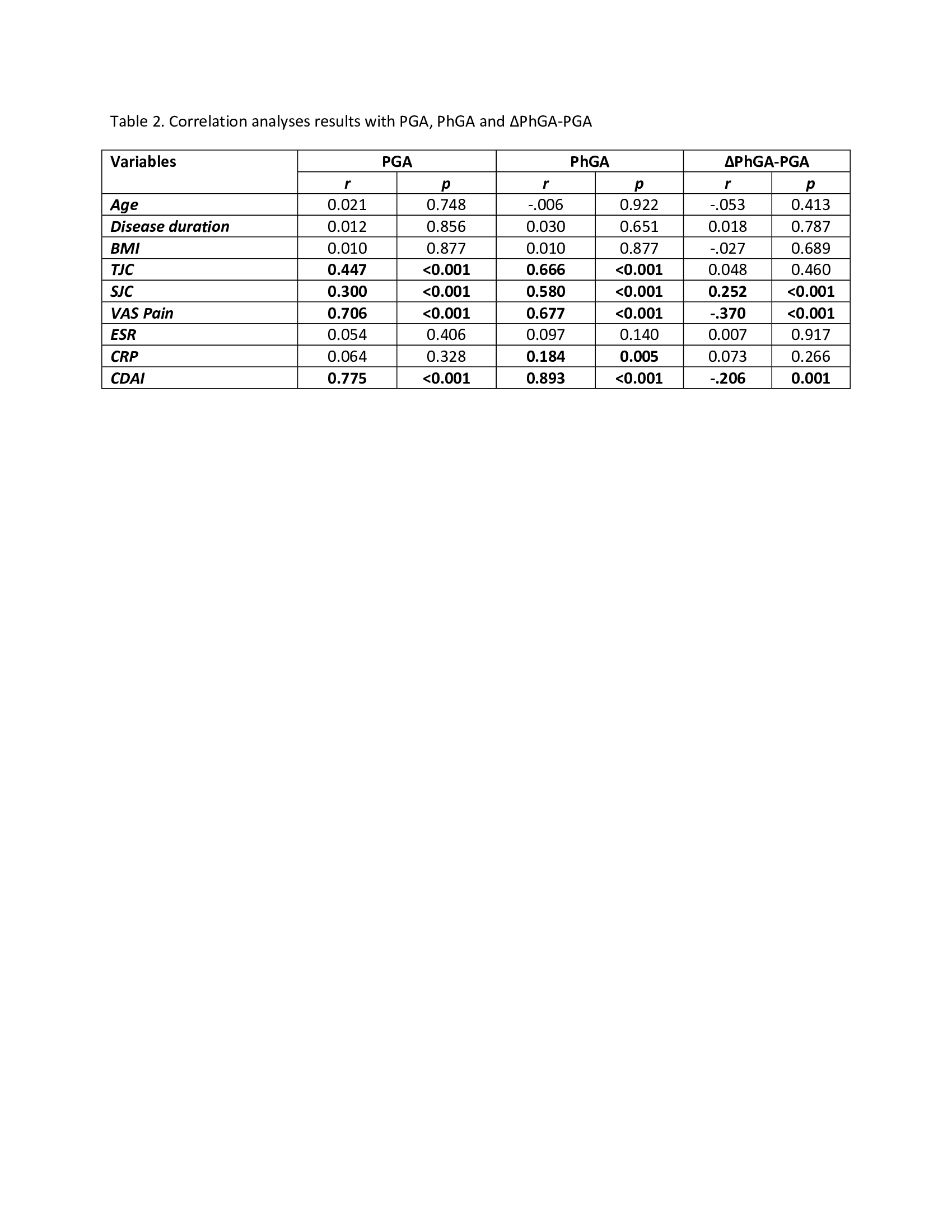
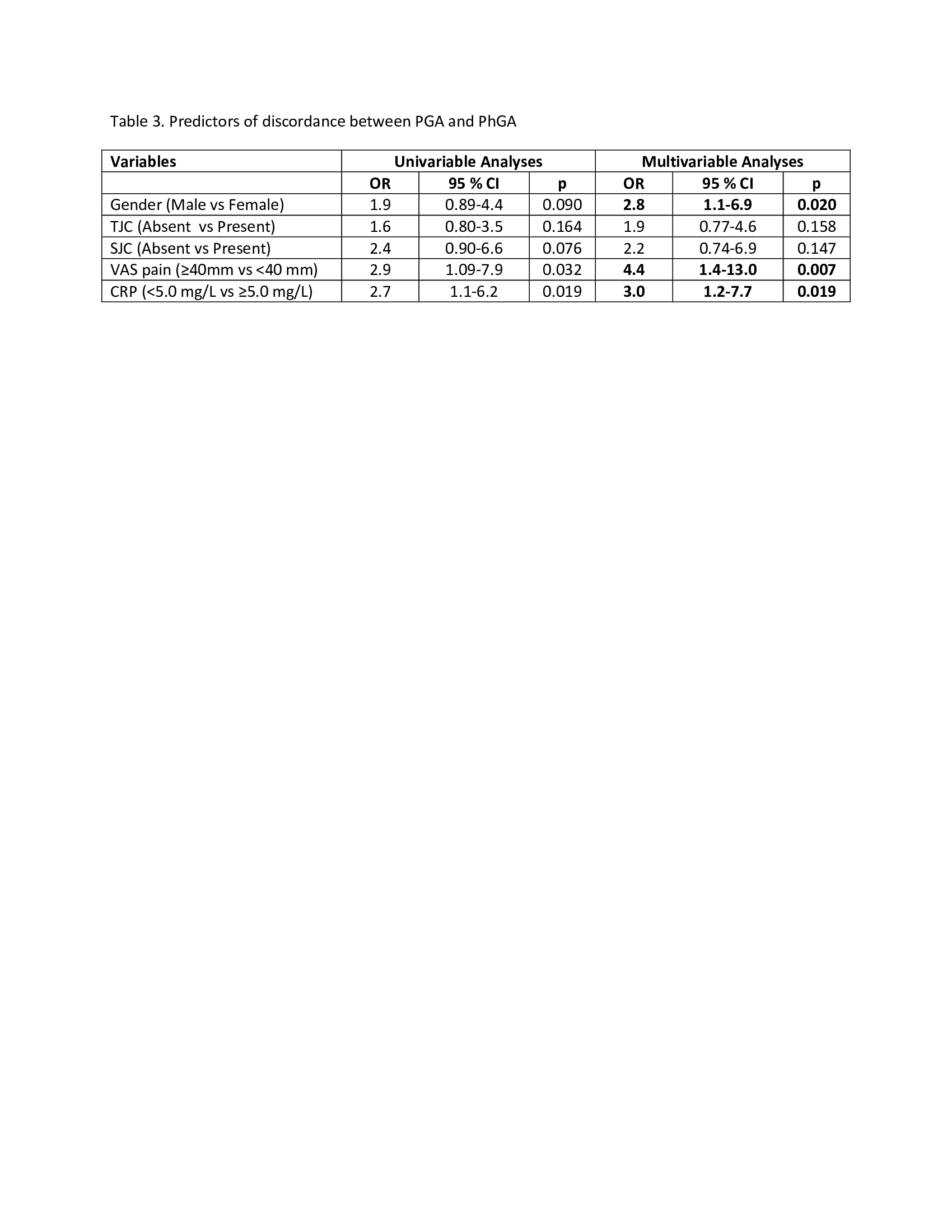
Results: One hundred eighty-five (79.3 %) of the 233 patients were female, and the mean age was 56.7 ± 11.4 years. The frequency of discordance was found 15% (35/233) cut-off for ≥30 mm and 59.7% (139/233) for ≥20 mm. Age and gender were found similar in patient with or without discordance and the other demographics and clinical characteristics were summarized in table 1. Patients with discordant assessments had less tender and swollen joint count with less pain score on VAS. And also, discordance was found lower in remission and high disease activity group according to the CDAI. Difference between PGA and PhGA had been shown positively correlated with pain VAS but negatively with SJC and CDAI (Table 2). In multivariable model, male sex, having higher pain VAS and normal CRP levels were found to be predictors of discordance on PGA and PhGA (Table 3).
Conclusion: Discordance between patient and physician was more common in the absence of objective findings such as TJC, SJC and CRP. However male sex, higher VAS pain and normal level of CRP might independently predict disagreement. The majority of the problem was observed in patients with low and moderate disease activity. This can be affected the treatment decision of physician.
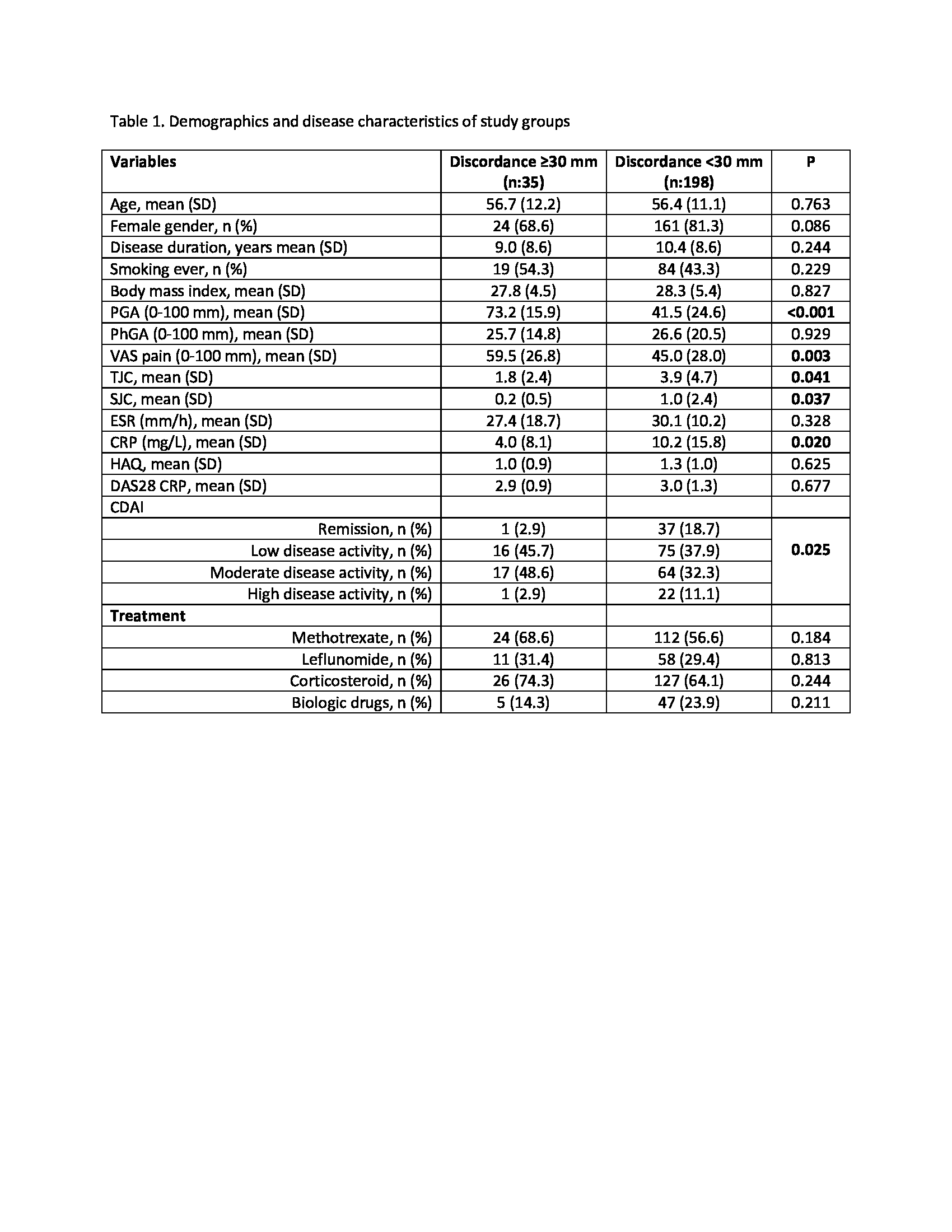 Table 1. Demographics and disease characteristics of study groups.jpeg”
To cite this abstract in AMA style:
Alp G, Solmaz D, Cinaklı H, Ediboglu E, OTMAN E, Erpek E, Akar S. Predictors of Discordance Between Patient and Physician Global Assessment in Patients with Rheumatoid Arthritis [abstract]. Arthritis Rheumatol. 2021; 73 (suppl 9). https://acrabstracts.org/abstract/predictors-of-discordance-between-patient-and-physician-global-assessment-in-patients-with-rheumatoid-arthritis/. Accessed .« Back to ACR Convergence 2021
ACR Meeting Abstracts - https://acrabstracts.org/abstract/predictors-of-discordance-between-patient-and-physician-global-assessment-in-patients-with-rheumatoid-arthritis/