
Session Information
Date: Monday, November 9, 2020
Title: RA – Diagnosis, Manifestations, & Outcomes Poster IV: Lifespan of a Disease
Session Type: Poster Session D
Session Time: 9:00AM-11:00AM
Background/Purpose: Accurate prediction of rheumatoid arthritis (RA) development in persons at risk can help to select individuals for early intervention trials. At-risk individuals exhibit a high prevalence of diverse symptoms 1,2 and information on the predictive ability of symptoms or symptom complexes is still largely lacking. We investigated if symptoms could predict RA development in persons at risk, using the validated ‘Symptoms in Persons At Risk of Rheumatoid Arthritis’ (SPARRA) questionnaire.
Methods: Individuals at-risk of RA from four different cohorts from the Netherlands (n=122), United Kingdom (n=77), Sweden (n=13) and Switzerland (n=20), were asked to complete the SPARRA questionnaire, consisting of 69 questions (previously described 3). Individuals were persons with anticitrullinated protein antibodies (ACPA) and/or rheumatoid factor (RF; n=135), having relevant symptoms (arthralgia suspicious for progression to RA) with or without RA-specific antibodies, (n=77) or first degree relatives (FDR, n=20) of RA patients. Follow up was ≥ 24 months or until clinical arthritis development. Univariable analyses preselecting possible predictors (Cox regression, p< 0.2) was followed by stepwise forward selection (p< 0.1) to create a multivariable prediction model. To test the added value of the SPARRA items over the clinical prediction model by van de Stadt et al 4, the likelihood ratio (LR) test was used to compare the van de Stadt model with and without SPARRA items
Results: The mean age of all participants was 51 years, 69% was female. In total, 58 persons (25%) developed clinical arthritis (n=23, 26, 7, 2 respectively in the 4 groups) after a median of 7 months (IQR 5.3 – 17.8). In total, 22 SPARRA questions were preselected and entered in the stepwise forward selection procedure. The symptoms that predicted time to development of arthritis are shown in table 1. The symptom ‘pain that moves from one side to the other’ showed added value to the van de Stadt model in predicting arthritis (LR test p = 0.012, AUC 0.73 (extended model) versus AUC 0.71 (van de Stadt model)).
Conclusion: Specific symptom details such as pattern of pain or degree of joint swelling can provide useful additional information to estimate a person’s RA risk. Our next steps are 1) to develop a new prediction model using both SPARRA data and clinical data and distinguishing between seropositive and seronegative individuals and 2) to create a shortened version of the SPARRA questionnaire to be used in prospective at-risk cohorts to enable homogenous symptom data collection. This will further improve our understanding of the prevalence and predictive ability of greatly diverse symptoms in different at-risk populations.
- Smolik I et al. J Rheumatol. 2013;40(6):818-24.
- Stack RJ et al. Arthritis Care Res (Hoboken). 2013;65(12):1916-26.
- van Beers-Tas MH et al. RMD Open. 2018;4(1):e000641.
- van de Stadt LA et al. Ann Rheum Dis. 2013;72(12):1920-6.
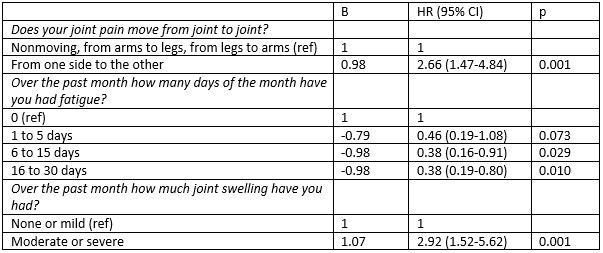 Table 1 Multivariable prediction model of SPARRA questions to predict clinical arthritis
To cite this abstract in AMA style:
van Boheemen L, ter Wee M, Falahee M, van Beers M, Finckh A, Hensvold A, Raza K, van Schaardenburg D. Predicting Rheumatoid Arthritis Using the Symptoms in Persons at Risk of Rheumatoid Arthritis (SPARRA) Questionnaire [abstract]. Arthritis Rheumatol. 2020; 72 (suppl 10). https://acrabstracts.org/abstract/predicting-rheumatoid-arthritis-using-the-symptoms-in-persons-at-risk-of-rheumatoid-arthritis-sparra-questionnaire/. Accessed .« Back to ACR Convergence 2020
ACR Meeting Abstracts - https://acrabstracts.org/abstract/predicting-rheumatoid-arthritis-using-the-symptoms-in-persons-at-risk-of-rheumatoid-arthritis-sparra-questionnaire/