ACR Meeting Abstracts

ACR Meeting Abstracts

  • Meeting Abstracts
    • All Meetings
    • PRSYM 2026
    • ACR Convergence 2025
    • Download Abstract Supplements
  • Keyword Index
  • Search
  • My Favorites
    • View and print all favorites
    • Clear all favorites

Abstract Number: 1411

Positivity of Anti-Ro/SSA Antibody Confer Poor Response and Persistence with Abatacept Therapy

Yushiro Endo1, Tomohiro Koga 1, Shin-ya Kawashiri 1, Ayako Nishino 1, Momoko Okamoto 1, Shimpei Morimoto 2, Sosuke Tsuji 1, Ayuko Takatani 1, Toshimasa Shimizu 1, Remi Sumiyoshi 1, Takashi Igawa 1, Naoki Iwamoto 1, Kunihiro Ichinose 1, Mami Tamai 1, Hideki Nakamura 1, Tomoki Origuchi 3, Yukitaka Ueki 4, Tamami Yoshitama 5, Nobutaka Eiraku 6, Naoki Matsuoka 7, Akitomo Okada 8, Keita Fujikawa 9, Hiroaki Hamada 10, Tomomi Tsuru 11, Shuji Nagano 12, Yojiro Arinobu 13, Toshihiko Hidaka 14, Yoshifumi Tada 15 and Atsushi Kawakami 16, 1Nagasaki University Graduate School of Biomedical Sciences, Department of Immunology and Rheumatology, Division of Advanced Preventive Medical Sciences, Nagasaki, Japan, 2Nagasaki University Hospital Clinical Research Centre, Nagasaki, Japan, 3Nagasaki University School of health sciences, Division of physical therapy, Nagasaki, Japan, 4Sasebo Chuo Hospital Rheumatic and Collagen Disease Center, Sasebo, Japan, 5Yoshitama Clinic for Rheumatic Diseases, Kirishima, Japan, 6Eiraku Clinic for Rheumatic Diseases, Kagoshima, Japan, 7Nagasaki Medical Hospital of Rheumatology, Nagasaki, Japan, 8Japanese Red Cross Nagasaki Genbaku Hospital, Nagasaki, Japan, 9JCHO Isahaya General Hospital Department of Rheumatology, Isahaya, Japan, 10Miyazaki University Hospital, Miyazaki, Japan, 11PS clinic, Fukuoka, Japan, 12Aso Iizuka Hospital, Iizuka, Japan, 13Department of Medicine and Biosystemic Science, Graduate School of Medical Sciences, Fukuoka, Japan, Fukuoka, Japan, 14Zenjinkai Shimin-no-Mori Hospital, Miyazaki, Japan, 15Saga University Hospital, Saga, Japan, 16Nagasaki University Graduate School of Biomedical Sciences, Department of Immunology and Rheumatology, Division of Advanced Preventive Medical Sciences, Nagasaki

Meeting: ACR/ARP Annual Meeting 2019

Keywords: Abatacept, rheumatoid arthritis, treatment and Sjogren's syndrome

  • Tweet
  • Email a link to a friend (Opens in new window) Email
  • Print (Opens in new window) Print
Session Information

Date: Monday, November 11, 2019

Title: RA – Treatments Poster II: Established Treatments

Session Type: Poster Session (Monday)

Session Time: 9:00AM-11:00AM

Background/Purpose: Rheumatoid arthritis (RA) occasionally overlaps Sjogren’s syndrome (SS), and RA patients with secondary SS have a higher disease activity of RA and worse joint damage compared with RA patients without SS.

A previous report indicated that the positivity of anti-Ro/SSA antibody (Ab), which is diagnostic maker for SS, was an independent factor associated with poor response to tumor necrosis factor inhibitors in RA patients. While, abatacept have showed the efficacy of both synovitis and glandular symptoms in RA patients with secondary SS. However, few reports show comparable efficacy of abatacept therapy between anti-Ro/SSA Ab-negative and -positive patients with RA.

To clarify whether the positivity of baseline anti-Ro/SSA Ab influence response to abatacept therapy, we compared clinical profiles between anti-Ro/SSA Ab-negative and -positive patients with RA using a multicenter RA ultrasonography prospective cohort.

Methods: We initially reviewed Japanese RA patients who newly started abatacept therapy as a first biological DMARDs between June 2013 and April 2018. Subsequently, we excluded patients whose baseline anti-Ro/SSA Ab status were uncleared and patients with baseline low disease activity at the initiation of abatacept therapy. Overall, enrolled total 51 patients were divided into anti-Ro/SSA Ab-negative and -positive groups of 35 and 16, respectively, according to the result of anti-Ro/SSA Ab assay. The Global OMERACT-EULAR Synovitis Score (GLOESS), which is composite PDUS scores of the greyscale (GS) and power Doppler (PD), was calculated at above examined 22 joints as an indicator of comprehensive ultrasonography activity.

Results: The median age at baseline was significantly higher in anti-Ro/SSA Ab-negative group (p = 0.04). Anti-Ro/SSA Ab-positive group had significantly higher frequencies of definite SS diagnosis and baseline antinuclear antibody > 80 times (p < 0.001, p = 0.02, respectively). The persistence ratio and the percentage of EULAR good responders at 12 months were significantly higher in anti-Ro/SSA Ab-negative group (p = 0.008, p = 0.02, respectively). Although there was no significant difference in changes in both SDAI and CDAI scores between anti-Ro/SSA Ab-negative and -positive groups, both DAS28-ESR and DAS28-CRP scores decreased significantly at 12 months in anti-Ro/SSA Ab-negative group (p = 0.02, p = 0.04, respectively). In addition, GLOESS scores also decreased significantly at 6 months in anti-Ro/SSA Ab-negative group (p = 0.03). Univariate and multivariate analyses showed that negativity of anti-Ro/SSA Ab was an independent factor associated with good responders to abatacept therapy.

Conclusion: Our results indicate that the positivity of anti-Ro/SSA Ab confer poor response and persistence to abatacept therapy by comprehensive assessments.
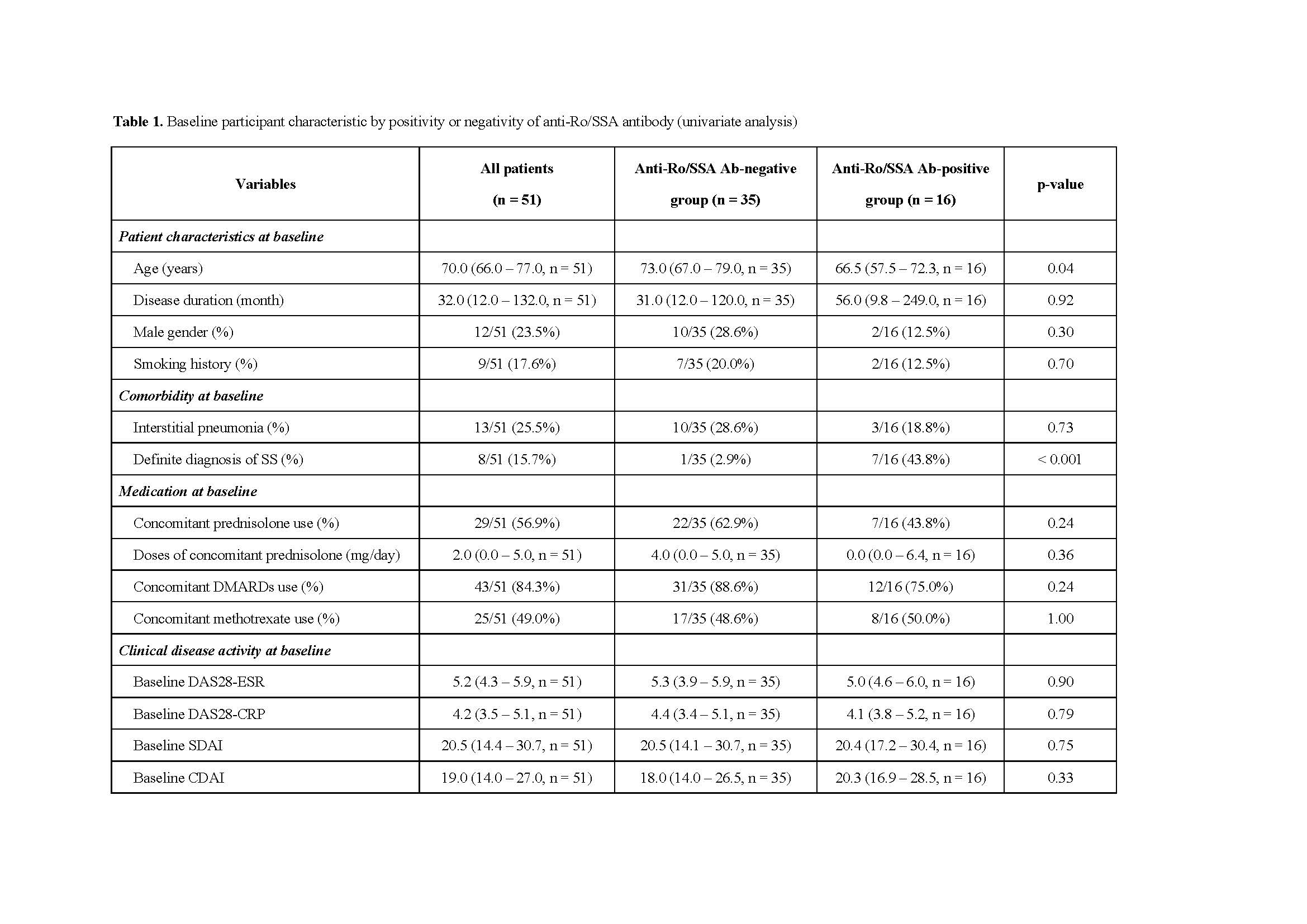

Table1

Table 1. Baseline participant characteristic by positivity or negativity of anti-Ro/SSA antibody -univariate analysis-


Figure1

Figure 1. Persistence, response, and each disease activity indicator at 6 or 12 months by positivity or negativity of anti-Ro/SSA antibody


Table2

Table 2. Comparison of selected variables associated with good responders to abatacept treatment in multiple logistic regression analysis -continuous variables-


Disclosure: Y. Endo, None; T. Koga, None; S. Kawashiri, None; A. Nishino, None; M. Okamoto, None; S. Morimoto, None; S. Tsuji, None; A. Takatani, None; T. Shimizu, None; R. Sumiyoshi, None; T. Igawa, None; N. Iwamoto, None; K. Ichinose, None; M. Tamai, None; H. Nakamura, None; T. Origuchi, None; Y. Ueki, None; T. Yoshitama, None; N. Eiraku, None; N. Matsuoka, None; A. Okada, None; K. Fujikawa, None; H. Hamada, None; T. Tsuru, None; S. Nagano, None; Y. Arinobu, None; T. Hidaka, None; Y. Tada, None; A. Kawakami, None.

To cite this abstract in AMA style:

Endo Y, Koga T, Kawashiri S, Nishino A, Okamoto M, Morimoto S, Tsuji S, Takatani A, Shimizu T, Sumiyoshi R, Igawa T, Iwamoto N, Ichinose K, Tamai M, Nakamura H, Origuchi T, Ueki Y, Yoshitama T, Eiraku N, Matsuoka N, Okada A, Fujikawa K, Hamada H, Tsuru T, Nagano S, Arinobu Y, Hidaka T, Tada Y, Kawakami A. Positivity of Anti-Ro/SSA Antibody Confer Poor Response and Persistence with Abatacept Therapy [abstract]. Arthritis Rheumatol. 2019; 71 (suppl 10). https://acrabstracts.org/abstract/positivity-of-anti-ro-ssa-antibody-confer-poor-response-and-persistence-with-abatacept-therapy/. Accessed .
  • Tweet
  • Email a link to a friend (Opens in new window) Email
  • Print (Opens in new window) Print

« Back to ACR/ARP Annual Meeting 2019

ACR Meeting Abstracts - https://acrabstracts.org/abstract/positivity-of-anti-ro-ssa-antibody-confer-poor-response-and-persistence-with-abatacept-therapy/

Advanced Search

My Favorites

Save and print abstracts during your browser session by clicking the “Favorite” button at the bottom of any abstract (must have cookies enabled in browser). See saved favorites.

Abstract Policies

  • ACR Convergence Abstract Embargo Policies
  • ACR Convergence Abstract Permissions & Reprints
  • PRSYM Abstract Policies

ACR Convergence. Where Rheumatology Meets

ACR Convergence 2026

Join us November 6-11 in Orlando, Florida.
See Registration Information

  • Contact ACR
  • Privacy Policy
  • ACR Policies
  • Cookie Preferences

© Copyright 2026 American College of Rheumatology