ACR Meeting Abstracts

ACR Meeting Abstracts

  • Meeting Abstracts
    • All Meetings
    • PRSYM 2026
    • ACR Convergence 2025
    • Download Abstract Supplements
  • Keyword Index
  • Search
  • My Favorites
    • View and print all favorites
    • Clear all favorites

Abstract Number: 1461

Peptidylarginine Deiminase-4 Antibodies Are Not Associated with Worse RA Activity, Symptoms or Impacts

Dana DiRenzo1, Erika Darrah2, Susan J. Bartlett3,4, Clifton O. Bingham III4 and Laura C. Cappelli1, 1Division of Rheumatology, Johns Hopkins University School of Medicine, Baltimore, MD, 2Department of Medicine/Division of Rheumatology, Johns Hopkins University School of Medicine, Baltimore, MD, 3Department of Medicine, Division of ClinEpi, Rheumatology, Respirology, McGill University, Montreal, QC, Canada, 4Rheumatology, Johns Hopkins University School of Medicine, Baltimore, MD

Meeting: ACR/ARHP Annual Meeting 2018

Keywords: outcome measures and rheumatoid arthritis (RA), PAD

  • Tweet
  • Email a link to a friend (Opens in new window) Email
  • Print (Opens in new window) Print
Session Information

Date: Monday, October 22, 2018

Title: Rheumatoid Arthritis – Diagnosis, Manifestations, and Outcomes Poster II: Diagnosis and Prognosis

Session Type: ACR Poster Session B

Session Time: 9:00AM-11:00AM

Background/Purpose:  

Antibodies to peptidylarginine deiminase (PAD) enzymes have been implicated in the pathogenesis of RA. Previous studies have shown that patients with PAD4 antibodies have more erosive joint disease compared to patients who do not. We hypothesized that patients with PAD4 antibodies would have more severe disease and report higher levels of RA symptoms and functional impacts than those without antibodies.

Methods:

Adults with MD-diagnosed RA enrolled in a longitudinal cohort study with serum available from the visit were included; almost all (96%) met 2010 ACR/EULAR RA criteria.  Anti-PAD4 antibodies were detected by immunoprecipitation. Independent t-tests and chi-square were used to compare patient and RA characteristics and selected patient reported outcomes (PROs: PROMISTM pain intensity, physical function, fatigue, ability to participate in social roles and activities, anxiety, depression, and sleep disturbance) by antibody status. 

Results:

Patients (n=151) had a mean age of 55 +/-13, were mostly female (80%), and white (85%). Most had longstanding RA (11 +/-10 years) with 35% in CDAI remission and 34% with low disease activity.  Nearly half (47%) were on a biologic, and 68% were on MTX. Anti-PAD antibodies and PROs were available on 135 patients (89%); baseline characteristics did not differ between those with and without completed PROs.  A total of 38 (28%) patients were anti-PAD4+. No significant differences were evident between groups in mean CDAI, SJC, PGA, EGA, stiffness severity, ESR, or CRP (Table 1). Although a higher proportion of anti-PAD4+ patients had erosions, there was no statistically significant difference between groups (Table 1). Mean PROMIS scores (pain intensity, physical function, fatigue, ability to participate in social roles and activities, anxiety, and depression) were in the normal range (i.e., 55-65) except pain intensity and physical function which were lower in both groups (Table 2); however, PRO scores were similar between groups. 

Conclusion:

In this well characterized cohort of RA patients, anti-PAD4+ patients had longer disease duration and a slightly lower TJC compared to patients without PAD antibodies. Anti-PAD4+ patients had a trend toward more erosive disease; but PROs were similar between groups. Contrary to expectations, anti-PAD4+ patients did not have clinical evidence of worse symptoms or functional impacts. The lack of congruency between bony damage and disease activity may suggest a difference in pathogenesis between these processes.
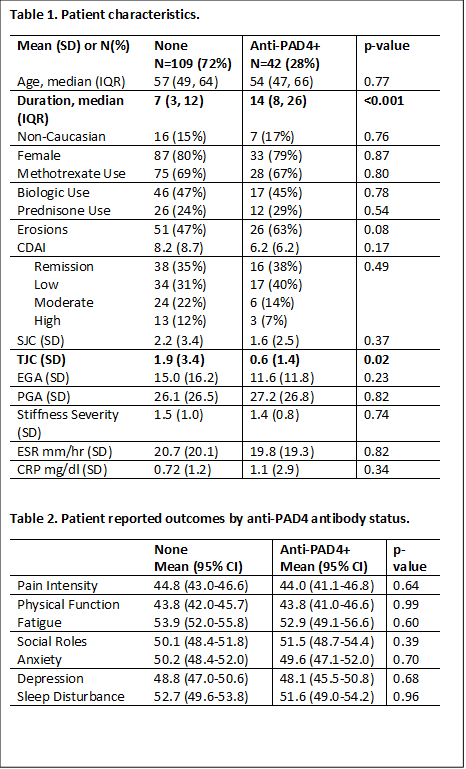
                                           

Table 1. Patient characteristics. Mean (SD) or N(%)	None N=109 (72%)	Anti-PAD4+ N=42 (28%)	p-value Age, median (IQR)	57 (49, 64)	54 (47, 66)	0.77 Duration, median (IQR)	7 (3, 12)	14 (8, 26)	<0.001 Non-Caucasian	16 (15%)	7 (17%)	0.76 Female	87 (80%)	33 (79%)	0.87 Methotrexate Use	75 (69%)	28 (67%)	0.80 Biologic Use	46 (47%)	17 (45%)	0.78 Prednisone Use	26 (24%)	12 (29%)	0.54 Erosions	51 (47%)	26 (63%)	0.08 CDAI	8.2 (8.7)	6.2 (6.2)	0.17 Remission Low Moderate High	38 (35%) 34 (31%) 24 (22%) 13 (12%)	16 (38%) 17 (40%) 6 (14%) 3 (7%)	0.49 SJC (SD)	2.2 (3.4)	1.6 (2.5)	0.37 TJC (SD)	1.9 (3.4)	0.6 (1.4)	0.02 EGA (SD)	15.0 (16.2)	11.6 (11.8)	0.23 PGA (SD)	26.1 (26.5)	27.2 (26.8)	0.82 Stiffness Severity (SD)	1.5 (1.0)	1.4 (0.8)	0.74 ESR mm/hr (SD)	20.7 (20.1)	19.8 (19.3)	0.82 CRP mg/dl (SD)	0.72 (1.2)	1.1 (2.9)	0.34 Table 2. Patient reported outcomes by anti-PAD4 antibody status.	None Mean (95% CI)	Anti-PAD4+ Mean (95% CI)	p-value Pain Intensity	44.8 (43.0-46.6)	44.0 (41.1-46.8)	0.64 Physical Function	43.8 (42.0-45.7)	43.8 (41.0-46.6)	0.99 Fatigue	53.9 (52.0-55.8)	52.9 (49.1-56.6)	0.60 Social Roles	50.1 (48.4-51.8)	51.5 (48.7-54.4)	0.39 Anxiety	50.2 (48.4-52.0)	49.6 (47.1-52.0)	0.70 Depression	48.8 (47.0-50.6)	48.1 (45.5-50.8)	0.68 Sleep Disturbance	52.7 (49.6-53.8)	51.6 (49.0-54.2)	0.96


Disclosure: D. DiRenzo, None; E. Darrah, Patent No. 8,975,033, 6, 9,Padlock Therapeutics, 6; S. J. Bartlett, None; C. O. Bingham III, None; L. C. Cappelli, Bristol-Myers Squibb, 2,Regeneron/Sanofi Genzyme, 5.

To cite this abstract in AMA style:

DiRenzo D, Darrah E, Bartlett SJ, Bingham III CO, Cappelli LC. Peptidylarginine Deiminase-4 Antibodies Are Not Associated with Worse RA Activity, Symptoms or Impacts [abstract]. Arthritis Rheumatol. 2018; 70 (suppl 9). https://acrabstracts.org/abstract/peptidylarginine-deiminase-4-antibodies-are-not-associated-with-worse-ra-activity-symptoms-or-impacts/. Accessed .
  • Tweet
  • Email a link to a friend (Opens in new window) Email
  • Print (Opens in new window) Print

« Back to ACR/ARHP Annual Meeting 2018

ACR Meeting Abstracts - https://acrabstracts.org/abstract/peptidylarginine-deiminase-4-antibodies-are-not-associated-with-worse-ra-activity-symptoms-or-impacts/

Advanced Search

My Favorites

Save and print abstracts during your browser session by clicking the “Favorite” button at the bottom of any abstract (must have cookies enabled in browser). See saved favorites.

Abstract Policies

  • ACR Convergence Abstract Embargo Policies
  • ACR Convergence Abstract Permissions & Reprints
  • PRSYM Abstract Policies

ACR Convergence. Where Rheumatology Meets

ACR Convergence 2026

Join us November 6-11 in Orlando, Florida.
See Registration Information

  • Contact ACR
  • Privacy Policy
  • ACR Policies
  • Cookie Preferences

© Copyright 2026 American College of Rheumatology