
Session Information
Date: Wednesday, November 16, 2016
Title: Health Services Research II
Session Type: ACR Concurrent Abstract Session
Session Time: 11:00AM-12:30PM
Background/Purpose: Hydroxychloroquine (HCQ) is the standard of care medication for most SLE patients, however cross-sectional studies suggest that nonadherence is common. Similar to the fluctuating nature of SLE, we hypothesized that adherence is dynamic and composite measures might not capture the nuances of medication use over time. We used a novel method, group-based trajectory modeling (GBTM), to investigate longitudinal patterns of nonadherence to newly prescribed HCQ, and demographic and disease-related predictors, in a U.S. nationwide SLE cohort.
Methods: We used Medicaid data with all claims and pharmacy data for beneficiaries in most states (2000-10), to identify adults 18-65 years with prevalent SLE. We restricted our cohort to new users of HCQ (≥6 months without HCQ use), and required ≥1 year of follow-up after first dispensing (index date). Predictors were collected in the 6 months pre-index date. The proportion of days covered (PDC) was used to describe overall 12-month adherence (<80%=nonadherent). We applied GBTM to examine patterns of monthly HCQ nonadherence (<80% of days/month covered), during the first 12 months post-index date. GBTM fit was assessed using Bayesian Information Criterion (BIC) and posterior probabilities. We used multivariable multinomial logistic regression models to examine predictors of nonadherence trajectories.
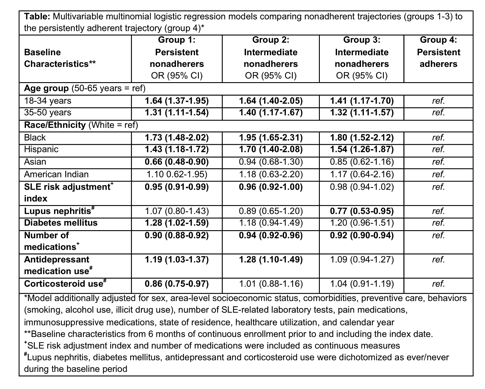
Results: We identified 10,900 HCQ new users with SLE. Mean age was 38 (±12) years, 94% were female, 43% black, 31% white, 19% Hispanic; 85% had a mean PDC <80%. The 4-trajectory group model had the lowest BIC and posterior probabilities >80%, suggesting the best fit (Figure); 36% were persistent nonadherers (group 1), 16% were persistent adherers (group 4). At 6 months, intermediate nonadherence trajectories diverged. Group 3 plateaued and group 2 declined; group 2 had fewer outpatient visits at 6 months vs. group 3 (p<0.001). Using multinomial regression, compared to adherers (group 4), the odds of nonadherence were increased for groups 1-3 for blacks and Hispanics vs. whites and for younger ages vs. older (Table). Increased SLE-related comorbidities (SLE risk adjustment index), was associated with reduced odds of nonadherence for groups 1 and 2, but not for 3.
Conclusion: Rates of HCQ nonadherence were extremely high and distinct patterns were uncovered. While younger age and black and Hispanic race/ethnicity increased odds of nonadherence overall, other predictors differed by nonadherence pattern. Six months was a critical juncture for intermediate nonadherers and utilization patterns suggest that improved access to outpatient care at this point may improve long-term HCQ adherence. 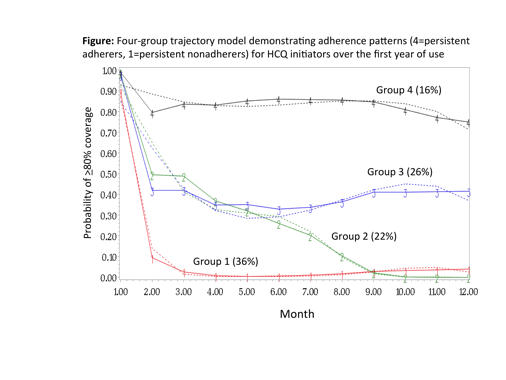
To cite this abstract in AMA style:
Feldman CH, Collins JE, Zhang Z, Solomon DH, Costenbader KH, Kawachi I. Patterns and Predictors of Hydroxychloroquine Nonadherence in a Nationwide Cohort of Medicaid Beneficiaries with Systemic Lupus Erythematosus [abstract]. Arthritis Rheumatol. 2016; 68 (suppl 10). https://acrabstracts.org/abstract/patterns-and-predictors-of-hydroxychloroquine-nonadherence-in-a-nationwide-cohort-of-medicaid-beneficiaries-with-systemic-lupus-erythematosus/. Accessed .« Back to 2016 ACR/ARHP Annual Meeting
ACR Meeting Abstracts - https://acrabstracts.org/abstract/patterns-and-predictors-of-hydroxychloroquine-nonadherence-in-a-nationwide-cohort-of-medicaid-beneficiaries-with-systemic-lupus-erythematosus/