
Session Information
Date: Monday, November 18, 2024
Title: SpA Including PsA – Diagnosis, Manifestations, & Outcomes Poster III
Session Type: Poster Session C
Session Time: 10:30AM-12:30PM
Background/Purpose: The utility of nailfold videocapillaroscopy (NVC) in conditions such as systemic sclerosis and primary Raynaud´s phenomenon is well known. Whether patients with psoriatic disease (PsD) have specific findings in NVC is not well stablished. We aimed to evaluate findings on NVC in patients with psoriatic disease and their association with clinical features.
Methods: This was a cross-sectional study that included patients with PsD (Pso according to a dermatologist and PsA according to CASPAR criteria). As a control group, we included healthy individuals. The disease activity was evaluated using PASI, NAPSI, and DAPSA scores.
NVC was performed using an optical probe equipped with a 200x contact lens (Optilia) connected to and image analysis software (Videocal, DS Medica, Milan, Italy). Four fields from each finger were obtained from the second to fifth finger of each hand. The following NVC parameters were retrieved: capillary density, overall nailfold architecture, normal capillaries (hairpin shaped), non-specific capillary variations of morphology (tortuous, crossed or bushy capillaries), and major abnormalities, including dilated and giant capillaries, microhemorrhages, neo-angiogenesis, and avascular areas. According to the capillaroscopic parameters, we assessed for NVC patterns: normal, unusual/atypical and scleroderma patterns (‘early’, ‘active’ and ‘late’ patterns).
Results: We included 39 patients with PsD, including 29 with PsA and 10 with Pso, and 28 healthy controls. Twenty-four (61.5%) had psoriasis activity according to PASI and 16 (55.2%) had active PsA according to DAPSA. Twenty-three (58.9%) had nail psoriasis.
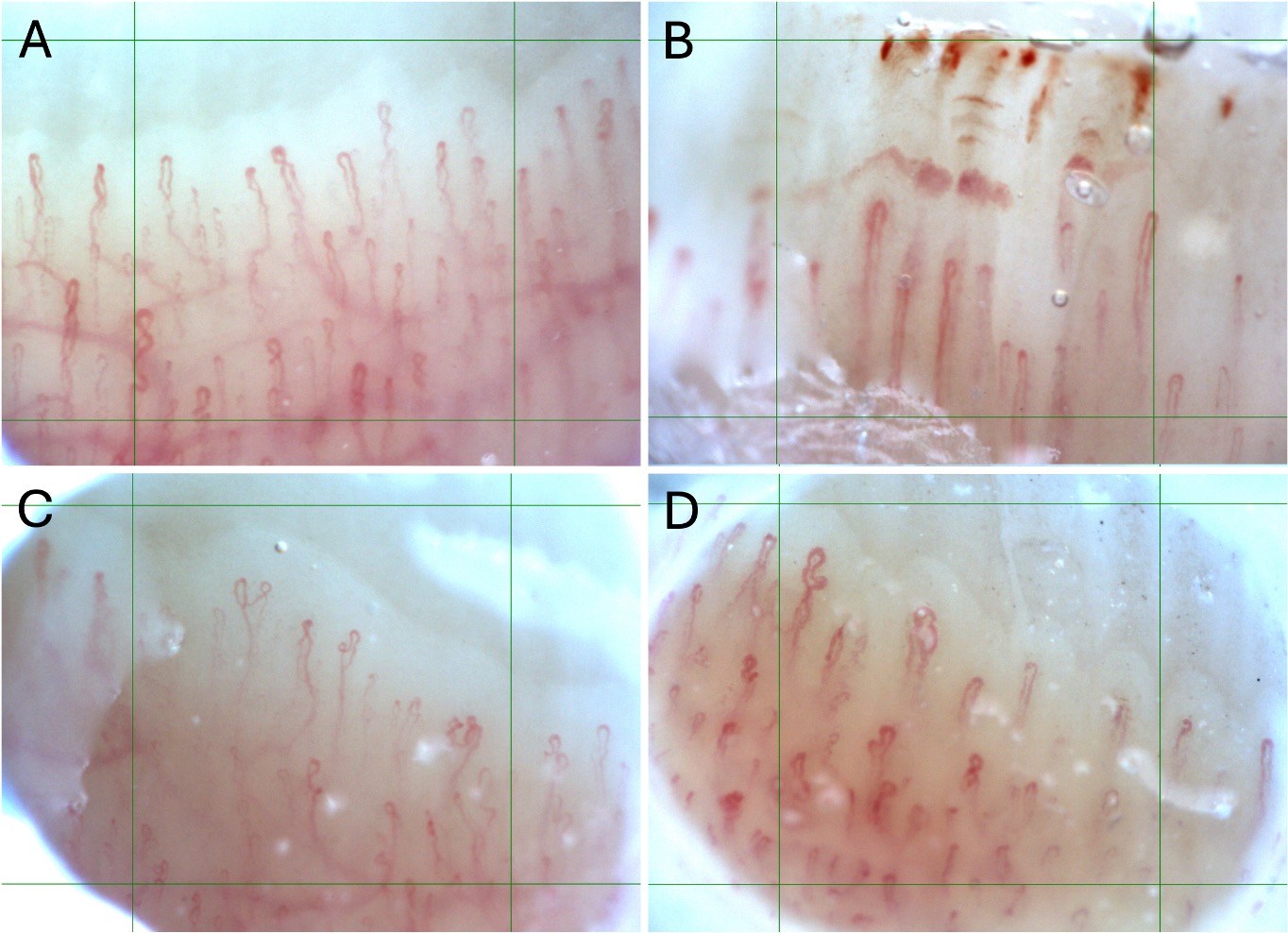
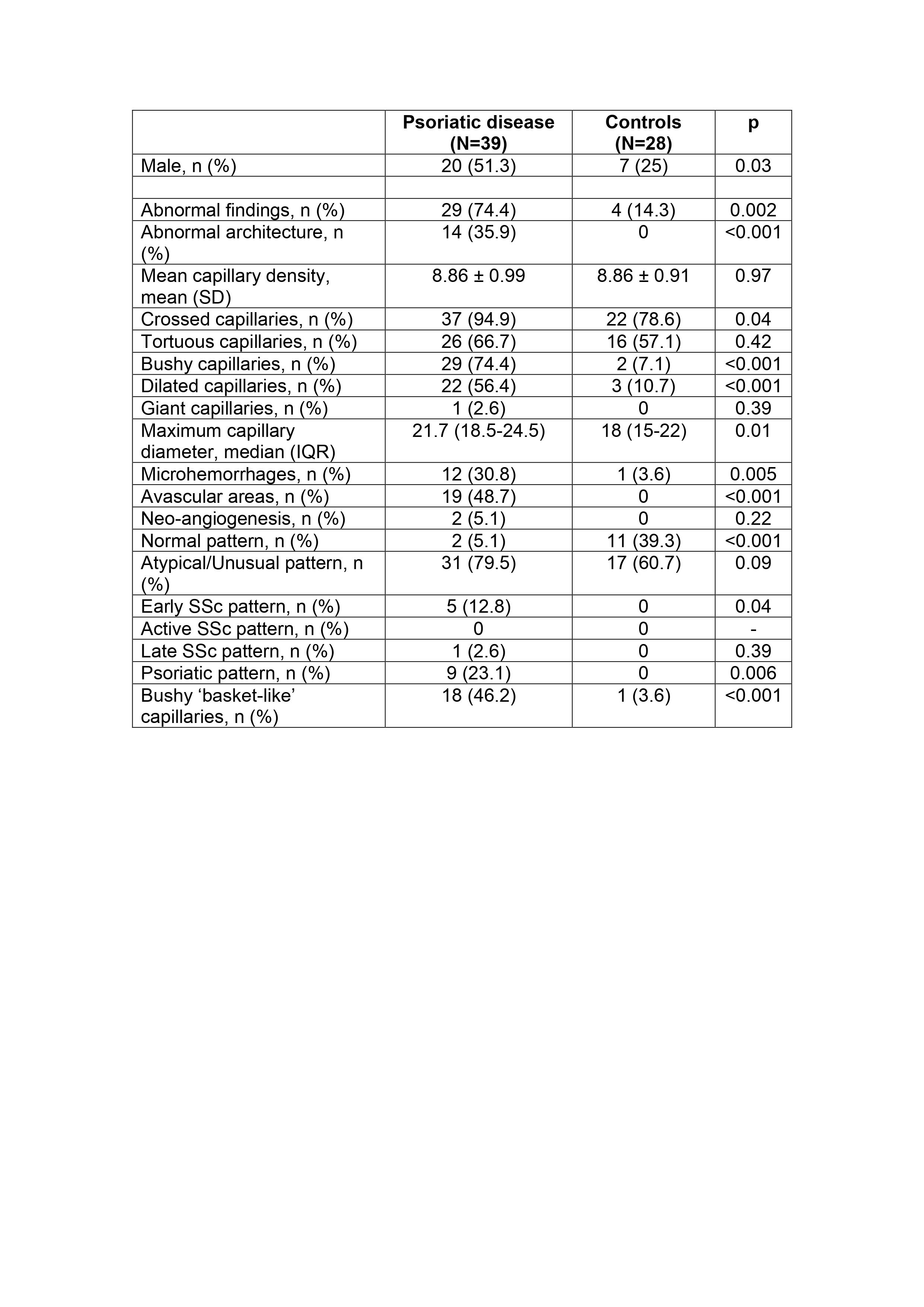
Patients in the PsD group have more frequently major NVC abnormalities compared to the healthy group (74.4% vs. 35.7%, p=0.002) (Table 1, Figure 1). In the PsD group, there was a higher frequency of abnormal nailfold architecture (35.9% vs. 0%, p< 0.001), crossed (94.9% vs. 78.6%, p=0.04), bushy (74.4% vs. 7.1%, p< 0.001), and dilated capillaries (56.4% vs. 10.7%, p< 0.001), microhemorrhages (30.8% vs. 3.6%, p=0.005) and avascular areas (48.7% vs. 0, p< 0.001) and less frequently exhibited a normal pattern (5.1% vs. 39.3%, p< 0.001). Only in PsD group there were cases of scleroderma patterns. Nine (23.1%) patients with PsD exhibited a NVC pattern (‘psoriatic pattern’) consisting in a bordering low capillary density, frequent bushy capillaries with a distinctive morphology (like the ‘basket-like’ morphology described in psoriatic plaques), and avascular areas. The mean capillary density correlated negatively with de DAPSA score (rho: -0.39, p=0.03)
There were no differences in the frequency and types of NVC abnormalities between patients with PsA and those with Pso, between those with and without nail Pso, or according to the presence of active skin or articular disease.
Conclusion: Major NVC abnormalities are frequent in PsD. PsA and Pso patients exhibited the same frequency and types of NVC abnormalities, irrespective of activity status and presence of nail involvement. A pattern consisting in bordering low capillary density, frequent distinctive bushy capillaries and avascular areas may be regarded as a ‘psoriatic pattern’.
To cite this abstract in AMA style:
Briones-García E, Rodríguez-Reyna T, Martin Nares E, Guaracha-Basañez G, García Herrera I. Nailfold Videocapillaroscopy Findings in Patients with Psoriatic Disease: Is There a Distinctive Psoriatic Pattern? [abstract]. Arthritis Rheumatol. 2024; 76 (suppl 9). https://acrabstracts.org/abstract/nailfold-videocapillaroscopy-findings-in-patients-with-psoriatic-disease-is-there-a-distinctive-psoriatic-pattern/. Accessed .« Back to ACR Convergence 2024
ACR Meeting Abstracts - https://acrabstracts.org/abstract/nailfold-videocapillaroscopy-findings-in-patients-with-psoriatic-disease-is-there-a-distinctive-psoriatic-pattern/