
Session Information
Session Type: ACR Poster Session B
Session Time: 9:00AM-11:00AM
Background/Purpose: To assess the efficacy of mycophenolate mofetil (MMF) in treatment of adult patients with interstitial pneumonia with autoimmune features (IPAF).
Methods: A retrospective medical record review was performed using electronic health record searches for interstitial lung diseases and either autoimmune diseases or positive ANA in the years 2000-2013 at an academic center. Records were then manually reviewed to include all adult subjects who met European Respiratory Society/American Thoracic Society classification criteria for IPAF and to exclude those with other specific connective tissue diseases. Sociodemographic, clinical, and pulmonary function data were manually abstracted for patients with and without MMF treatment and followed longitudinally from the date of IPAF diagnosis. In this analysis, we examined diffusing capacity for carbon monoxide (DLCO) and forced vital capacity (FVC) recorded over 4 years (24 months before or after MMF initiation) to compare rates of change between treated and untreated and within treated patients.
Results: We identified 52 subjects who met criteria for IPAF, 63% female, ranging from age 31 to 83 years. Of the 52 subjects with IPAF, 28 were treated with MMF and 24 were not treated with MMF. Median time to MMF initiation among those treated was 22 months. Within the MMF group, 11 and 14 subjects had DLCO and FVC measurements, respectively, before and after MMF initiation. Median time to MMF start among those who were treated was 22 months. The average decline in FVC% and DLCO% between the MMF treated and untreated groups was not significantly different (FVC% change p=0.08; DLCO% change p=0.17); however, there was a trend to more rapid decline of both FVC% and DLCO% in the MMF-treated group.
Among subjects treated with MMF, the rate of decline of DLCO (mL/min/mmHg) significantly improved after therapy with MMF (Figure 1,p=0.007). There was not a significant difference in rate of change of FVC (L) before and after MMF treatment (p=0.07) although many stabilized (Figure 2).
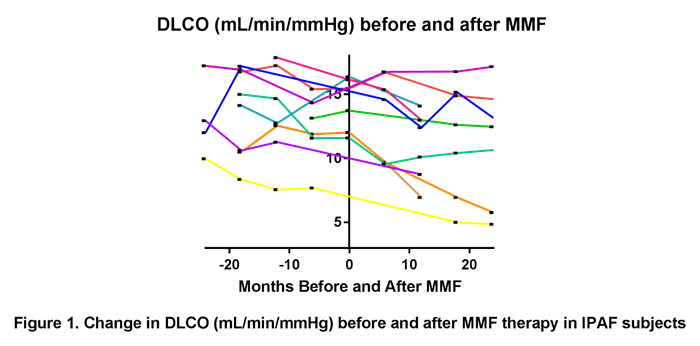
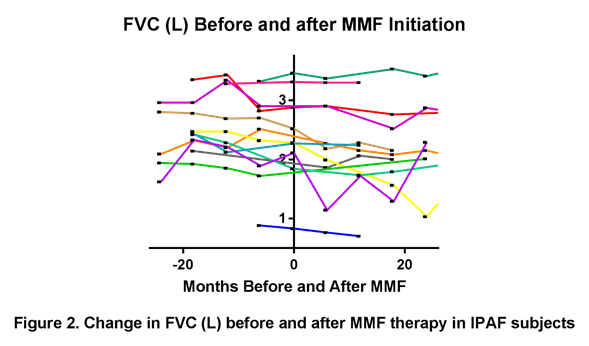
Conclusion: MMF therapy stabilized the decline of DLCO and was associated with a trend toward stabilization of FVC in treated IPAF patients. These findings suggest that MMF may slow the progression of PFT changes in IPAF. Further studies are needed to confirm these findings.
To cite this abstract in AMA style:
McCoy SS, Mukadam Z, Meyer KC, Sampene E, Kanne JP, Meyer CA, Martin MD, Aesif SW, Rice L, Bartels CM. Mycophenolate Mofetil May Improve Interstitial Pneumonia with Autoimmune Features [abstract]. Arthritis Rheumatol. 2017; 69 (suppl 10). https://acrabstracts.org/abstract/mycophenolate-mofetil-may-improve-interstitial-pneumonia-with-autoimmune-features/. Accessed .« Back to 2017 ACR/ARHP Annual Meeting
ACR Meeting Abstracts - https://acrabstracts.org/abstract/mycophenolate-mofetil-may-improve-interstitial-pneumonia-with-autoimmune-features/