
Session Information
Date: Tuesday, November 12, 2019
Title: RA – Diagnosis, Manifestations, & Outcomes Poster III: Comorbidities
Session Type: Poster Session (Tuesday)
Session Time: 9:00AM-11:00AM
Background/Purpose: The Metabolic Syndrome (MetS) is an independent factor of cardiovascular morbidity and mortality and most studies show that its prevalence is higher in established Rheumatoid Arthritis (RA) than in the general population, which would be associated with systemic inflammatory activity. Few studies have evaluated this association in patients with Early Arthritis (EA) with different results. Objective: To study the frequency of MetS in patients with EA and its association with disease activity and antibodies profile.
Methods: We studied all the patients with diagnosis of EA who consecutively attended to Rheumatology Unit at Cordoba Hospital from August 2016 to February of 2018. EA was diagnosed by the presence of inflammation in 3 or more joints of less than 12 months duration. A non-RA population was a control group, matched by age and gender. Clinical and laboratory data were collected. The activity of the disease was evaluated by DAS28-ESR. The presence of MetS was evaluated according to 3 different international classification: World Health Organization 1998-1999 (WHO), Adult Treatment Panel III 2004 (ATPIII) e International Diabetes Federation 2005 (IDF). EA cases were analysed in to two groups according to MetS or not diagnosis (MetS+/MetS-). A chi-squared test and T-test or Mann–Whitney U test were applied for comparison of categorical and continuous variables as appropriate. P < 0.05 was considered statistically significant.
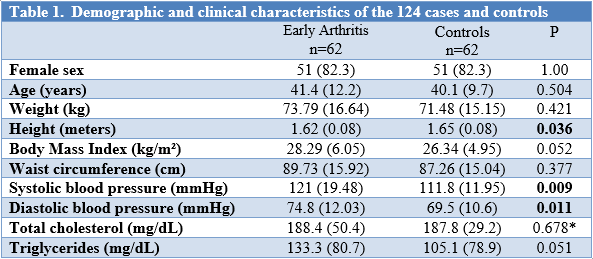
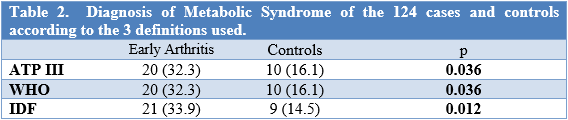
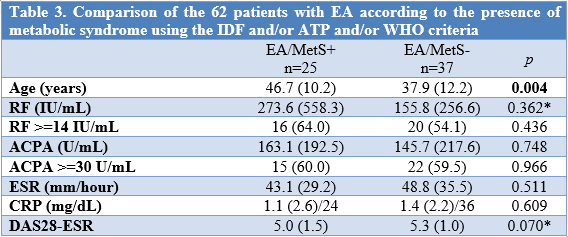
Results: Sixty-two EA patients were included. Demographic and clinical data are shown in table 1. Diagnosis criteria of MetS was more frequent in EA patients than in the control group according to the 3 definitions used (Table 2). In addition, EA patients with and without presence of MetS did not show statistically significant differences in ESR neither in CRP level. There was also no significant difference in level of RF and ACCP antibodies. On the other hand, there was no difference in DAS 28-ESR between EA patients with and without MetS. These results are shown in Table 3.
Conclusion: MetS seems to be more frequent in EA and its presence is not associated with disease activity and the presence of RF or ACCP antibodies. MetS is a known risk factor for cardiovascular disease, morbidity and mortality in systemic autoimmune diseases. A tight control of this condition in the early stages of disease should be recommended.
To cite this abstract in AMA style:
Guiñazú F, Gobbi C, Alba P, Maldini C, Alonso C, Albiero A, Albiero E, Neme V, Demarchi M, Yorio M. Metabolic Syndrome and Early Arthritis: Frequency, Association with Antibodies Profile and Disease Activity [abstract]. Arthritis Rheumatol. 2019; 71 (suppl 10). https://acrabstracts.org/abstract/metabolic-syndrome-and-early-arthritis-frequency-association-with-antibodies-profile-and-disease-activity/. Accessed .« Back to 2019 ACR/ARP Annual Meeting
ACR Meeting Abstracts - https://acrabstracts.org/abstract/metabolic-syndrome-and-early-arthritis-frequency-association-with-antibodies-profile-and-disease-activity/