
Session Information
Session Type: Poster Session (Monday)
Session Time: 9:00AM-11:00AM
Background/Purpose: Biologic disease modifying agents (DMARDs) have become an integral part of rheumatoid arthritis (RA) treatment guidelines, but they are associated with a substantial increase in direct medical care costs. Given Medicare’s role in providing health care coverage to older adults, we assessed the impact biologic and conventional DMARDs have had on its drug expenditures.
Methods: We compiled six years (2012-17) of publicly available Medicare spending reports capturing DMARDs expenditures aggregated from Part B (infusions) and Part D (oral) claims. Data included: total expenditures (before rebates), beneficiary counts, and unit drug costs. We distinguished trends at the product level and subclasses, conventional and biologics DMARDs.
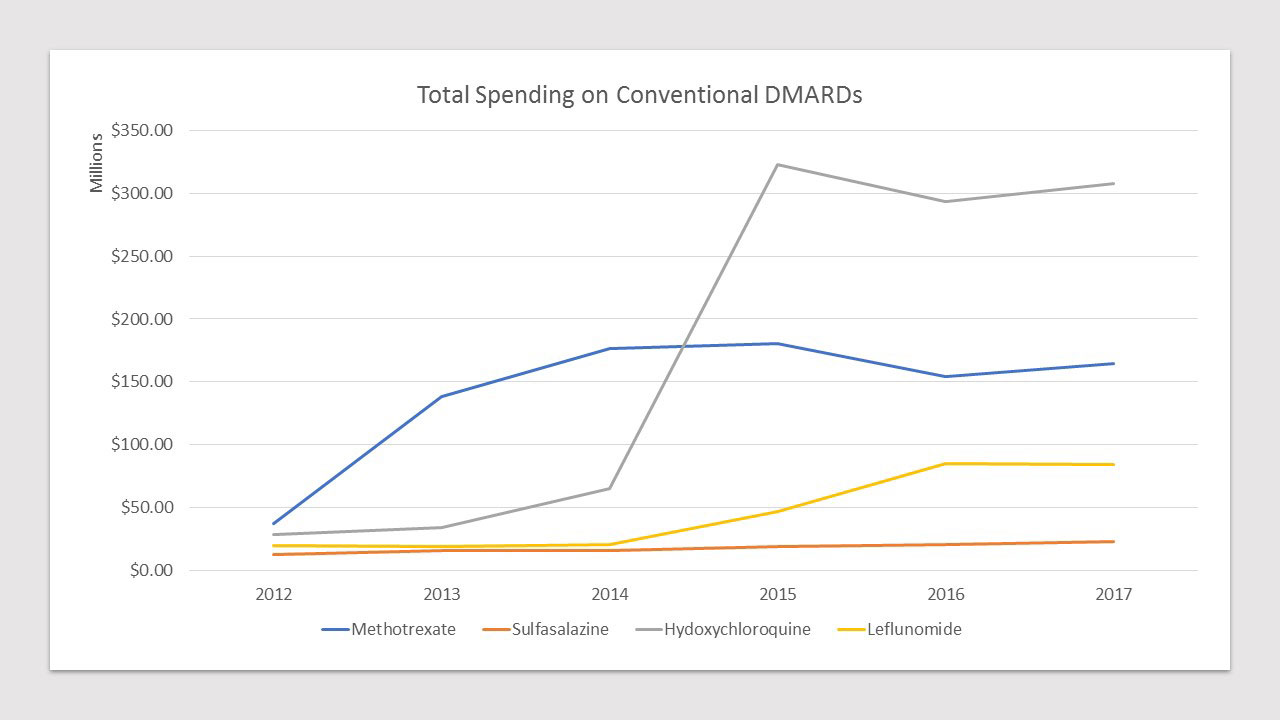
Results: Total spending for conventional DMARDs increased from $98 million to $579 million. Expenditures for methotrexate were surpassed by hydroxychloroquine expenditures in 2014-15 (Fig 1). The 6-fold increase in total spending was driven by increase in unit cost of drugs rather than increases in beneficiaries (738,000 to 1.13 million).
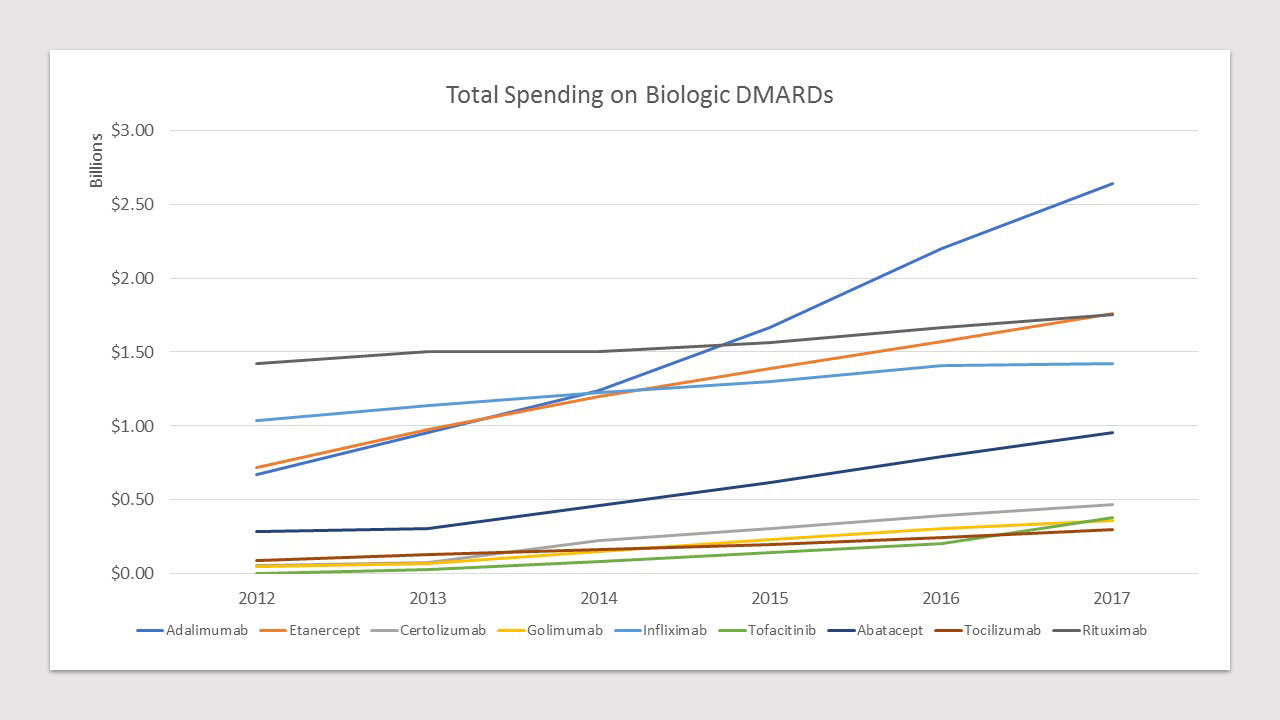
Total spending on biologic DMARDs rose from $4.3 billion to $10.0 billion with a more modest increase in the number of beneficiaries (252,225 to 353,960). Adalimumab expenditures rose from $674.8 million (2012) to $2.64 billion (2017): expenditures for etanercept ($1.76 billion) and rituximab ($1.75 billion) were the next highest (Fig 2).
Conclusion: Medicare expenditure for conventional agents increased dramatically but remained a fraction of the total spending (5.7%) on DMARDs when biologic agents were included. Rise in unit drug costs rather than increase in beneficiaries were often responsible for increased total spending. It is important to acknowledge that these products are also used for non-RA indications, and we were unable to account for manufacturers’ rebates. Further work is needed to determine if increases in DMARD are offset by cost reductions and lead to better patient outcomes.
To cite this abstract in AMA style:
Dalal D, Zhang T, Shireman T. Medicare Spending (2012-2017) on Disease Modifying Agents Commonly Used in Rheumatoid Arthritis [abstract]. Arthritis Rheumatol. 2019; 71 (suppl 10). https://acrabstracts.org/abstract/medicare-spending-2012-2017-on-disease-modifying-agents-commonly-used-in-rheumatoid-arthritis/. Accessed .« Back to 2019 ACR/ARP Annual Meeting
ACR Meeting Abstracts - https://acrabstracts.org/abstract/medicare-spending-2012-2017-on-disease-modifying-agents-commonly-used-in-rheumatoid-arthritis/