
Session Information
Date: Monday, November 9, 2020
Session Type: Abstract Session
Session Time: 12:00PM-12:50PM
Background/Purpose: Assessment of radiographic joint damage extent and progression is important in clinical trials evaluating treatments for psoriatic arthritis (PsA). Joint damage in patients with PsA has substantial impact on physical function, quality of life and survival, therefore, inhibiting radiographic progression is one of the main goals of therapy.1,2 Here we present results from a machine learning analysis of pooled data from two phase 3 secukinumab trials in PsA aimed to identify prevalence and magnitude of pre-existing radiographic damage at baseline and its association with clinical swollen and tender joint count; and investigate the extent to which radiographic damage at baseline could influence the response to secukinumab therapy.
Methods: Mixed-effects linear regression models were applied to data from FUTURE 1 and FUTURE 5 studies to investigate the association at baseline between overall radiographic damage and swollen / tender joint counts on a patient level and on a joint-within-patient / individual joint level; random effects were used to account for variability at both the levels. Visualization was used to explore joint activity progression patterns as functions of time and secukinumab dosing, and to estimate the probability of joint activity as a function of radiographic damage at each joint. Two additional mixed-effects models (one at overall patient level and another at joint segment level) were implemented to estimate the impact of radiographic damage, treatments and baseline patient characteristics on joint activity over time. Response to secukinumab therapy was assessed using swollen/tender joint count and proportion of patients achieving minimal disease activity (MDA) over time.
Results: Data for 1554 patients from FUTURE 1 and FUTURE 5 studies were pooled. At baseline, 69.4% and 50.1% of patients, respectively, showed detectable erosions and joint space narrowing (JSN; defined as patients with radiographic scores >1). Patients with early PsA diagnosis (≤2 years) showed strong prevalence of erosions and JSN, which progressively worsened over time. At an individual joint level, the probability of tenderness and swelling was strongly and significantly associated with the extent of radiographic damage (Figure 1). At a patient level, significant reductions of swollen/tender joint count were observed in all secukinumab dose regimens regardless of the levels of radiographic damage. However, patients with higher radiographic damage showed a lower proportion of complete remission of joint symptoms (swollen joint count and tender joint count = 0; Figure 2). The MDA response showed a similar pattern to the tender/swollen joint count responses corresponding to low and high levels of radiographic damage (Figure 3).
Conclusion: A strong and significant association was demonstrated between disease activity and baseline radiographic damage at the individual joint level, whereas the analysis at patient level showed a weaker association. High radiographic damage at baseline was associated with a lower rate of achieving remission.
References:
- Coates LC, et al. Arthritis Rheumatol. 2016;68:1060–1071.
- Gossec L, et al. Ann Rheum Dis. 2016;75:499–510.
 Association between tenderness and joint space narrowing on individual joints assessed radiographically across patients at baseline
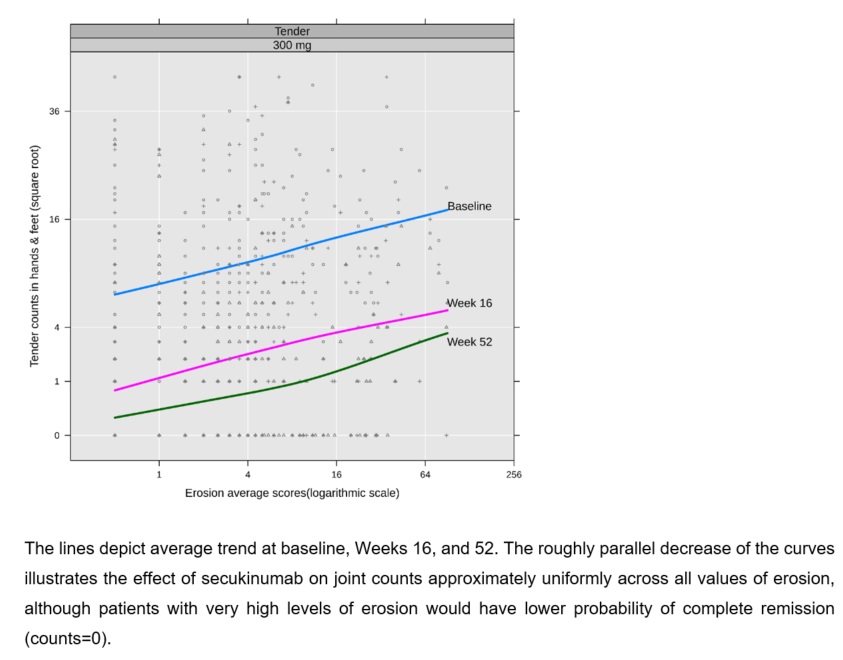 Number of tender joint counts versus erosion scores for every patient at baseline, Week 16, and Week 52
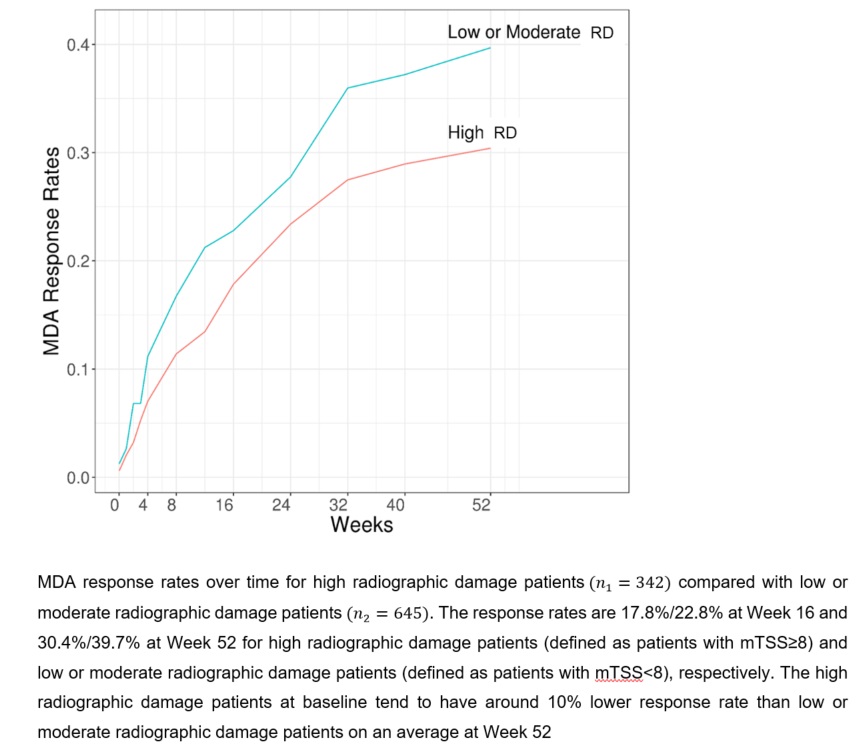 MDA response rate through Week 52
To cite this abstract in AMA style:
Mease P, van der Heijde D, Kirkham B, Schett G, Orbai A, Ritchlin C, Merola J, Pricop L, Zhu X, James D, Ligozio G. Machine Learning Identifies an Association Between Pre-existing Radiographic Damage and Long-term Clinical Outcomes with Secukinumab Therapy in Patients with Psoriatic Arthritis [abstract]. Arthritis Rheumatol. 2020; 72 (suppl 10). https://acrabstracts.org/abstract/machine-learning-identifies-an-association-between-pre-existing-radiographic-damage-and-long-term-clinical-outcomes-with-secukinumab-therapy-in-patients-with-psoriatic-arthritis/. Accessed .« Back to ACR Convergence 2020
ACR Meeting Abstracts - https://acrabstracts.org/abstract/machine-learning-identifies-an-association-between-pre-existing-radiographic-damage-and-long-term-clinical-outcomes-with-secukinumab-therapy-in-patients-with-psoriatic-arthritis/