ACR Meeting Abstracts

ACR Meeting Abstracts

  • Meeting Abstracts
    • All Meetings
    • PRSYM 2026
    • ACR Convergence 2025
    • Download Abstract Supplements
  • Keyword Index
  • My Favorites
    • View & print my favorites
  • Search

Home » Meeting Abstracts » ACR/ARP Annual Meeting 2019

Abstract Number: 1387

Low Probability of Clinical Worsening Following Switching Biologic DMARD in Patients with RA and Partial Response to Adalimumab

Jeffrey Curtis1, Daniel Aletaha 2, Gerd Burmester 3, Kerri Ford 4, Hubert van Hoogstraten 5, Henry Leher 6, Karthinathan Thangavelu 7 and Vivian Bykerk 8, 1University of Alabama at Birmingham, Birmingham, AL, 2Medical University of Vienna, Vienna, Austria, 3Charité—University Medicine Berlin, Berlin, Germany, 4Sanofi Genzyme, Bridgewater, NJ, 5Sanofi, Bridgewater, NJ, 6Regeneron Pharmaceuticals, Inc, Tarrytown, NY, 7Sanofi Genzyme, Boston, MA, 8Hospital for Special Surgery, New York City, NY

Share on X (Twitter) Share on Facebook Share on LinkedIn Share on Email
Print

Meeting: ACR/ARP Annual Meeting 2019

Keywords: IL-6, outcomes and patient outcomes, Rheumatoid arthritis (RA), rheumatoid arthritis treatment

Session Information

Date: Monday, November 11, 2019

Title: RA – Treatments Poster II: Established Treatments

Session Type: Poster Session (Monday)

Session Time: 9:00AM-11:00AM

Background/Purpose: Guidelines recommend adjusting therapy in patients with RA who fail to reach low disease activity or remission. Partial responders to a TNF inhibitor may decline treatment changes for fear of clinical worsening and losing the response they had so far achieved. Little is known about the likelihood of worsening after switching therapy to a drug with a different mechanism of action, and this limits patients’ ability to make informed decisions. We performed a post hoc analysis to assess the effect of switching from adalimumab to sarilumab in patients with RA who partially responded to adalimumab in MONARCH (NCT02332590), a head-to-head study of sarilumab versus adalimumab monotherapy. At the end of the trial, patients on adalimumab were switched to sarilumab 200 mg q2w for the open-label extension (OLE).

Methods: Thresholds of change in Clinical Disease Activity Index (CDAI) of ±6 and ±12 units were used to define meaningful improvement/worsening, anchored at the OLE baseline (BL). Partial responders to adalimumab or sarilumab were characterized at OLE BL and defined as having had a clinically meaningful change in CDAI (≤−12 if MONARCH BL CDAI >22 or ≤−6 if MONARCH BL CDAI >10 to ≤22) during MONARCH while still having moderate-to-high disease activity (CDAI >10) at OLE BL. Response was assessed by change in CDAI from OLE BL at Week 24. The proportions of partial responders achieving meaningful improvement or worsening were calculated.

Results: There were 369 patients enrolled in MONARCH, of whom 320 (87%) entered OLE—155 switching from adalimumab to sarilumab, 165 continuing sarilumab. Of the patients in OLE, 52% were partial responders at OLE BL: switch, n=91/155 (59%); continuation, n=74/165 (45%). Mean (SE) CDAI at OLE BL was 19.56 (0.86) in switch partial responders and 18.99 (1.02) in continuation partial responders, with mean (SE) change in CDAI from OLE BL at Week 24 of −7.37 (1.10) and −5.52 (0.94), respectively (Table). Based on a CDAI threshold of ±6, improvement in disease activity was observed in 57% (switch) and 43% (continuation), while worsening was observed in 6% and 4% of patients. No change (−6 to +6) was evident in 37% (switch) and 53% (continuation). Based on a CDAI threshold of ±12, improvement in disease activity was observed in 27% (switch) and 17% (continuation), while worsening was observed in 2% and 1%, and no change (−12 to +12) was evident in 71% and 81%, respectively. Other efficacy measures demonstrated improvements from baseline (Table). No new safety signals emerged during OLE, and the adverse event profile among switch patients was similar to that of continuation patients.

Conclusion: Among adalimumab partial responders who switched to sarilumab, there was a low (6%) likelihood of clinical worsening, and almost all patients (94%) experienced clinical improvement or had no change. These findings can help inform patients’ and clinicians’ shared decision making when considering changes in RA therapy.
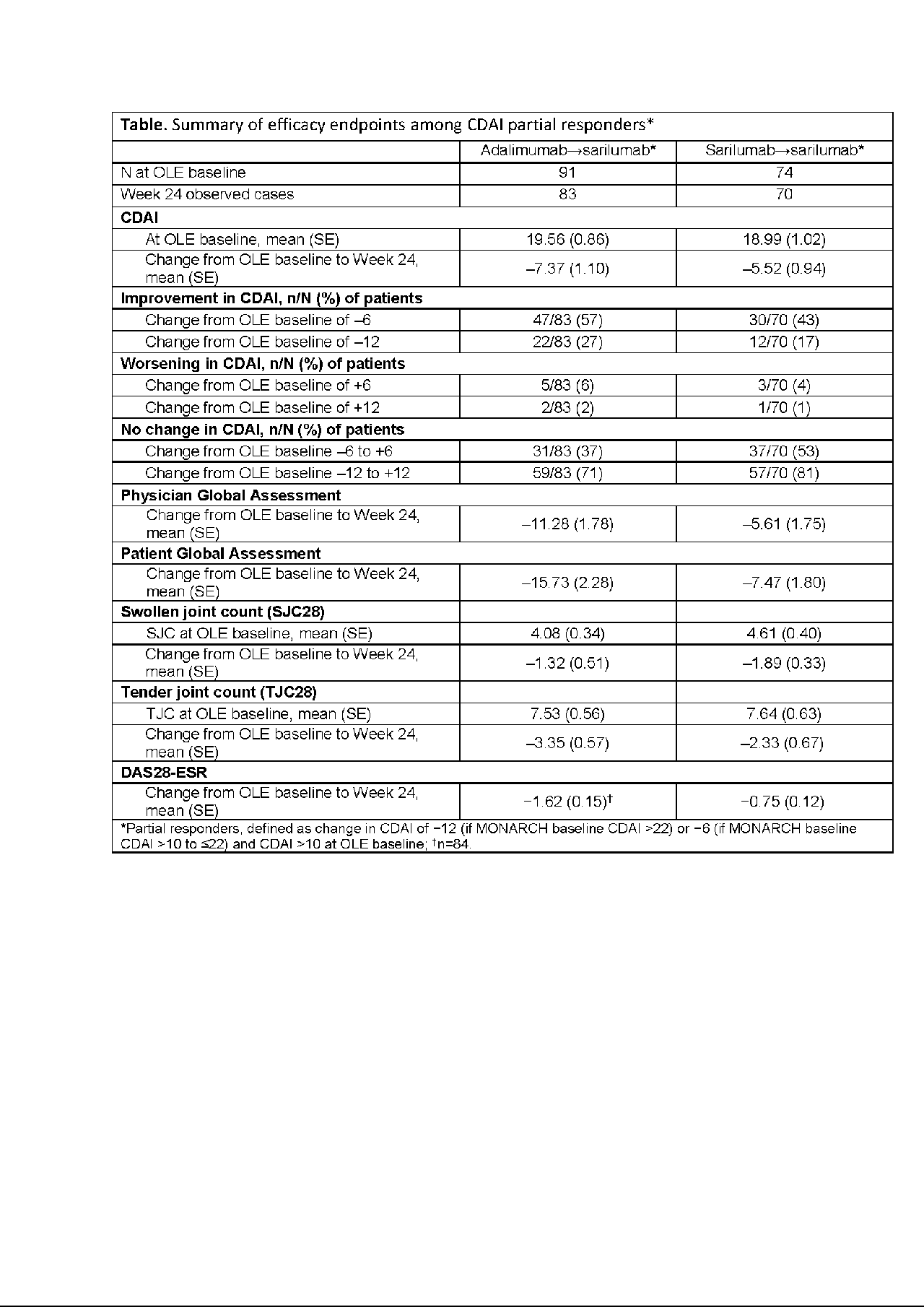
Table. Summary of efficacy endpoints among CDAI partial responders*


Disclosure: J. Curtis, AbbVie, 2, 5, Abbvie, 2, 5, AbbVie, Amgen, Bristol-Myers Squibb, Corrona, Lilly, Janssen, Myriad, Pfizer, Regeneron, Roche, and UCB, 2, 5, Amgen, 2, 5, Amgen Inc., 2, 5, BMS, 2, 5, Bristol-Myers Squibb, 2, 5, Corrona, 2, 5, Crescendo, 2, 5, Eli Lilly, 2, 5, Eli Lilly and Company, 2, 5, Genentech, 2, 5, Janseen, 5, Janssen, 2, 5, Janssen Research & Development, LLC, 2, Lilly, 2, 5, Myriad, 2, 5, Patient Centered Outcomes Research Insitute (PCORI), 2, Pfizer, 2, 5, Radius Health, Inc., 9, Regeneron, 2, 5, Roche, 2, 3, 5, Roche/Genentech, 5, UCB, 2, 5; D. Aletaha, AbbVie, 2, 5, 8, AbbVie, Janssen, Lilly, Novartis, Pfizer, and Roche, 5, AbbVie, Merck Sharp and Dohme, and Roche., 2, Amgen, 5, 8, Bristol-Myers Squibb, 8, Bristol-Myers Squibb, Celgene, Merck Sharp and Dohme, and UCB, 8, Celgene, 5, 8, Janssen, 5, Lilly, 5, 8, Medac, 5, 8, Merck, 5, 8, Merck Sharp and Dohme, 2, 8, Novartis, 2, 5, 8, Pfizer, 5, 8, Roche, 2, 5, 8, Sandoz, 5, 8, Sanofi/Genzyme, 5, 8, UCB, 8; G. Burmester, AbbVie, 5, 8, Abbvie, 5, 8, AbbVie Inc, Eli Lilly, Gilead, Janssen, Merck, Roche, Pfizer, and UCB Pharma., 5, 8, AbbVie Inc., 5, 8, BMS, 5, 8, Eli Lilly, 5, 8, Eli Lilly and Company, 5, Gilead, 5, 8, Gilead Sciences, Inc., 5, 8, Janssen, 5, 8, Lilly, 5, 8, Merck, 5, 8, Merck Shar & Dohme, 5, 8, MSD, 5, 8, Pfizer, 2, 5, 8, Roche, 2, 5, 8, Roche, Sanofi-Genzyme, 5, 8, Sanofi, 5, 8, UCB, 5, 8, Union Chimique Belge, 2, 5, 8; K. Ford, Sanofi, 1, 3, 4; H. van Hoogstraten, Novartis, 1, Regeneron, 1, Sanofi, 1, 3, Zambon (Dr Falk for PhD research), 2; H. Leher, Regeneron Pharma Inc, 1, 3, 4; K. Thangavelu, EMD Serono, 3, Sanofi, 1, 3, 4; V. Bykerk, AbbVie, 5, Amgen, 1, 2, 3, 5, 8, Brainstorm Therapeutics, 1, 2, 3, 5, 8, Bristol-Myers Squibb, 5, Genentech, 5, Gilead, 5, NIH, 2, Pfizer, 1, 2, 3, 5, 8, Regeneron, 5, Regeneron Pharmaceuticals, Inc, 5, Sanofi, 5, Sanofi/Genzyme-Regeneron, 5, Sanofi-Genzyme/Regeneron, 1, 2, 3, 5, 8, Scipher, 1, 2, 3, 5, 8, The Cedar Hill Foundation, 9, UCB, 1, 2, 3, 5, 8, UCB Pharma, 5.

To cite this abstract in AMA style:

Curtis J, Aletaha D, Burmester G, Ford K, van Hoogstraten H, Leher H, Thangavelu K, Bykerk V. Low Probability of Clinical Worsening Following Switching Biologic DMARD in Patients with RA and Partial Response to Adalimumab [abstract]. Arthritis Rheumatol. 2019; 71 (suppl 10). https://acrabstracts.org/abstract/low-probability-of-clinical-worsening-following-switching-biologic-dmard-in-patients-with-ra-and-partial-response-to-adalimumab/. Accessed .

ACR Meeting Abstracts - https://acrabstracts.org/abstract/low-probability-of-clinical-worsening-following-switching-biologic-dmard-in-patients-with-ra-and-partial-response-to-adalimumab/

My Favorites

Save and print abstracts during your browser session by clicking the “Favorite” button at the bottom of any abstract (must have cookies enabled in browser). See saved favorites.

Abstract Policies

  • ACR Convergence Abstract Embargo Policies
  • ACR Convergence Abstract Permissions & Reprints
  • PRSYM Abstract Policies

ACR Convergence. Where Rheumatology Meets

ACR Convergence 2026

Join us November 6-11 in Orlando, Florida.
See Registration Information

  • Contact ACR
  • Privacy Policy
  • ACR Policies
  • Cookie Preferences

© Copyright 2026 American College of Rheumatology